




































A team of astronomers has made a groundbreaking discovery, revealing a gigantic, flat cosmic sheet surrounding the Milky Way. This structure, primarily composed of dark matter, explains why most nearby galaxies are moving away from our galaxy rather than being drawn in by its gravitational pull. The findings, published on March 6, 2026, by researchers from the University of Groningen, shed light on long-standing mysteries regarding galactic motion.
For nearly a century, astronomers have puzzled over the observation made by Edwin Hubble that nearly all galaxies are receding from the Milky Way. This phenomenon laid the foundation for modern cosmology and provided compelling evidence of the universe’s expansion following the Big Bang. Yet, exceptions exist, such as the Andromeda Galaxy, which is approaching the Milky Way at approximately 100 kilometers per second.
Over the past fifty years, scientists have grappled with the question of why many large galaxies near the Milky Way, excluding Andromeda, appear to be moving away instead of being attracted by the Local Group’s gravity. The Local Group includes the Milky Way, Andromeda, and several smaller galaxies, all of which collectively exert a significant gravitational influence.
A New Model Explains Galactic Motion
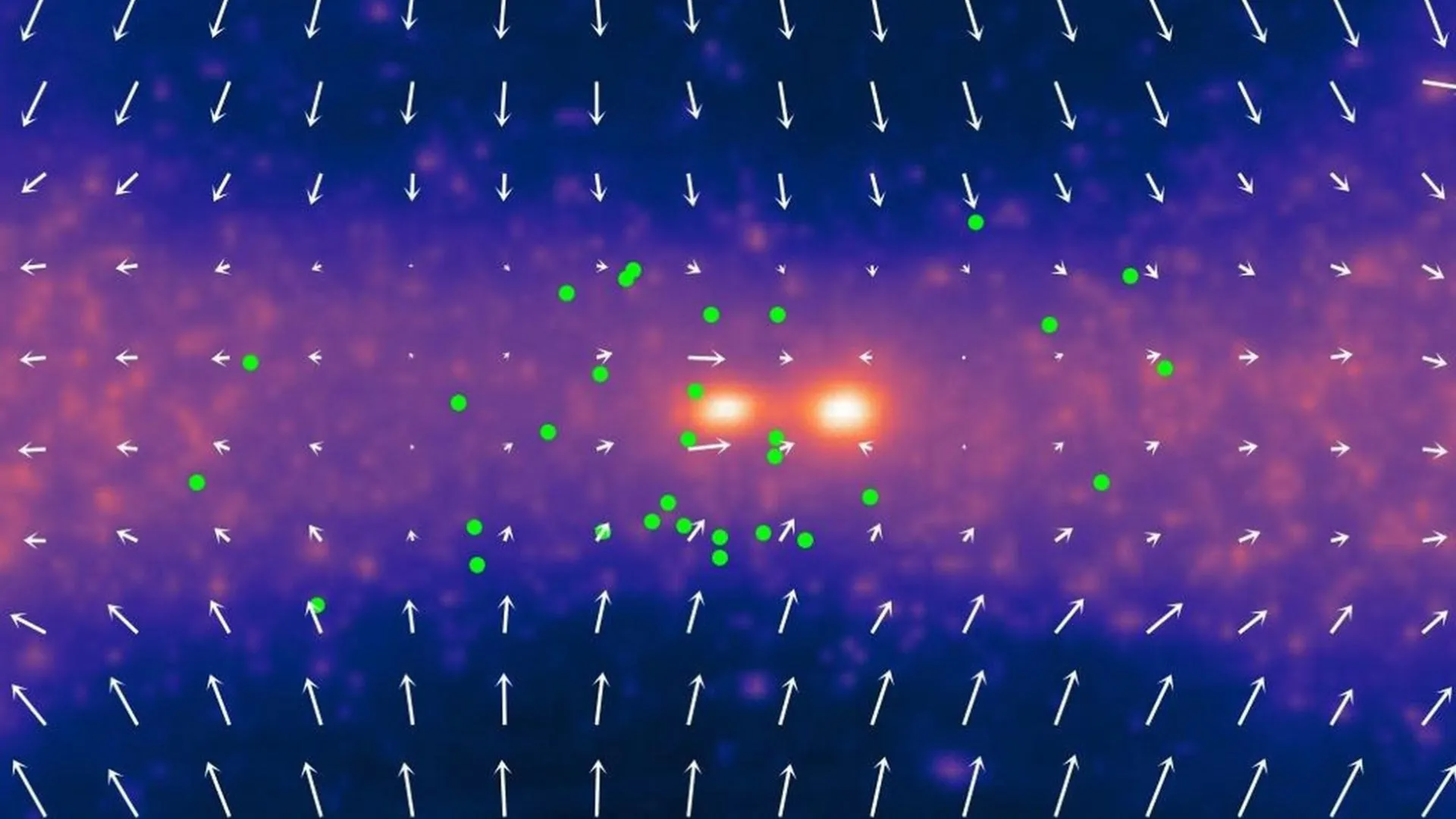
An international research team led by PhD graduate Ewoud Wempe from the Kapteyn Institute believes it has found the solution. Through advanced computer simulations, the researchers identified a broad, flattened structure of matter stretching across tens of millions of light-years around the Local Group. This structure consists of both visible and invisible matter, including dark matter, and is flanked by vast cosmic voids.
The simulations accurately reproduce the observed positions and velocities of galaxies in our vicinity. The model reflects the dynamics of the universe, aligning with the patterns astronomers have documented. This innovative approach created a “virtual twin” of our cosmic neighborhood by simulating conditions from the early universe.
To construct their model, scientists utilized measurements from the cosmic microwave background to estimate the distribution of matter shortly after the Big Bang. A powerful computer simulation generated a timeline, evolving this early universe to create a contemporary system mirroring the Local Group. The resulting model accurately reflects the masses, locations, and motions of the Milky Way and Andromeda, alongside 31 other galaxies just beyond our immediate group.
Understanding the Cosmic Structure
The new model demonstrates that the flat distribution of matter accounts for the observed movement of surrounding galaxies. Although the Local Group’s gravity should draw nearby galaxies inward, the influence of additional mass within the same plane counterbalances this pull. Consequently, galaxies drift outward at speeds consistent with current observations.
“We are exploring all possible local configurations of the early universe that ultimately could lead to the Local Group,”
stated lead researcher Ewoud Wempe. He emphasized the significance of the model in harmonizing the current cosmological framework with the dynamics of our local environment.
Astronomer Amina Helmi also expressed excitement regarding the findings, noting the longstanding challenge of understanding galactic motion. She remarked,
“I am excited to see that, based purely on the motions of galaxies, we can determine a mass distribution that corresponds to the positions of galaxies within and just outside the Local Group.”
This discovery not only answers a critical question in astronomy but also enhances our understanding of the universe’s structure and the role of dark matter. The implications of this research extend beyond theoretical knowledge, potentially influencing future studies of cosmic dynamics and the evolution of galaxies.
















