









































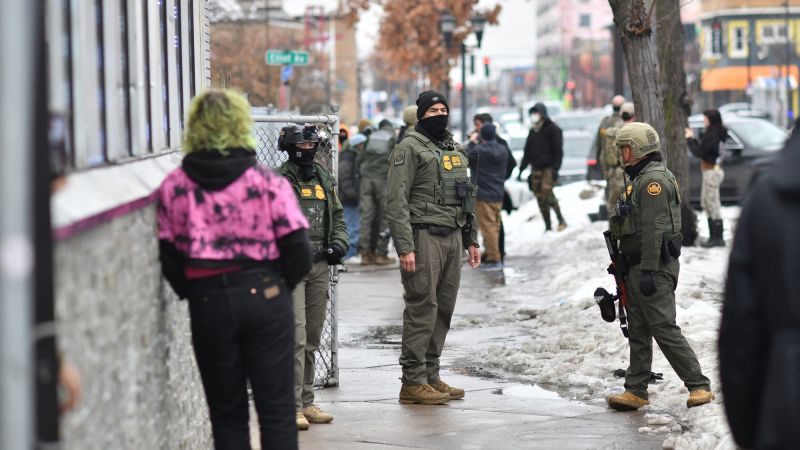
Federal immigration agents have intensified their presence in St. Paul, Minnesota, significantly impacting local businesses. The operations, which began last month, have led to a chilling effect on spending and customer attendance, particularly at establishments like El Burrito Mercado, a well-known Mexican supermarket and restaurant. CEO Melissa Silvia-Diaz described the situation as dire, noting that masked agents in unmarked vans have scared off both customers and staff. The restaurant, which has been a fixture in the community for 47 years, reports a drastic drop in sales and has been forced to close early due to staff shortages.
According to the Department of Homeland Security, over 2,000 individuals have been arrested as part of this crackdown. Many residents, both legal and undocumented immigrants, have reduced their public outings, leading to empty shopping districts and significantly reduced business hours. Local business owners compare the current climate to the economic downturn experienced during the COVID-19 pandemic, expressing uncertainty about their ability to sustain operations. The situation escalated following the tragic death of Renee Good, a U.S. citizen, at the hands of an ICE agent, prompting dozens of businesses to temporarily close.
Legal Action and Broader Impact on the Economy
In response to the federal operations, the Twin Cities and the state of Minnesota have filed a lawsuit against the Trump administration, citing substantial economic repercussions. Reports indicate that some businesses have experienced sales declines between 50% and 80%. Local leaders express concern about potential decreases in tax revenue as spending decreases. The impact of these immigration enforcement actions extends beyond Minnesota, with business owners in major cities such as Chicago and Los Angeles reporting similar economic challenges.
The White House defended the operations, stating, “The Trump Administration’s immigration enforcement operations have resulted in countless dangerous criminal illegals being removed from the streets.” They argue that enhancing public safety will create an environment where businesses can thrive.
The Heart of the Community
Founded in a vibrant Mexican-American neighborhood known as the District del Sol, El Burrito Mercado has expanded over the decades to include a catering service and a food truck. Silvia-Diaz and her sister took over the family business from their parents, who emigrated from Mexico in the 1970s. The area has seen significant growth, with over 30% of its population now identifying as Latino.
Sales began to decline last year as immigration enforcement increased in nearby Chicago, but the situation worsened dramatically following the heightened ICE presence in the Twin Cities. Silvia-Diaz noted that her primarily Latino customer base has largely stopped visiting, leading to a shift in demographics among recent patrons. She now carries a passport for safety in case she encounters immigration agents.
Similarly, Miguel Lopez, owner of Homi, a Mexican restaurant in St. Paul, has transitioned to pickup-only orders, citing safety concerns for himself and his employees. He expressed his apprehension, stating, “I don’t feel safe either in my house or my business.”
The operations have also deeply affected larger companies. Target, headquartered in Minneapolis with approximately 50 stores in the metro area, has become a focal point for immigration enforcement. Reports surfaced of immigration officers conducting operations in Target stores, resulting in the arrest of employees, including a U.S. citizen. Local leaders have urged the company to protect its staff and customers from these actions.
While companies like Target have faced pressure, many have opted to remain silent, avoiding potential backlash from the administration. In an internal email, the company referred to the ICE actions as “events in our hometown” and assured employees that they are monitoring the situation closely.
Long-Term Economic Concerns
Immigrant businesses and workers are vital to the economy of Minnesota, which is already facing challenges such as a slowing population growth due to an aging workforce and declining birth rates. The Minnesota Chamber of Commerce highlighted the importance of immigration for the state’s economic health, noting that nearly 94% of the net population growth between 2020 and 2024 was driven by immigrant populations. The state’s foreign-born labor force has increased by 41% since 2010 compared to just 4% for U.S.-born workers.
Mike Logan, CEO of the Minneapolis Regional Chamber of Commerce, expressed concern that the current situation might deter potential talent from relocating to Minnesota. He emphasized the need for a resolution that prioritizes both community safety and economic stability.
As businesses grapple with the ongoing effects of ICE operations, the future of Minneapolis’s diverse economy hangs in the balance. Many owners continue to question how they can survive in this increasingly volatile environment.
















