









































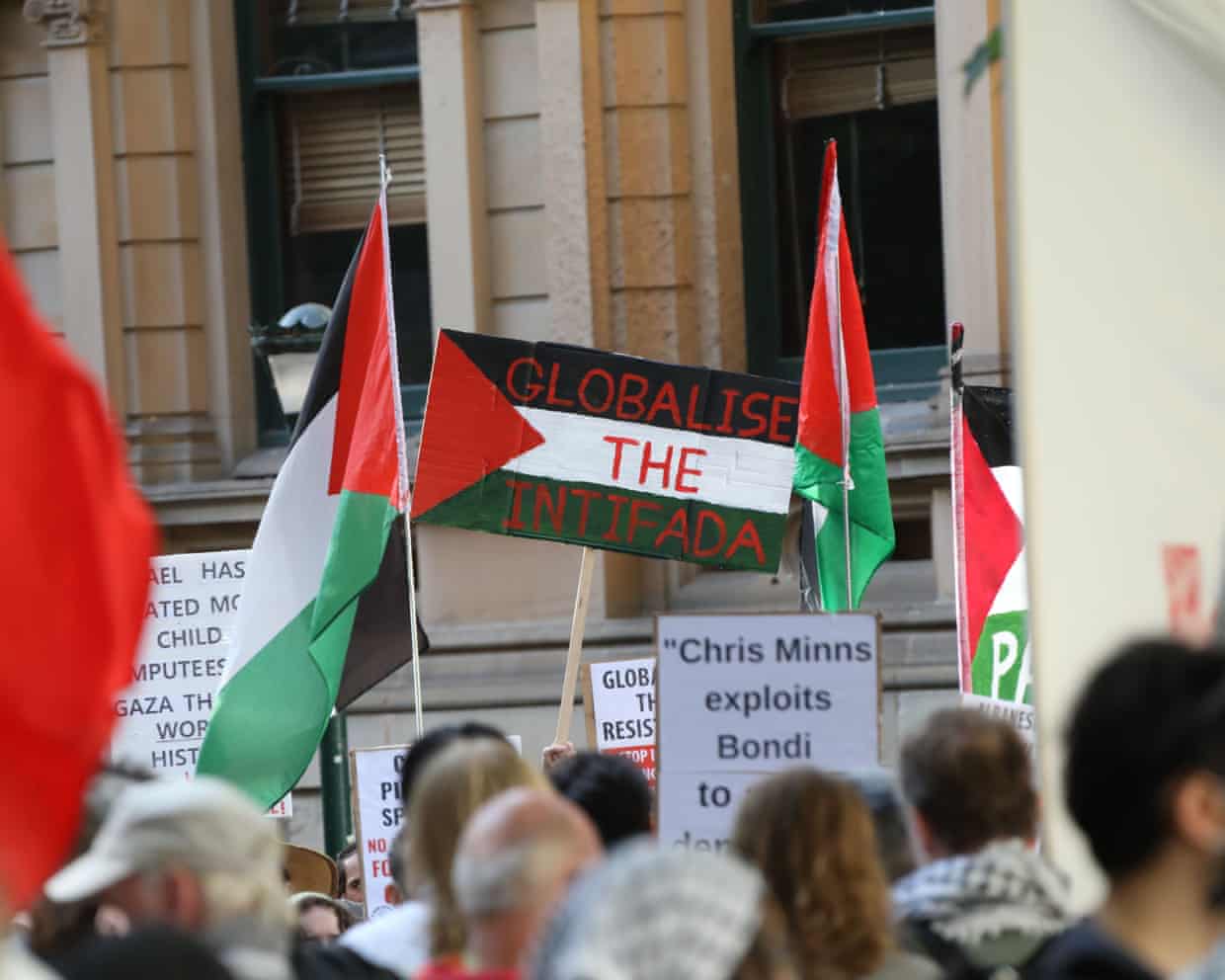
A parliamentary inquiry in New South Wales (NSW) is set to recommend a ban on the phrase “globalise the intifada” when used to incite violence. However, it will not propose a blanket ban on the phrase or others, such as “from the river to the sea.” The inquiry’s chair, Edmond Atalla, confirmed these draft recommendations to Guardian Australia ahead of a conclusive meeting scheduled for Thursday.
The inquiry has faced criticism from the NSW opposition, which has labeled the process as “rushed” and predetermined. Opposition members argue that the recommendations are unclear and may criminalize actions that are already illegal. The final report is expected to be submitted to the state government on Friday, allowing for legislative discussions when parliament reconvenes next week.
Public submissions for the inquiry were open for just three weeks, resulting in over 500 individual submissions, most of which will remain unpublished. Hugh McDermott, the inquiry’s deputy chair, stated that amendments to the recommendations could be made during the final meeting and defended the timing of the inquiry, which occurred over the holiday period while some committee members were overseas.
The shadow attorney general, Damien Tudehope, expressed dissatisfaction with the draft recommendation, arguing that it would only prohibit the slogan in circumstances already addressed by the Crimes Act. He stated, “If conduct is already unlawful under existing provisions, this recommendation adds nothing except confusion.”
The phrase “globalise the intifada,” which translates from Arabic as “to shake off,” is used by some pro-Palestinian groups to reference uprisings against Israel that began in 1987 and 2000. Concerns have been raised by some members of the Jewish community, who interpret the phrase as a call to violence.
Both the NSW Jewish Board of Deputies and the Executive Council of Australian Jewry (ECAJ) have advocated for the creation of new offenses targeting what they describe as “hateful slogans.” However, the draft report does not recommend any additional phrases for prohibition.
Several organizations, including the Palestine Action Group and the Australian National Imams Council, have countered that the phrases in question are not inherently hateful or antisemitic. They assert that imposing a ban would infringe on constitutional freedoms. In her submission to the inquiry, constitutional law expert Prof. Anne Twomey indicated that attempting to ban specific political expressions raises complex legal issues. She noted, “It is unrealistic to expect a parliamentary committee, in such a very short time over the Christmas holiday break, with no oral hearings and presumably few submissions by experts in the field, to come up with the desired constitutionally challenge-proof law.”
On Thursday, Twomey remarked that the inquiry’s recommendation would be “constitutionally much safer than an outright ban.” Current laws in NSW, specifically sections 93Z and 93ZAA of the Crimes Act, already address incitement to violence and hatred based on race. McDermott emphasized the need for a new offense specifically targeting the phrase “globalise the intifada” when used to incite violence, arguing that it could increase the likelihood of prosecution.
There would be exemptions for artistic, academic, and educational contexts regarding the phrase, though the criteria for determining incitement remain unclear. Atalla suggested that the phrase’s “historical context” would play a significant role in such determinations, noting, “’Globalise the intifada’ as words on their own chanted probably mean nothing to a lot of people, but to the Jewish people, it threatens.”
NSW Premier Chris Minns has consistently indicated his support for banning the phrase following a violent incident in Bondi on December 14, 2023. He reiterated that the inquiry operates independently and did not expect immediate legislation to be presented when parliament reconvenes.
McDermott characterized the committee’s work as a preliminary step, justifying the shorter inquiry duration due to the Bondi attack. Extensions were granted for submissions from the Jewish community organizations due to substantial demands following the incident. He also defended the choice to publish only 150 out of approximately 700 submissions, stating that it is common practice for committees to withhold certain submissions upon request or for not contributing meaningfully to the report.
Atalla will attend the final meeting via video link from overseas, where he is engaged in a humanitarian mission to Namibia. He reported that his responsibilities as chair had not been hindered. Previous committee meetings occurred on December 22 and January 13, during which the terms of reference and public submissions were discussed. The committee has been tasked with reviewing existing hate speech laws and exploring best practices from other countries, including the United Kingdom.
In the UK, the phrase “globalise the intifada” has not been explicitly banned; however, police have indicated they may take action against individuals utilizing the term in inciting contexts. On December 4, 2023, three individuals faced charges for chanting in support of an intifada during a protest in London, as part of broader law enforcement efforts against pro-Palestine demonstrations.
















