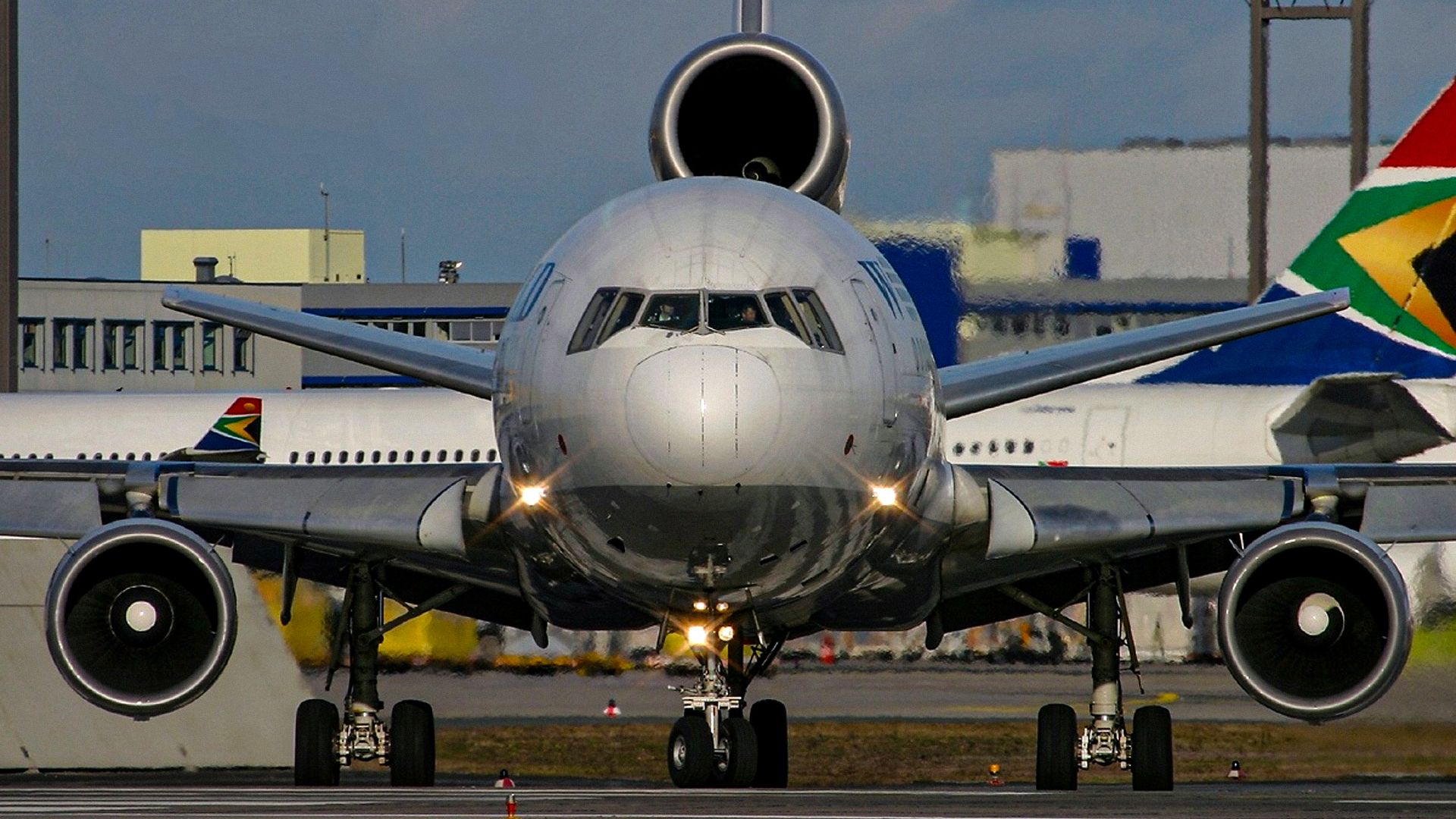
The design of the McDonnell Douglas MD-11’s tail engine distinguishes it significantly from other trijets. Unlike the Boeing 727 and Lockheed L-1011, which feature a pronounced S-duct that directs airflow from the fuselage to a deeper-set tail engine, the MD-11 employs a more straightforward arrangement. Its center engine is mounted directly at the base of the aircraft’s vertical stabilizer. This configuration not only alters the aerodynamic profile but also simplifies maintenance, diverging from the complexities of traditional three-engine aircraft.
Distinctive Design Choices
These design decisions reflect the engineering philosophy behind the Douglas DC-10 and its successor, the MD-11. By avoiding the intricate curves associated with S-ducts, the MD-11 maintains a structurally robust tail installation. This also allows for a clean underwing engine layout, enhancing overall aerodynamics. However, it introduces unique maintenance quirks, including the need for technicians to access the tail structure during upkeep, which can be more labor-intensive compared to traditional designs.
The MD-11 was conceived to modernize and extend the successful commercial lineage of the DC-10 into the 21st century. The aircraft retains the trijet layout with two underwing engines and a tail-mounted engine while incorporating a stretched fuselage, aerodynamic enhancements, and winglets. The MD-11 also features an advanced two-crew glass cockpit, which reduces operating costs and improves performance metrics compared to earlier models.
In terms of capacity, the aircraft can accommodate up to 410 seats in a high-density configuration. It is classified as a medium-to-long-range widebody, capable of serving both passenger and freight markets. Although the MD-11’s efficiency does not match that of contemporary widebody aircraft, it continues to find utility with cargo operators, who often prioritize payload flexibility over fuel efficiency.
Engine Performance and Operational Capabilities
The MD-11’s performance is powered by several engine options, with the most common being the General Electric CF6-80C2D1F. This high-bypass turbofan, specially designed for the MD-11, delivers approximately 61,500 lbf (around 273.6 kN) of takeoff thrust. This consistency across all three engines was vital for the aircraft’s complex engineering and operational demands, especially as two-person cockpits became the standard in commercial aviation.
The CF6-80C2 family features a 93-inch (2.36 m) fan and a modern core architecture, allowing the MD-11 to meet range and payload targets effectively. Other options included Pratt & Whitney’s PW4000 series and, occasionally, the Rolls-Royce RB211 engine, highlighting the aircraft’s adaptability to airline preferences.
Operationally, the MD-11 was designed for long-haul missions, accommodating large passenger loads or significant freight volumes. In passenger service, the aircraft typically operated in a multi-class layout, although its maximum range is around 7,144 nautical miles (13,231 km). The cruising speed is approximately 519 knots (961 km/h), with a service ceiling of about 32,600 feet (9,940 m), which aids efficiency on extended routes.
As a freighter, the MD-11 excels in payload-range flexibility, capable of carrying a maximum payload of 201,035 lbs (91,185 kg) while maintaining a range of around 3,486 nautical miles (6,456 km). However, its operational demands increase with weight, necessitating longer runways as it approaches maximum takeoff weight.
Legacy and Current Status
The MD-11 has carved out a niche within the aviation market, appealing to airlines due to its combination of DC-10 capacity and updated technology. Launch customers included prominent carriers like Alitalia, Finnair, Korean Air, and Federal Express (FedEx). In passenger service, airlines such as KLM and Delta Air Lines utilized the aircraft for long-haul routes into the 1990s.
In cargo operations, the MD-11 has left a lasting legacy, with FedEx acquiring 22 freighter variants and Lufthansa Cargo purchasing 14. The aircraft’s versatility has allowed it to thrive in both passenger and cargo markets, adapting to evolving demands.
As of the 2020s, the MD-11’s role has predominantly shifted to cargo operations, with the last scheduled passenger flights ceasing in 2014. Major operators have increasingly retired their fleets, notably with Lufthansa Cargo withdrawing its last MD-11 in October 2021. Recent events, including a significant incident involving a UPS MD-11 in November 2025, have led to industry-wide pauses and inspections, further complicating its operational future.
Despite these challenges, the MD-11 remains a remarkable aircraft, known for its long-haul capabilities and unique design. It continues to serve cargo operators, demonstrating resilience in a competitive market, though its future remains uncertain as the aviation landscape evolves.