



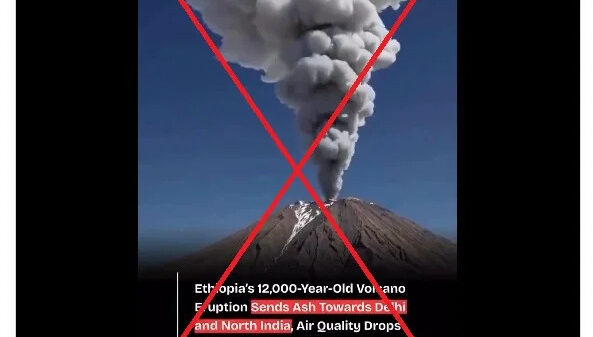
































A dramatic video falsely portraying the recent eruption of the Hayli Gubbi volcano in northeastern Ethiopia has sparked widespread confusion online. While the volcano erupted for the first time in nearly 12,000 years on November 23, 2025, the circulating clip, which depicts smoke and lava, is actually an AI-generated creation uploaded months earlier.
The Hayli Gubbi volcano, located in the Afar region approximately 800 kilometres (about 500 miles) northeast of the capital, Addis Ababa, erupted at 15:30 Thailand time, sending ash clouds soaring 14 kilometres (around nine miles) into the atmosphere. This event, confirmed by the Smithsonian Institution’s Global Volcanism Program, is significant as it marks the volcano’s first activity since the Holocene era.
Despite the eruption’s historical importance, a video associated with the event has caused misinformation to spread. The clip, which shows dramatic visuals of a volcano, was originally posted on YouTube on July 5, 2025, well before the actual eruption. A reverse image search revealed that the video was labeled as “for representation only” and was intended to be a fictional simulation for entertainment. The channel hosting the clip specializes in AI-generated content, boasting over 200,000 subscribers and focusing on simulations of natural disasters.
Following the eruption, a post in Thai shared the misleading video, prompting further dissemination across various languages including English, Hindi, and Arabic. The Toulouse Volcanic Ash Advisory Centre reported that ash clouds from the Hayli Gubbi eruption drifted over regions including Yemen, Oman, India, and northern Pakistan, highlighting the eruption’s far-reaching impact.
While the Hayli Gubbi volcano’s eruption is a natural phenomenon of great significance, the spread of AI-generated visuals has raised concerns about the accuracy of information in the digital age. As misinformation can lead to panic or misunderstanding, awareness and verification of sources are increasingly crucial.
The Agence France-Presse (AFP) has actively debunked similar false representations in the past, emphasizing the need for critical evaluation of visuals related to significant events. As technology continues to advance, distinguishing between reality and artificial creation becomes essential for informed public discourse.