









































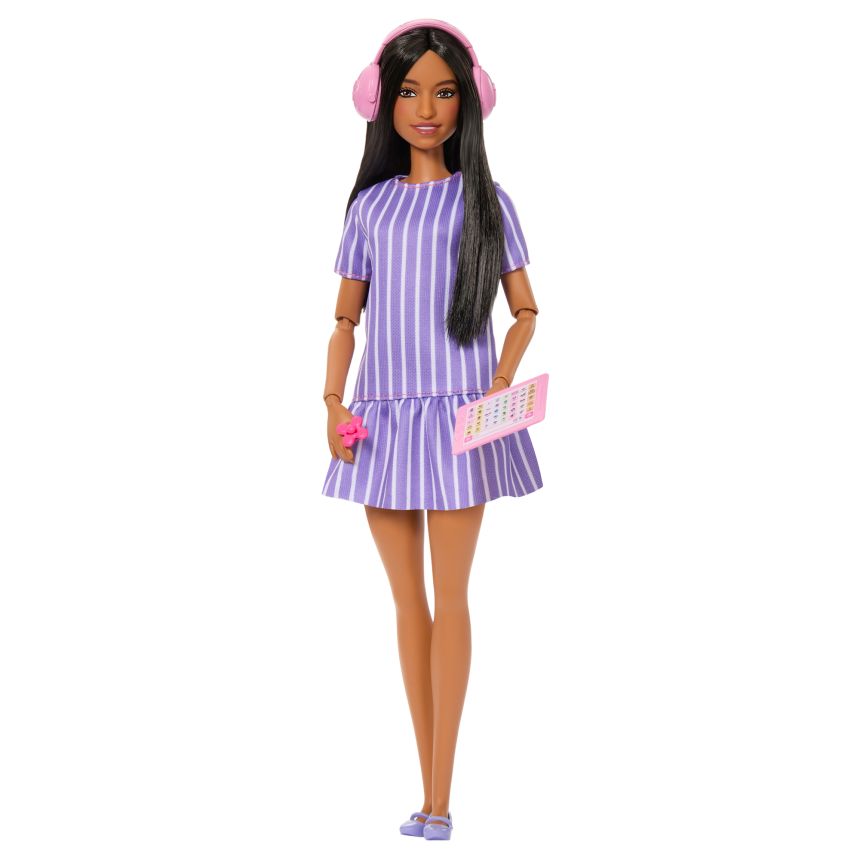
A new Barbie doll launched by Mattel represents a significant milestone for autism advocacy, as it is the first doll designed specifically for children on the autism spectrum. The doll debuted on March 4, 2024, and features distinctive accessories that resonate with the experiences of those with autism.
Five-year-old Mikko, who attended the launch event in Las Vegas, was thrilled to see the doll holding a pink fidget spinner and wearing oversized noise-cancelling headphones, just like her own. Mikko’s mother, Precious Hill, expressed that the moment felt “almost magical.” Hill, who also has autism, noted the importance of representation for her daughter, stating, “Autism is such an invisible disability at times, and to see that it’s being represented through Barbie… it really matters to me that she’s not alone.”
The doll carries a pink tablet that symbolizes her augmentative and alternative communication (AAC) device, which is essential for many nonverbal individuals. Hill highlighted that Mikko uses a similar device to communicate, emphasizing the real-life relevance of the doll’s features.
Celebrating Diversity and Inclusion
The Barbie doll is part of Mattel’s Fashionistas collection, which aims to showcase a diverse range of identities. This launch is timely, as data indicates that approximately 1 in 31 children in the United States are diagnosed with autism by age eight. To ensure authenticity, Mattel partnered with the Autistic Self Advocacy Network during the design process. Colin Killick, the executive director of the organization, stated, “It is so important for young autistic people to see authentic, joyful representations of themselves, and that’s exactly what this doll is.”
The doll’s design includes specific features that reflect the preferences of many individuals on the spectrum. For example, her gaze is slightly averted, mimicking the tendency of some autistic individuals to avoid direct eye contact. The flowy, loose-fitting purple pinstripe dress caters to sensory sensitivities, allowing for comfort.
Hill’s insights into autism, stemming from her own experiences and her daughter’s diagnosis at age two, provided valuable context for the doll’s attributes. She was diagnosed with autism at age 29 after recognizing parallels in her own life while researching autism for Mikko.
A Broader Conversation on Autism
Eileen Lamb, senior director of social media and marketing at Autism Speaks, shared her own experience of being diagnosed later in life. She noted that many girls with autism remain undiagnosed until adulthood. “Autism can look different in girls, and the fact that Barbie is a girl is powerful in some way,” Lamb said. This launch not only celebrates diversity but also opens avenues for conversations about autism in a relatable manner.
While the new Barbie doll highlights vital tools, such as the AAC device and fidget spinner, it is essential to recognize that autism is a broad spectrum. Lamb pointed out, “It’s not possible to represent everyone, but it’s a great step.” She emphasized the significance of toys that reflect real-life experiences, stating, “Representation matters, and it’s really good for children to see themselves in a toy.”
Overall, the release of this Barbie doll signifies a cultural shift towards greater inclusivity and understanding of autism, providing children and families a sense of visibility and recognition. As the conversation about autism continues to evolve, this doll stands as a symbol of hope and representation for countless individuals on the spectrum.
















