






































A team of international archaeologists has made a groundbreaking discovery in the Nefud Desert of Saudi Arabia, revealing rock art that dates back more than 12,000 years. Published in the journal Nature Communications, the findings challenge previous assumptions about human settlement in the Arabian Peninsula and highlight the significance of ancient cultural networks.
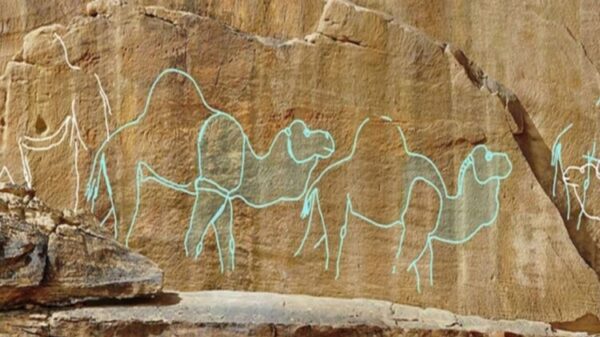
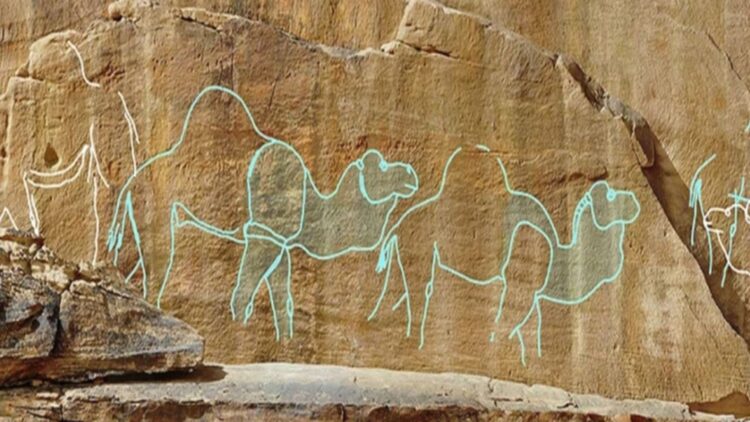
The discovery includes over 170 engravings found on cliffs near the southern edge of the Nefud Desert, specifically in three previously unexplored areas: Jebel Arnaan, Jebel Mleiha, and Jebel Misma. The rock art features large, life-sized representations of camels, goats, and other animals, indicating a rich cultural expression that predates much of the known art in the region.
Uncovering Ancient Artistry
Erosion has obscured many examples of ancient rock art, leaving researchers with limited options to study early human creativity. In May 2023, the team set out to explore lesser-known sites to uncover additional artistic expressions not included in UNESCO’s World Heritage listings. Their efforts led to the identification of more than 60 rock art panels, showcasing a total of 130 engravings.
Among these artworks, one panel stood out to lead researcher Maria Guagnin. She described two large camels depicted in motion, with one appearing to stand and the other walking on the rocky surface. The same layer contained artifacts typical of the period, such as arrowheads, stone beads, and a shell bead, allowing researchers to better understand the tools and lifestyle of the artists.
Using luminescence dating, which measures the last exposure of sediment to light, the researchers dated the layers of rock to approximately 12,000 years ago. This precise dating offers invaluable insights into the timeline of human activity in the area.
Implications for Understanding Human Movement
The implications of these findings extend beyond the art itself. The engravings indicate that the creators were part of a broader cultural network that reached as far as the Levant, located 400 kilometers to the north. The study reveals that these early inhabitants used similar stone tools and jewelry, suggesting a significant level of interaction among distant communities.
Additionally, the site now known as Jebel Mleiha was once a seasonal lake, a vital resource during its time, reflecting a dramatic climatic shift. Researchers believe that the return of surface water to Arabia after an extremely arid period made the region more hospitable for human settlement. This evidence reshapes the understanding of how early humans adapted to changing environmental conditions.
The discovery of these ancient camel carvings not only enriches the narrative of human history in Arabia but also offers a glimpse into the interconnectedness of early communities across the region. As archaeologists continue to explore the Nefud Desert, further revelations about early artistic expression and culture are anticipated, promising to deepen our understanding of human origins.