









































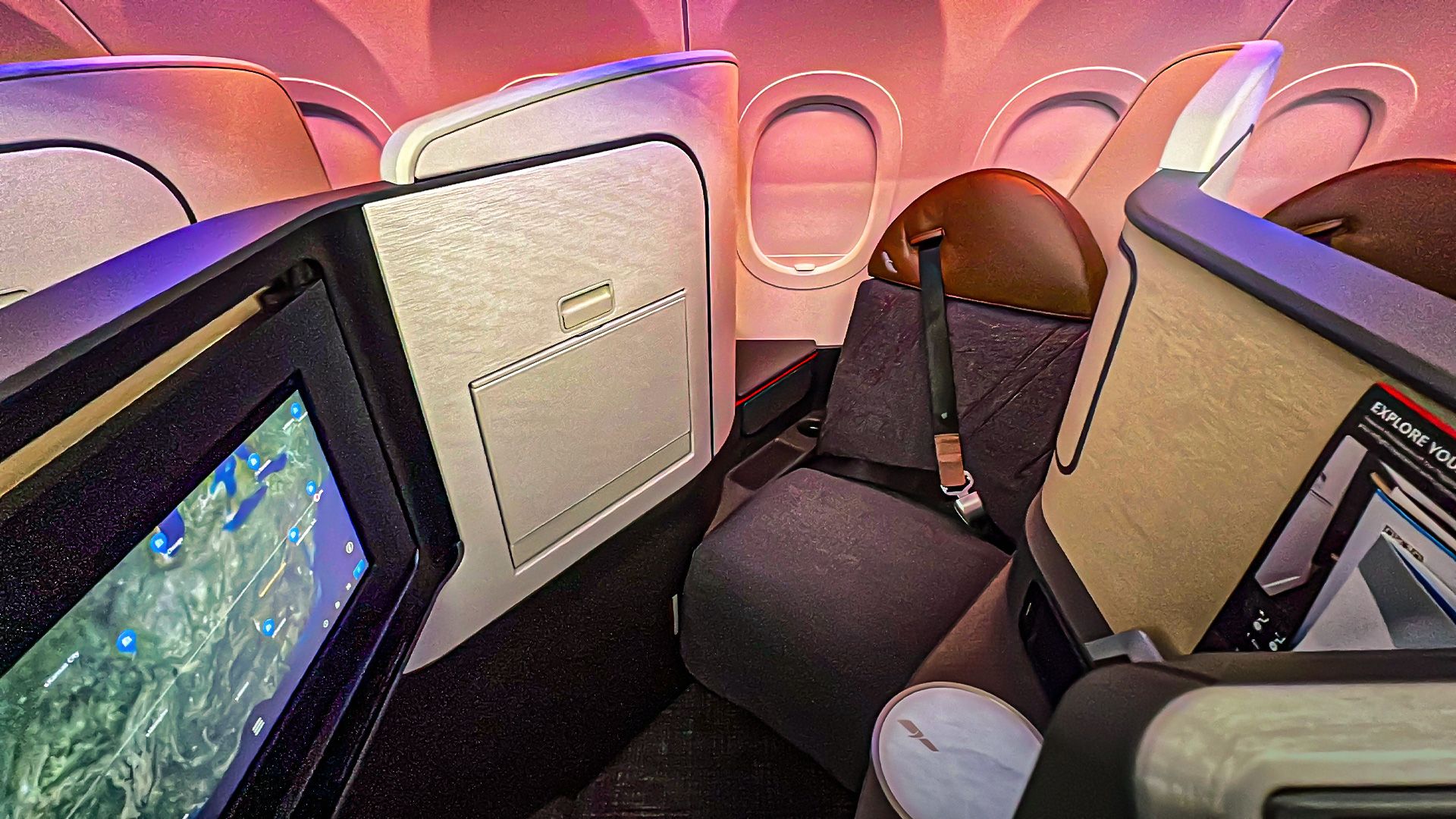
Airlines are transforming the business class experience on narrowbody aircraft by introducing lie-flat seats, a feature traditionally associated with larger planes. This shift reflects a growing demand for enhanced comfort on shorter routes, as airlines aim to provide a premium experience without the extensive costs associated with widebody aircraft.
Historically, narrowbody aircraft like the Boeing 757-200 and Airbus A321 primarily catered to short-haul flights, often offering little more than standard economy seating. European airlines, in particular, have been known for their basic short-haul business class, frequently featuring standard economy seats with a blocked middle seat. However, this landscape is changing as more airlines adopt lie-flat seating, which offers passengers more comfort during their journeys.
Development of Lie-Flat Seats in Narrowbody Aircraft
The introduction of lie-flat business class seating on narrowbody aircraft began with Continental Airlines, which first equipped its Boeing 757-200s with these seats in 2010. Following its merger with United Airlines, these aircraft continued to operate under the United banner, retaining the Collins Aerospace Diamond seats that provide a premium experience for travelers.
American carriers were pioneers in this field, with Delta Air Lines also offering lie-flat seats on select Boeing 757-200s for premium transcontinental routes. JetBlue and American Airlines have joined the trend with their Airbus A321 fleets, featuring comparable seating aimed at enhancing the travel experience on longer domestic routes. The trend has now expanded globally, with airlines around the world installing similar seating on their Airbus A321neo and Boeing 737 MAX aircraft.
These lie-flat seats often utilize designs like the Collins Diamond or Thompson Vantage, which are adapted for narrowbody configurations. Manufacturers have developed new products tailored specifically for these aircraft, featuring innovative designs that maximize space while maintaining passenger comfort.
Regional Variations and Notable Implementations
In the Americas, United Airlines continues to operate Boeing 757-200s with the Collins Diamond seats, providing a consistent lie-flat option for transcontinental flights. Delta Air Lines utilizes twelve such aircraft for similar routes, although it has shifted its operational focus away from Europe. Meanwhile, American Airlines boasts 15 Airbus A321-200s equipped with the Collins Diamond for its Flagship Business service, along with upcoming Airbus A321XLR aircraft set to feature the Collins Aurora.
JetBlue’s A321-200s and A321neos are outfitted with the Thompson Vantage, and its A321LRs also feature this seating arrangement. Notably, Copa Airlines stands out as the only carrier in the Americas outside the United States to offer lie-flat seats on a narrowbody, using the Collins Diamond on its Boeing 737 MAX 9 aircraft.
Across the Atlantic, European airlines primarily feature lie-flat seats on narrowbody aircraft for transatlantic flights. La Compagnie operates an all-business class service between Europe and Newark, initially using Boeing 757s and now employing Airbus A321neos equipped with 76 Collins Diamond seats. Other notable carriers include ITA Airways, which flies Airbus A321neos with the Stelia Opera reverse herringbone seats, and TAP Air Portugal, which utilizes the Thompson Vantage for its transatlantic services.
In the Middle East, airlines like Qatar Airways and Etihad Airways have also adopted lie-flat seating on their narrowbody fleets. Qatar Airways features a subfleet of Airbus A320-200s with the Collins Diamond, while Etihad’s new Airbus A321LRs showcase the Stelia Opera. Gulf Air and flydubai have also embraced this trend, equipping their aircraft with the Thompson Vantage seating.
In South Asia, Air India has introduced lie-flat seating on its Airbus A321neos, while the Maldives-based airline BeOnd offers a unique all-business class configuration on its Airbus A319-100 and A321-200, featuring custom lie-flat seats.
Narrowbody aircraft with lie-flat seating represent a significant evolution in air travel, enhancing the comfort and experience for passengers on shorter routes. As airlines continue to innovate and adapt to passenger preferences, the competition for premium seating is expected to grow, making long-haul comfort accessible even on narrowbody aircraft.
















