









































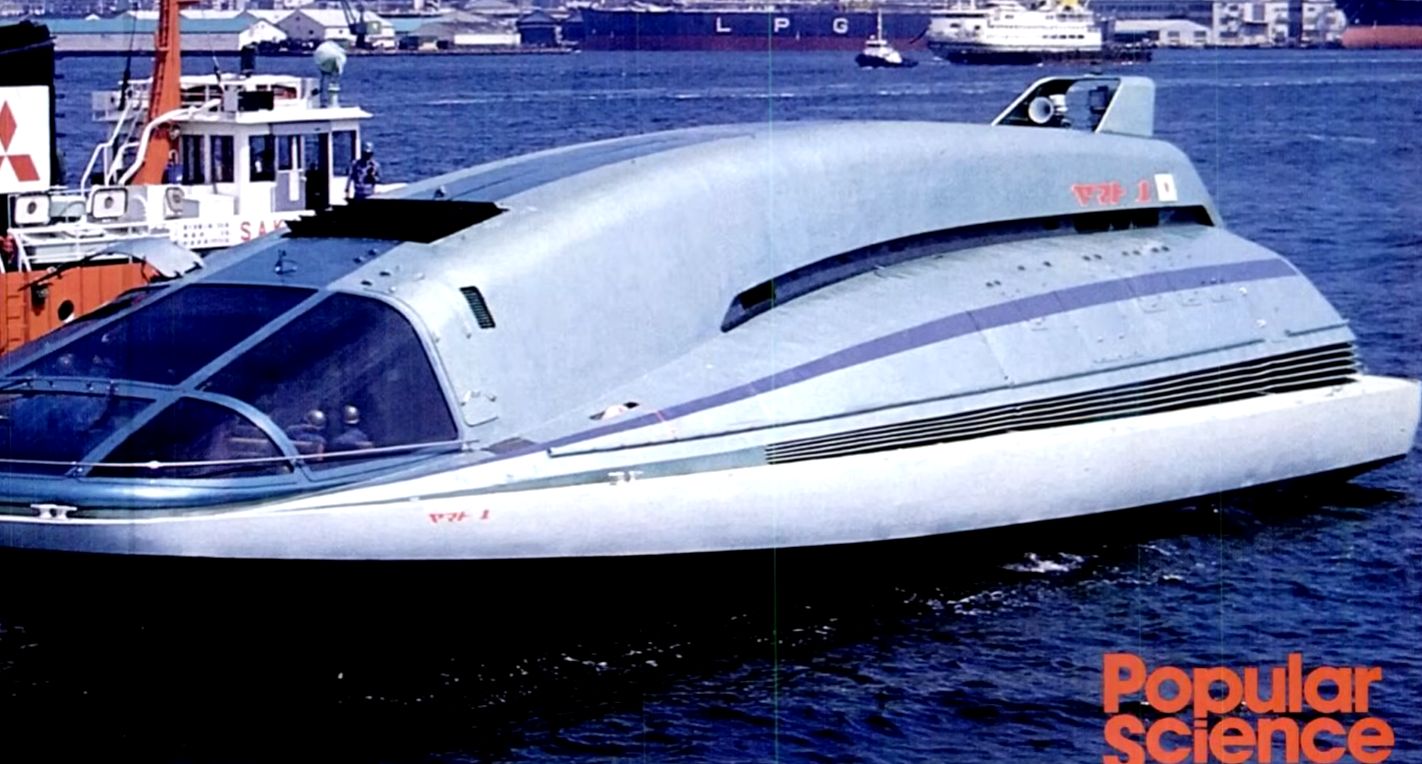
The **Yamato-1**, a groundbreaking vessel from Japan, stands as the first ship ever to utilize magnetohydrodynamic propulsion. This innovative technology, which employs the **Lorentz force** to move through water, demonstrates an alternative to traditional propulsion methods like the propeller. Despite its intriguing design, the Yamato-1 remains an unusual example in marine engineering.
The magnetohydrodynamic drive (MHDD) operates by using seawater, a conductive fluid, as its working medium. This system eliminates the need for moving parts, relying instead on two primary types of MHDD: conduction, which incorporates electrodes, and induction, which utilizes a magnetic field. The Yamato-1 employed the induction method, featuring liquid helium-cooled, superconducting coils that interact with the seawater’s ions. According to reports, this interaction generates thrust by causing the seawater to accelerate in response to the magnetic field.
Despite its innovative design, the Yamato-1 faced significant efficiency challenges. The propulsion system achieved a working efficiency of approximately **15%** and a maximum speed of **15 km/h** (about **8 knots**). These limitations highlight the fundamental issues with using seawater as a propellant without enhancing its ionic content. As a result, the Yamato-1 has become an anomaly in maritime history, much like the **Lun-class ekranoplan**, a ground effect vehicle known for its unique design.
Legacy and Challenges of Magnetohydrodynamic Propulsion
Constructed in **1992**, the Yamato-1 was primarily housed at the **Kobe Maritime Museum** until its decommissioning and eventual scrapping in **2016**. During its operational years, this full-scale prototype was the only manned vessel to test the capabilities of MHDD technology. Recent media coverage, including a video by **Sails and Salvos**, highlighted the vessel’s unique features and its time spent in relative obscurity.
Research into magnetohydrodynamic drives continues, though advancements have been slow. The inherent inefficiency of seawater as a propulsion medium poses a significant hurdle for further development. While enthusiasts can experiment with simpler versions of MHDD technology in controlled environments, such as a kitchen sink, the complexity of scaling this technology for large vessels remains a considerable challenge.
The Yamato-1 serves as a reminder of the potential for innovative propulsion systems in maritime technology. It is a testament to human ingenuity, even as it stands as a curiosity in the broader context of naval engineering. As researchers explore the possibilities of alternative propulsion methods, the legacy of the Yamato-1 will likely inspire future innovations in the field.
















