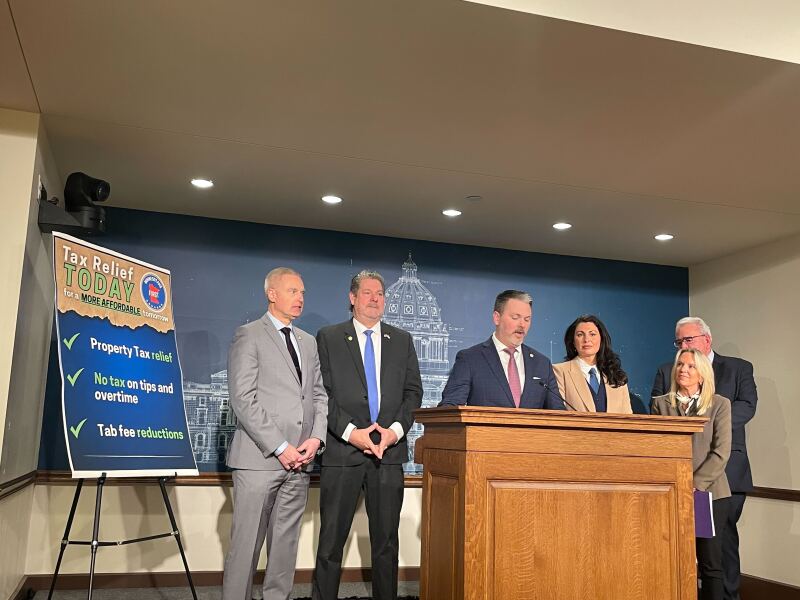
UPDATE: Minnesota Senate Republicans have just announced a groundbreaking tax relief package that aims to bring immediate financial relief to residents. Introduced on March 2, 2026, at the state Capitol in St. Paul, the proposals include property tax caps, the elimination of taxes on tips and overtime, and a significant reduction in license tab fees.
The announcement follows a favorable budget forecast revealing a $3.7 billion budget surplus for 2026-27, up from a previous deficit. “This surplus tells us taxes are too high, and we have room to make these changes without harming state finances,” stated Sen. Julia Coleman, R-Waconia, during a news conference.
Among the key proposals is SF3669, spearheaded by Sen. John Jasinski, R-Faribault, which seeks to revert license tab fees to their pre-2023 levels. Another significant measure from Sen. Michael Kreun, R-Blaine, would cap property taxes at the rate of inflation plus half of the population growth for cities with over 2,500 residents. Notably, increases over this cap would require voter approval.
Additionally, Speaker of the House Lisa Demuth, R-Cold Spring, expressed her interest in federal tax conformity, which is partially addressed by Sen. Karin Housley’s proposal to eliminate taxes on tips and overtime. This proposal includes a maximum deduction of $25,000 for tips and $12,500 for overtime, phasing out once income reaches $150,000 for single filers and $300,000 for married joint filers. However, this measure could cost the state approximately $391 million in its first fiscal year.
With a surplus of only $377 million anticipated for the 2028-29 fiscal year, concerns are rising about how the state will cover this shortfall. Housley remarked, “We have the next 10 weeks to work out where that money would be coming from.”
Senate Minority Leader Mark Johnson, R-East Grand Forks, emphasized the need for spending cuts in other areas or savings through fraud prevention measures. Recent reports indicate that claims have decreased by 4% across 14 high-risk state Medicaid programs, thanks to a newly implemented pre-payment review process, which has already saved the state $75 million in the current biennium.
It remains uncertain whether the tax relief proposals will attract bipartisan support. House Leader Zack Stephenson, DFL-Coon Rapids, indicated that he would closely assess the implications of federal tax conformity. “We need to evaluate who the winners and losers are in the federal bill [HR 1] and determine how to allocate our limited resources effectively,” he stated.
As discussions progress, the urgency for swift action on these proposals is palpable, with many residents eagerly awaiting potential tax breaks that could significantly impact their finances. The next steps in this developing story will be crucial as lawmakers negotiate the specifics of the proposed measures and their implications for Minnesota taxpayers. Stay tuned for updates as this situation unfolds.