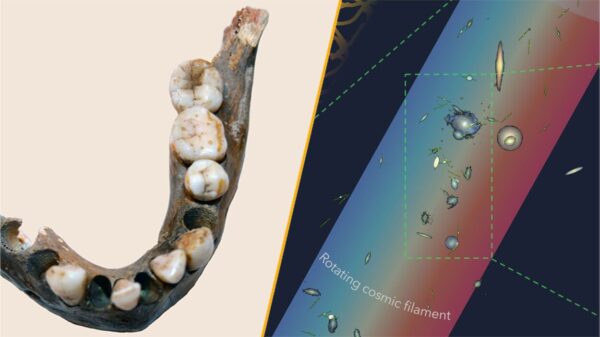




































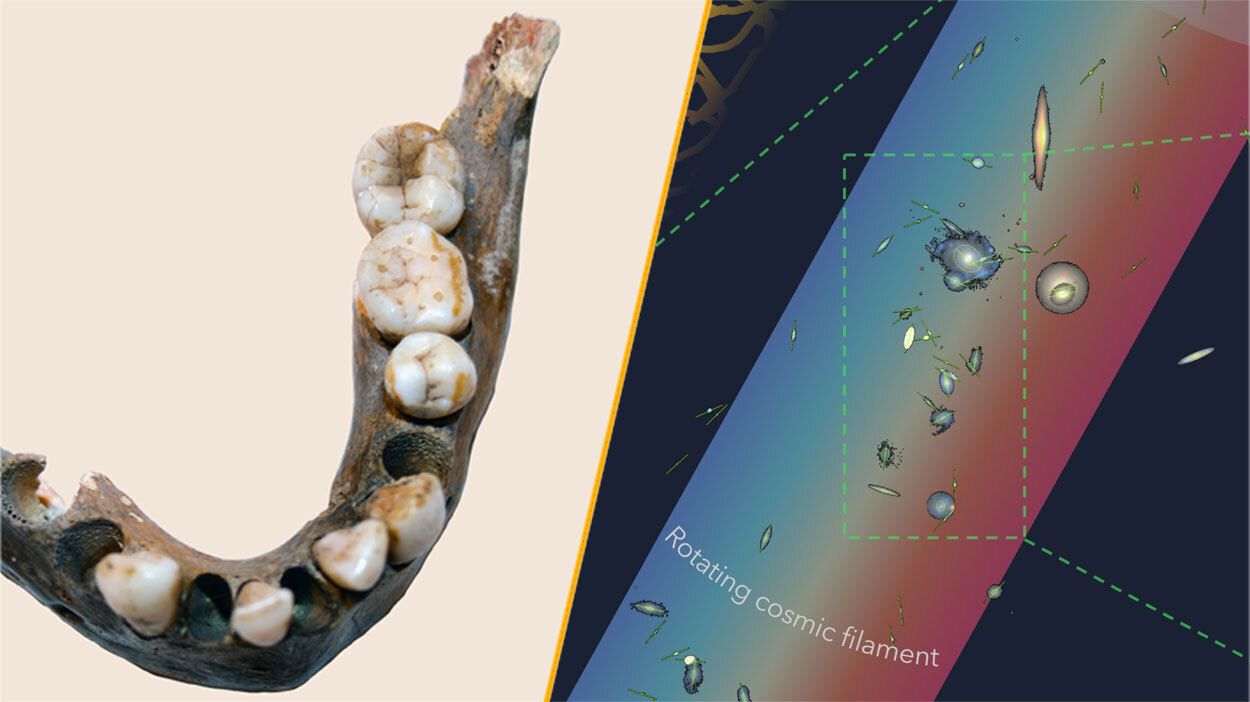
BREAKING NEWS: This week, groundbreaking science discoveries are captivating global audiences, revealing astonishing secrets about our universe and ancient human history. Just announced, scientists have identified the largest spinning structure ever observed—an immense cosmic filament located a staggering 140 million light-years away.
The newly discovered filament, wider than the Milky Way, is tethered to a spectacular chain of 14 galaxies and whirls at a breathtaking speed of 68 miles per second (approximately 110 kilometers per second). This finding reshapes our understanding of cosmic structures and their formation.
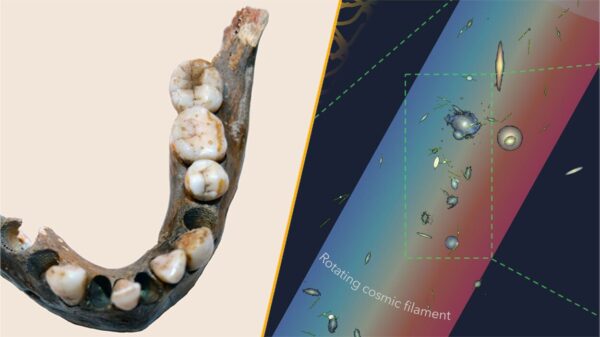
In southern Africa, researchers made a remarkable discovery regarding ancient humanity. They studied human skeletons dating back up to 10,000 years, unearthed near the Limpopo River, which flows from South Africa into Mozambique. Notably, the genetic makeup of these ancient individuals starkly contrasts with that of modern humans, indicating that this isolated population was genetically distinct for 100,000 years. The researchers emphasized that these individuals represent “an extreme end of human genetic variation,” shedding light on human evolution.
Meanwhile, across the globe, archaeologists in China uncovered a shocking mass grave outside a 4,000-year-old city. This pit was filled predominantly with male skulls, defying typical sacrificial patterns seen in nearby settlements. The discovery raises urgent questions about the cultural practices of ancient civilizations and the reasons behind such a stark gender disparity in burial rites.
On a more alarming note, a recent analysis revealed that China’s ambitious Great Green Wall project, designed to combat desertification, has had unintended consequences. While the tree-planting initiative initially succeeded, it has altered rainfall and evaporation patterns, leading to dangerously low water levels in some of the nation’s most populous regions.
In yet another fascinating update, the record heat of 134°F (56.7°C) set in Death Valley in 1913 may have been miscalculated, according to new research. This revelation has implications for how we understand temperature records and climate extremes.
Switching to interstellar news, comet 3I/ATLAS continues to astonish astronomers with its spectacular “ice volcanoes.” New images show spiral jets erupting from its surface, suggesting that the comet is losing ice as it approaches the sun. Researchers are using the Joan Oró Telescope in northeastern Spain to study this cosmic visitor, reinforcing its similarities to other solar system objects.
In a significant technological breakthrough, MIT engineers unveiled a new method to extract drinking water from air, even in arid regions. This innovative technique uses ultrasound to efficiently shake water from sponges, achieving a remarkable efficiency rate of 45 times greater than traditional evaporation methods. While the device requires a power source, researchers believe solar integration could provide a sustainable solution for water scarcity.
Lastly, in thrilling paleontological news, scientists in Bolivia have discovered 18,000 dinosaur tracks along the Carreras Pampa coastline, marking it as a premier site for dinosaur footprints globally. This extraordinary find spans an area of 80,570 square feet (approximately 7,485 square meters) and offers a glimpse into ancient life on Earth.
These urgent scientific breakthroughs not only expand our understanding of the universe and human history but also challenge us to consider their implications for our future. Stay tuned for more updates as these stories develop!