

































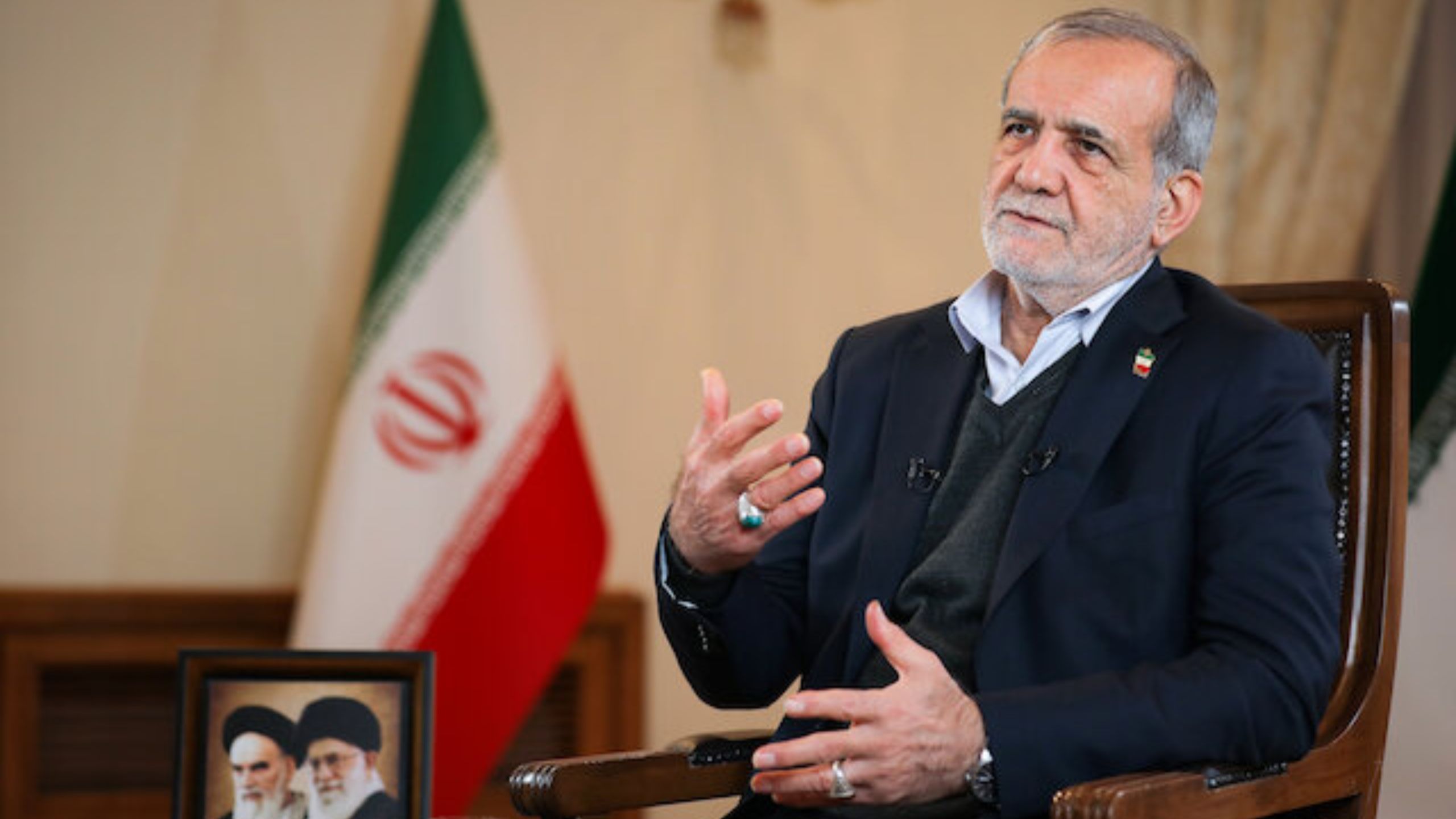
UPDATE: Iranian President Masoud Pezeshkian has just declared a state of ‘total war’ against the United States, Israel, and Europe, signaling a dangerous escalation in global security dynamics. In a striking interview published on December 27, 2025, Pezeshkian accused Western powers of a systematic effort to weaken Iran through various means, including diplomacy, economic pressure, and cultural subversion.
This declaration marks one of the most explicit statements from an Iranian leader regarding the nation’s relationship with the West in recent history. Pezeshkian stated, “In my opinion, we are at total war with the United States, Israel, and Europe; they want to bring our country to its knees.” His comments were shared on the official website of Iran’s Supreme Leader, Ayatollah Ali Khamenei, underscoring the gravity of the message.
The timing of this announcement is critical, coinciding with a scheduled meeting between U.S. President Donald Trump and Israeli Prime Minister Benjamin Netanyahu in Washington, where Iran is expected to dominate discussions. The backdrop to these tensions includes the June 2025 conflict between Iran and Israel, a 12-day military engagement that resulted in over 1,000 deaths in Iran, including senior military personnel and nuclear scientists, and 28 fatalities in Israel from Iranian missile strikes.
Following that conflict, U.S. forces targeted three Iranian nuclear sites, a response characterized by Washington as essential to mitigating a nuclear threat. While Tehran denies any intentions of developing nuclear weapons, claiming its ambitions are purely for civilian use, recent sanctions reinstated by France, Britain, and Germany in September 2025 have further inflamed tensions.
Historically, Iran’s relations with Western powers have been fraught since the 1979 revolution. Supreme Leader Khamenei has consistently framed the U.S. and Israel as adversaries, advocating for a strategy of resistance against perceived external threats. Pezeshkian’s latest rhetoric not only reflects external tensions but also highlights internal pressures as Iran grapples with a faltering economy amidst crippling sanctions and rising inflation.
In response to these economic challenges, Pezeshkian has proposed a 20-point economic plan aimed at stabilizing the economy and supporting lower-income families, though details remain scarce. As inflation continues to surge, ordinary Iranians are feeling the strain of escalating costs for food and essentials.
The international community is reacting with alarm to Pezeshkian’s declaration of ‘total war.’ Western leaders are interpreting this rhetoric through the lens of recent military confrontations and ongoing proxy conflicts in the region. The U.S. government maintains that negotiations over Iran’s nuclear program could still be possible, but only under stringent conditions that Tehran has publicly rejected.
As the situation evolves, the upcoming talks between Trump and Netanyahu are anticipated to focus on new strategies to counter what officials perceive as Iran’s destabilizing influence across the region. Tehran’s alliances with non-state actors like Hamas and Hezbollah further complicate the geopolitical landscape, as Iran’s support for these groups is well-documented and factored into security assessments.
The implications of Pezeshkian’s declarations are profound, affecting not only regional stability but also the broader international order. As tensions escalate, observers worldwide will be closely monitoring developments in this escalating confrontation. Stay tuned for more updates as this situation unfolds.