









































UPDATE: China has officially revolutionized drone warfare with new AI-driven tactics, as engineers from Beihang University unveil nature-inspired strategies that could redefine combat. In a recent test, drones trained to mimic hawks destroyed all opponents in just 5.3 seconds, showcasing the People’s Liberation Army’s (PLA) ambitious goals in autonomous warfare.
This urgent advancement comes in the wake of Beijing’s push to integrate animal-inspired AI into military technology. As detailed by The Wall Street Journal, the PLA is heavily investing in drone swarms, robot dogs, and other AI systems, aiming to overwhelm adversaries with minimal human intervention. The implications are staggering as China produces over 1 million drones yearly, dwarfing the U.S. output of tens of thousands.
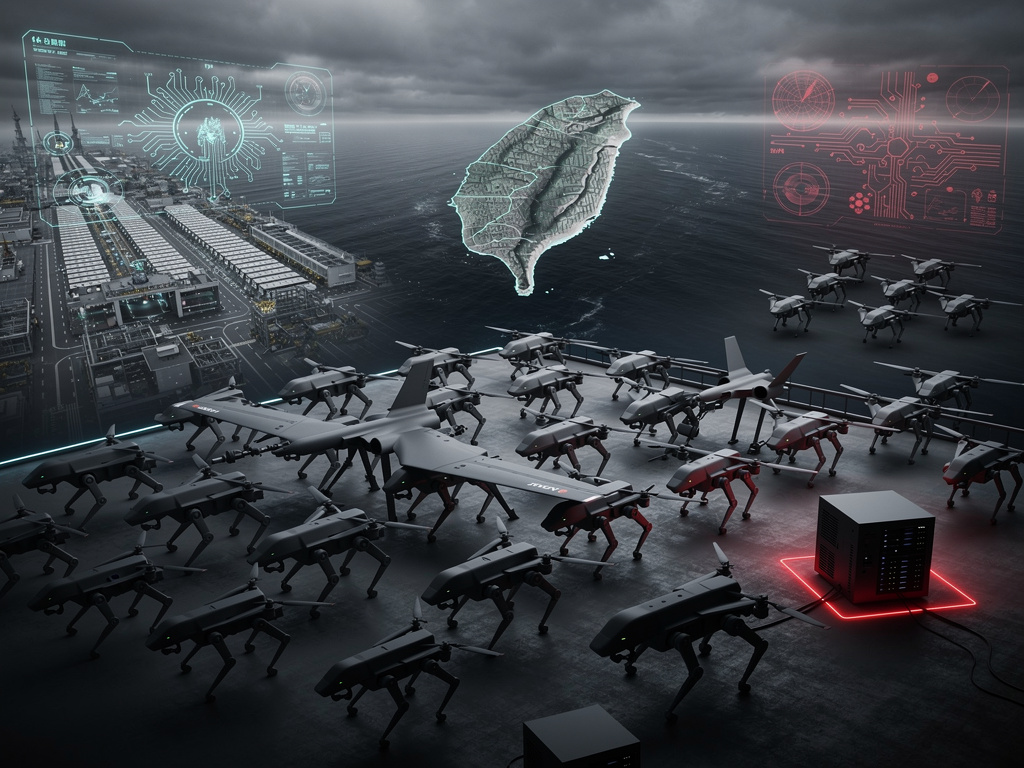
In an eye-opening demonstration, state media showcased the Jiutian mothership drone, designed to deploy swarms for reconnaissance and strikes. This drone completed its maiden flight in December 2024, marking a significant leap in China’s military capabilities. Furthermore, the PLA exhibited weaponized robot dogs, referred to as “robot wolves,” during parades, emphasizing their role in future combat scenarios.
Experts are sounding alarms about this rapid evolution. Sunny Cheung, an open-source intelligence specialist at the Jamestown Foundation, stated, “There’s a growing consensus that autonomous systems have the potential to perform better than humans.” This shift addresses longstanding concerns over the competence of PLA soldiers, largely untested since the 1970s.
The urgency of these developments is underscored by the ongoing conflict in Ukraine, where electronic jamming has challenged drone operations. As a direct response, Chinese military theorists have proclaimed that the AI era heralds “a new style of warfighting driven by algorithms,” emphasizing the necessity for autonomous systems.
In a startling revelation, procurement platforms indicate that since 2022, Chinese entities have filed at least 930 swarm intelligence patents, compared to just 60 in the U.S. This surge is a clear signal of China’s commitment to dominating the battlefield through innovative AI technologies.
By 2025, the PLA aims to integrate DeepSeek AI into its arsenal, enhancing the effectiveness of drones and autonomous vehicles. Reports reveal that this AI system can evaluate 10,000 scenarios in 48 seconds, versus 48 hours for human operators. The military’s emphasis on “smart, small drones” is a strategic priority, as China holds an 80% global production dominance in this sector.
On January 23, 2026, the PLA’s National University of Defense Technology demonstrated a soldier controlling over 200 autonomous drones in just 99 seconds during urban combat drills. This capability, resistant to jamming, marks a pivotal moment in warfare, as the PLA shifts towards effective control over massive swarms.
Despite concerns over the ethical implications of such technology, including the potential for unintended consequences, the PLA continues to advance rapidly. Retired PLA colonel Zhou Bo warned, “AI’s military applications are burgeoning, so its consequences have yet to be fully discovered.”
As global calls for limits on AI in warfare intensify, U.S. defense initiatives struggle to keep pace. The Pentagon is aiming for thousands of autonomous drones by the end of 2025 to counter China’s rapid advancements.
As we move forward, the landscape of warfare is being reshaped by AI and drone technology, with China positioning itself at the forefront of this new era. The implications for global security are profound, and the world watches closely as these developments unfold.
















