









































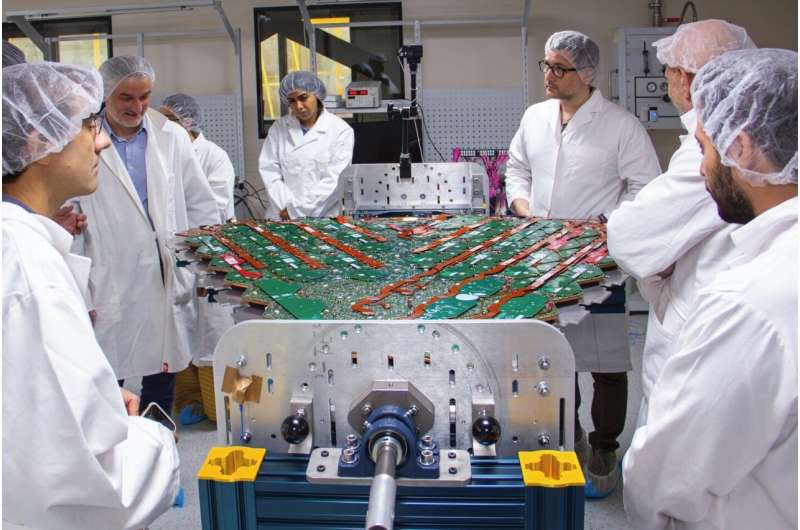
A team of scientists at CERN has successfully developed the first prototype “cassette” for the new CMS High-Granularity Calorimeters (HGCALs). These innovative cassettes represent a significant advancement in particle detection technology, designed to enhance the capabilities of the Compact Muon Solenoid (CMS) experiment as it prepares for the upcoming High-Luminosity Large Hadron Collider (HL-LHC), set to begin operations in 2030.
Significant Technological Advancements
The HGCALs will consist of wedge-shaped cassettes that serve as the building blocks for the new endcap calorimeters. According to Dimitra Tsionou, a physicist from National Taiwan University, the HGCAL will function as a “5D calorimeter,” providing advanced 3D spatial reconstruction, energy reconstruction, and high timing resolution. This technology is crucial for managing the increased number of particle collisions expected during experiments at the HL-LHC.
The HL-LHC is projected to deliver 4 to 5 times more simultaneous particle collisions compared to the existing LHC, generating up to 140–200 collisions every second. The new endcaps will need to endure higher radiation levels resulting from these intensified collisions, a challenge that the HGCAL is specifically designed to address.
The Scale of the New Endcaps
Each full endcap will cover an area of approximately 500 square meters, nearly equivalent to two tennis courts, and will house more than 3 million detector channels. This extensive setup will enable detection of particles produced during collisions, which may occur up to 10 cm apart in space and about ten trillionths of a second apart in time. The high density of sensors—termed “high granularity”—is essential for tracking the paths of these particles back to their origins.
The construction of the HGCAL will involve collaboration between CERN and Fermilab. CERN will focus on building the 26 layers closest to the collision point, responsible for detecting electrons and photons, while Fermilab will take charge of the 21 layers further from the collision point, dedicated to measuring protons and neutrons. Once the hadronic cassettes are tested at Fermilab, they will be transported to CERN, where they will be integrated into steel structures, the first of which is being re-assembled at CERN after initial production in Pakistan.
Ludivine Ceard, HGCAL physicist and logistics manager from National Taiwan University, expressed enthusiasm about the project, stating, “It’s very ambitious. This is the first time that a detector using this technology will be built on this scale and have to operate in such tough conditions.” The team recognizes the challenges ahead but remains committed to delivering a groundbreaking detector.
The HGCAL not only promises to enhance particle detection capabilities but also aims to improve energy resolution, particle identification, and triggering performance compared to existing systems. As CERN moves forward with this project, the scientific community is eager to see how these advancements will contribute to our understanding of fundamental physics.
















