




















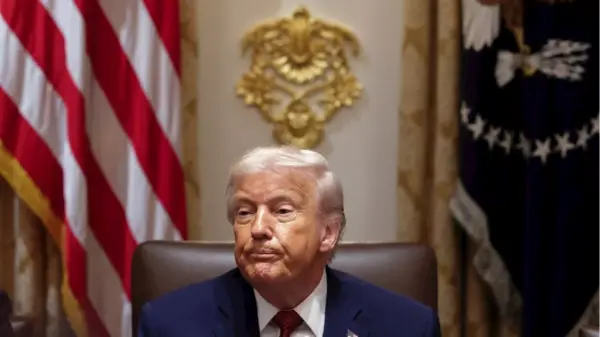
















President Donald Trump is set to sign an executive order aimed at establishing a unified regulatory framework for artificial intelligence (AI) across the United States. This move seeks to replace the current fragmented set of state laws that some argue could impede the development and innovation of AI technologies.
The announcement follows ongoing concerns regarding AI safety, copyright issues, and the absence of comprehensive federal regulations. Trump emphasized the necessity of a single set of rules, stating, “There must be only One Rulebook if we are going to continue to lead in AI.” He expressed concern that the existing state-based system could hinder progress, declaring, “I will be doing a ONE RULE Executive Order this week. You can’t expect a company to get 50 Approvals every time they want to do something.”
Challenges of State-Level Regulations
The rapid evolution of AI technology has left Congress struggling to keep pace with necessary regulations, resulting in a patchwork of state laws that vary widely. Many industry leaders have voiced their concerns regarding the implications of these differing regulations. According to Adam Kovacevich, founder and CEO of Chamber of Progress, the current state legislation is often driven by a pessimistic view of AI. He noted, “Most voters want to capture the upsides of artificial intelligence… while minimizing its abuses and excesses. But the problem is, we don’t totally know what those abuses and excesses are yet.”
The regulatory vacuum has led businesses to adopt the most stringent state regulations available, potentially stifling innovation. Jared Polis, Governor of Colorado, stated, “To do this right, we really need federal action to establish a national regulatory framework for AI to preempt the states and avoid a patchwork of state laws that would deter innovation.”
The urgency for a cohesive regulatory approach is underscored by recent statistics from the Brennan Center for Justice, which revealed that over 150 AI-related bills were introduced in the last Congress, with none becoming law. The current Congress has faced similar challenges in addressing the regulatory needs of the technology sector.
Political Implications and Future Prospects
Responses to Trump’s planned executive order vary among political leaders. Ron DeSantis, Governor of Florida, expressed skepticism about the effectiveness of an executive order in overriding state laws. He remarked that while having a federal standard for AI is beneficial, achieving such a standard requires more than just a signature. DeSantis suggested that Congress would need to unite across party lines to create a viable regulatory scheme.
Kovacevich echoed this sentiment, stating, “You need to get members of Congress, Republicans and Democrats, talking to each other about rules of the road and a federal standard that doesn’t just preempt states.” He anticipates that a genuine regulatory framework may not materialize until next year, emphasizing the urgency for action.
As the debate continues, the implications of Trump’s executive order could significantly shape the future landscape of AI regulation in the United States. The outcome may determine how effectively the country can maintain its leadership in the rapidly advancing field of artificial intelligence.