









































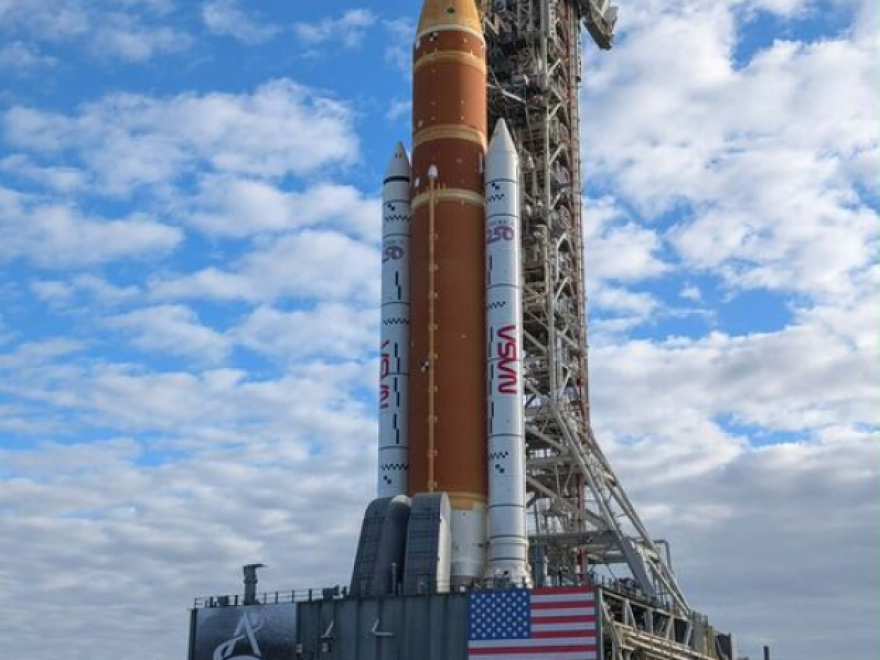
NASA has officially rolled out the spacecraft designated for the upcoming Artemis II mission, which will take astronauts on a journey around the moon. On Saturday, at approximately 9 a.m. ET, the integrated Space Launch System (SLS) rocket and Orion spacecraft began their journey from the Vehicle Assembly Building to Launch Pad 39B. This process, which involves transporting the 11 million-pound rocket stack over a four-mile distance, is expected to take up to 12 hours.
During the rollout event, NASA director Jared Isaacman highlighted the significance of this mission. “The architecture you see behind us here with SLS and the Orion spacecraft is just the beginning,” he stated. Isaacman emphasized that as missions progress, NASA would gain valuable insights that would lead to improvements in vehicle architecture, enabling more frequent and cost-effective missions to the moon.
The Artemis II mission is tentatively scheduled for launch on February 6, 2024, contingent on the readiness of both the team and the rocket. The mission will feature four astronauts: Christina Koch, Victor Glover, Reid Wiseman, and Jeremy Hansen from the Canadian Space Agency. The crew will first orbit Earth before embarking on their lunar journey, which is projected to last approximately ten days.
Goals of the Artemis Program
The overarching aim of the Artemis program is to return Americans to the moon for the first time in more than 50 years. This initiative also serves as a stepping stone toward future missions to Mars. The launch of Artemis II follows the success of the original Artemis mission, which successfully sent an uncrewed spacecraft into space in 2022.
Regarding the scientific objectives of the lunar orbit, Isaacman remarked, “What the lunar orbit would teach its onboard scientists is what’s going to enable missions like Artemis 100 and beyond.” He expressed hope that this mission would inspire future generations of astronauts and space enthusiasts.
“Why are we doing this? We are doing this to fulfill a promise – a promise to the American people that we will return to the moon,” he concluded. With the Artemis II mission, NASA is taking significant strides toward realizing its ambitious goals and reigniting interest in lunar exploration.
















