









































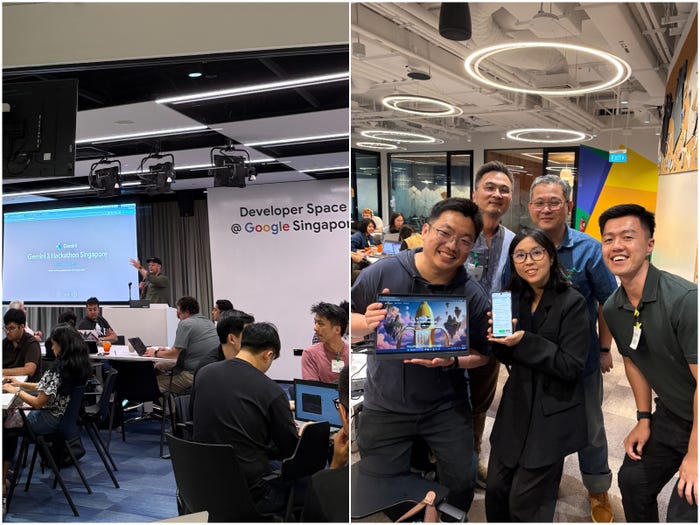
Four Malaysian developers participated in the Gemini 3 Hackathon, held in Singapore on January 2024, where they aimed to create an innovative app in just seven hours. The team, comprising varied professionals including an accountant, an AI lecturer, an IT specialist, and a startup chief technology officer, embarked on this challenge with the goal of building a real-time feng shui app.
Initially, the team envisioned an application to analyze properties using feng shui principles, a concept deeply rooted in Chinese culture that evaluates environments based on their influence on luck and well-being. However, due to time constraints, they pivoted to a more immediate idea: an app that would assess users’ outfits and workspaces for feng shui compatibility using their phone cameras.
The hackathon, organized by Google DeepMind and 65labs, featured a significant prize pool of 100,000 credits for the winning team, with the first prize set at 30,000 credits. Participants were tasked with submitting a working demo, a public code repository, and a short explanatory video by 5:30 p.m. on the same day.
Starting at 9:30 a.m., the team quickly divided responsibilities. Chan Wei Khjan took the lead on prompting the AI to generate the necessary workflow and code, while Chan Ler-Kuan ensured that the outputs adhered to feng shui principles. Loh Wah Kiang and Lee How Siem, known as Benny, focused on refining the code and troubleshooting issues.
After an hour of work, the AI generated the initial codebase. However, it came with several bugs that needed fixing. Wei Khjan adeptly copied error messages back into the AI for resolution. Despite its flaws, the application began to take shape by noon, albeit in a rough form.
During the lunch period, the team chose to forgo food, remaining glued to their screens as they encountered further issues with the app’s responsiveness. Wei Khjan emphasized the importance of precise prompting, noting that asking the AI to “discuss it with me” enhanced its reasoning capabilities and fostered a more collaborative dynamic.
By 1 p.m., the team tested the app, which successfully recognized clothing colors and provided feng shui advice based on the user’s attire. As they progressed, they finally took a brief pizza break around 1:20 p.m. to recharge before diving back into their work.
With just a few hours left, they shifted their focus to evaluating workspace feng shui and refining the app’s interface. At 2 p.m., they had developed a visually appealing landing page. As the deadline approached, the team utilized the AI to create a storyboard for their demo video, integrating various scenes and a script.
By 4 p.m., the application was functioning well, and they added an audio output feature for users preferring auditory assistance. The first attempts to generate a voice were unsatisfactory, but after several iterations, they settled on a voice that resembled that of a feng shui master.
As the clock ticked down to 5:30 p.m., the team rushed to finalize their video submission, capturing the essence of their project. With mere minutes to spare, they submitted their entry. Although they did not secure a prize, the experience proved enriching.
Ler Kuan reflected on the day, stating, “Sometimes, the best experiences come from saying ‘yes’ without overthinking. Innovation starts with curiosity and a little bit of spontaneity.”
















