









































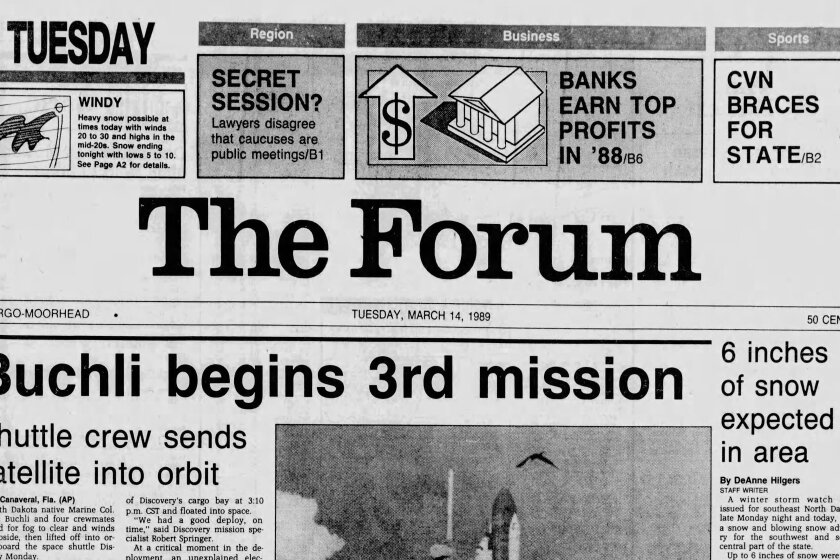
On March 6, 1989, Marine Colonel James Buchli and his four crewmates successfully launched aboard the Space Shuttle Discovery from Cape Canaveral, Florida. The mission aimed to deploy a $100 million communications satellite into orbit, marking a significant milestone for NASA as it embarked on an ambitious schedule of seven shuttle launches that year.
The launch, initially delayed for nearly a month due to mechanical issues, took place at 8:57 a.m. CST. Just over eight minutes later, Discovery achieved orbit at an altitude of 180 miles above Earth. The primary objective of the mission was accomplished at 3:10 p.m. CST, when the Tracking and Data Relay Satellite (TDRS), weighing 2.5 tons, was successfully deployed from Discovery’s cargo bay.
Mission Overview and Challenges
The deployment of TDRS completed a crucial part of a global communications network, enabling future space missions to maintain constant contact with Mission Control. Despite a momentary glitch caused by an unexplained electronic signal during the satellite’s deployment, the satellite was soon confirmed to be functioning normally. After the successful release, TDRS’s first-stage rocket fired, propelling it toward its designated orbit 22,300 miles over the Atlantic Ocean.
According to launch director Bob Sieck, the lift-off was a crucial beginning to an intensive launch season. The launch was delayed by dense fog and high-altitude winds, which posed risks of damaging shear forces. To address this, engineers quickly reprogrammed a computer on board Discovery, allowing for a successful ascent once the countdown resumed.
Scientific Experiments Aboard Discovery
The five-day mission included an array of scientific experiments. Among them were studies on bone healing in microgravity, utilizing four rats as test subjects. The rats had small pieces of their bones clipped before the mission, allowing scientists to compare their healing process in space with that of similar rats on Earth. In addition, 32 fertilized chicken eggs were also part of the mission, allowing for comparisons of growth rates between eggs in space and those left on the ground.
The flight commander, Michael Coats, led a diverse crew that included Air Force Colonel John Blaha, Mission Specialist Robert Springer, and physician Dr. James Bagian. The crew shared their cabin with the rats, chicken eggs, and a small garden of plants, further contributing to the scientific objectives of the mission.
Following the successful deployment of TDRS, the mission continued to progress smoothly. NASA confirmed that the two reusable solid rocket boosters, which propelled Discovery into orbit, were in good condition after splashing down in the Atlantic Ocean approximately 160 miles offshore. Recovery ships reached the boosters about 45 minutes later, commencing the retrieval process.
As the mission unfolds, the successful launch and deployment mark a pivotal moment for both NASA and the future of space communications. The accomplishments of James Buchli and his team illustrate the ongoing dedication to advancing human exploration beyond our planet.
















