





































The release of the Sony a7 V has garnered significant attention in the photography community, particularly for its advanced features aimed at both amateur and professional photographers. This new model showcases a 33 MP partially stacked sensor that offers an impressive 16 stops of dynamic range. After a week of testing the camera during a family trip to Aruba and various portrait sessions, I am sharing my insights to help potential buyers determine if this camera meets their needs.
The primary focus of my tests was on the camera’s silent shutter capabilities. The a7 V introduces a newly designed partially stacked sensor, a significant upgrade over older traditional sensors that often struggle with readout speeds. This slow readout can lead to the “jello effect,” where straight lines appear distorted when capturing moving subjects. Previous solutions included the introduction of stacked sensors and global shutters, which, while effective, come with higher price tags. The partially stacked design of the a7 V attempts to balance speed and affordability, delivering quicker readout speeds than traditional sensors, albeit not as fast as fully stacked sensors or global shutters.
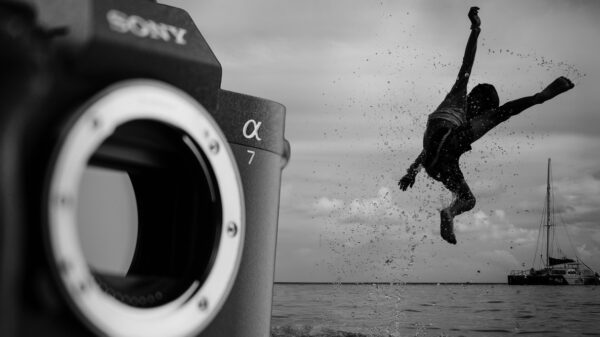
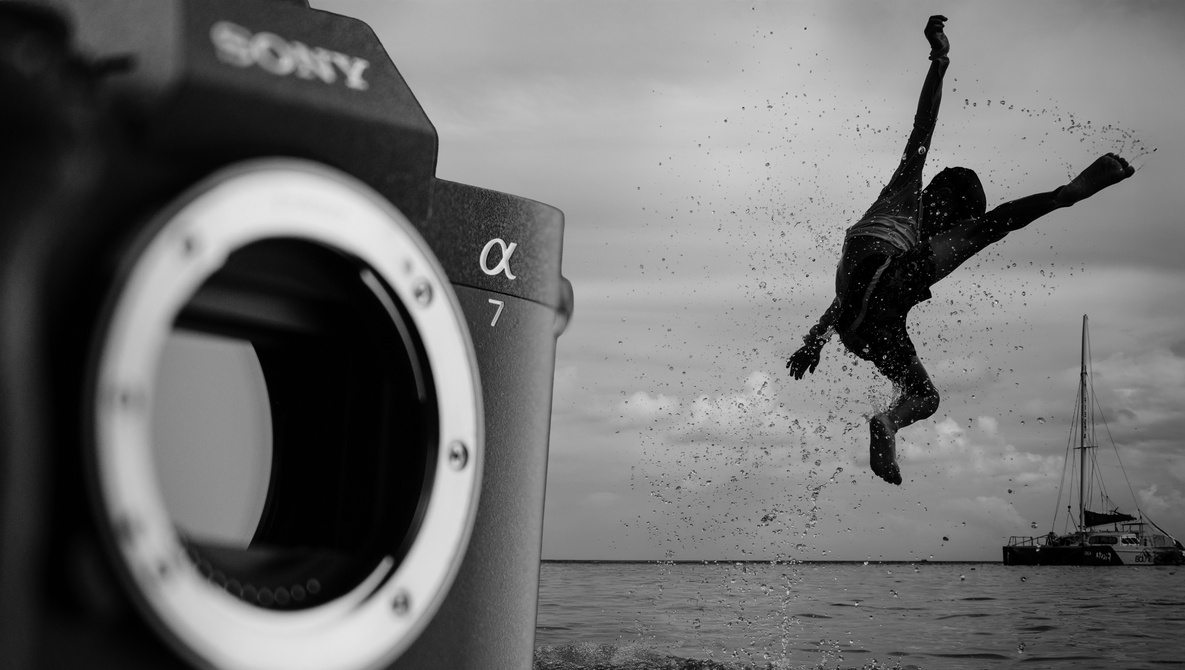
To evaluate its performance, I photographed my children in motion, capturing around 6,000 images over the week. One notable test involved my son swinging a rake; the image showed no distortion, maintaining a straight appearance despite some motion blur from a 1/250th shutter speed. In another instance, I had my daughter swing a plastic sword, where minor jello distortion became evident, though it remained largely inconsequential. Overall, the camera performed exceptionally well, even capturing images of my nephew sprinting into the ocean with clarity.
On the trip, I exclusively used the silent shutter mode. Notably, as the camera is new, there was no raw support available in Lightroom, which meant all images were JPEGs utilizing one of the latest Sony film simulations called “film2.” Despite the limitations of using JPEGs, the a7 V proved capable of handling fast-paced action without major issues.
The camera’s sensor design allows for high-speed shooting at 30 frames per second. While this figure may seem less than the Canon R3‘s 40 frames per second, the a7 V offers a significant advantage by shooting in 14-bit raw files without blackout, compared to the R3’s limit of 12-bit at maximum speed. Personally, I find the higher bit depth more beneficial than the additional frames per second, although preferences may vary among users.
The a7 V also includes innovative features like pre-capture and boost mode. With pre-capture activated, the camera continuously buffers images, saving those captured prior to pressing the shutter button. Users can adjust the pre-capture duration from 0.03 seconds to a full second. I preferred a setting between 0.2 and 0.3 seconds to avoid excessive image capture. The boost button allows for a temporary increase in frame rate, letting users shoot at a more manageable 10 fps until higher speed is required.
While the camera’s functionality is impressive, the body design left some room for improvement. I found the lack of a C5 button on the front, similar to the a9 III, somewhat disappointing. Nevertheless, the a7 V features an exceptional flipping and tilting screen, enhancing usability. Additionally, Sony has improved custom button functionality, allowing users to cycle through shutter type options without navigating a menu, though I wish this feature was extended to other customizations.
The a7 V employs a new Bionz XR2 processor with built-in AI, enhancing autofocus accuracy, color fidelity, and battery longevity. Users can expect around 630 images per charge with the electronic viewfinder and 750 images using the rear screen. Throughout my testing, I consistently maintained over 20 percent battery life, even on demanding days.
One functional drawback is the camera’s screen blackout feature, designed to conserve battery by turning off the screen while the camera remains on. However, the electronic viewfinder (EVF) sensor triggers activity status, preventing the screen from shutting off when the camera is worn on a strap. A more effective design would allow the screen to turn off even when the EVF is active.
Though primarily a stills camera, the a7 V performs well in video mode, offering 7K oversampled 4K60 video with full pixel readout and the option for 4K120 in a Super 35 crop. Despite my focus on photography, the video capabilities are noteworthy, demonstrating the camera’s versatility.
The a7 V features a single combo slot alongside a second slot limited to SD cards, which raises questions about Sony’s decision to omit a second combo slot. This choice appears to be a cost-saving measure, though the benefits of such a slot would have been significant. On a positive note, the camera now includes a second USB-C port, facilitating tethered shooting without requiring dummy batteries.
In conclusion, the Sony a7 V emerges as an excellent choice for wedding and general photography, offering enhanced features compared to its predecessors at a competitive price. While it may not match the extreme speeds of the a9 III, it excels in dynamic range, resolution, and overall usability. For those prioritizing quality over sheer speed, the a7 V stands out as a versatile option for various photographic needs.
Jason Vinson, a wedding and portrait photographer based in Bentonville, Arkansas, is recognized as one of the Top 100 Wedding Photographers in the World and has a passion for educating others in the craft.