










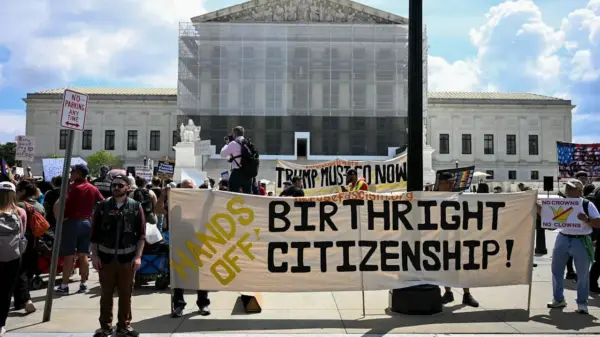



























The ongoing debate over immigration policies has reached a new intensity, with contrasting views emerging between advocates of open borders and those who support stricter enforcement measures. Michael Barone, a prominent political analyst, argues that equating the enforcement of immigration laws with the moral atrocities of the Holocaust is misguided and oversimplified.
In recent years, particularly after the election of former President Donald Trump, the landscape of immigration policy has shifted significantly. While previous administrations, including those of Bill Clinton and Barack Obama, expressed a desire to enforce immigration laws, the current dialogue often portrays strict enforcement as morally reprehensible. Barone points out that the influx of undocumented immigrants peaked at approximately 12 million in 2007, and by 2019, this figure had decreased to around 10.5 million. However, he notes an increase of roughly 4 million during the Biden administration, which he claims adopted more lenient policies towards undocumented migrants.
Barone highlights a broader cultural context influencing immigration discussions in both the United States and Europe. He identifies a growing belief that restricting entry to individuals who differ in ancestry or customs from existing populations constitutes discriminatory practices. This sentiment is often voiced in the context of immigration from regions such as Africa, the Middle East, and South Asia, with many critics arguing that these immigrants may bring attitudes that clash with established societal norms.
The situation in Europe is particularly complex. Barone references the ongoing challenges faced by nations such as Britain and Germany, where political parties advocating for stricter immigration controls are often marginalized. For instance, the Reform party in the UK and Marine Le Pen’s Rassemblement National in France have gained traction, yet face significant resistance from mainstream parties. In Germany, the Alternative für Deutschland (AfD) is similarly treated with disdain despite its rising popularity.
The analyst further critiques the notion that restricting immigration policies equates to the ideologies of historical oppressors. He argues that excluding individuals based on cultural differences is not comparable to the systemic extermination of minorities, such as the Holocaust. Barone asserts that framing immigration policy discussions in such stark moral terms reflects a misunderstanding of both history and current realities.
Barone also addresses the implications of current immigration policies on social dynamics. He points out that, while many immigrants successfully assimilate into their new environments, there are instances where cultural conflicts arise. This is exemplified by issues related to the so-called “grooming gangs” in the UK, where long-settled immigrant communities have been implicated in serious crimes against local populations. Such cases often highlight the complexities of integration and the potential for societal tensions.
In conclusion, Barone calls for a more nuanced understanding of immigration that considers both the ethical dimensions of open borders and the practical realities of enforcing immigration laws. He suggests that many ordinary citizens in the U.S. and Europe maintain a common-sense perspective that contrasts sharply with elite views, and he expresses hope that this might influence future policy discussions.
As the debate continues, the implications of immigration policies on economic, social, and cultural landscapes remain a focal point for policymakers and citizens alike.