









































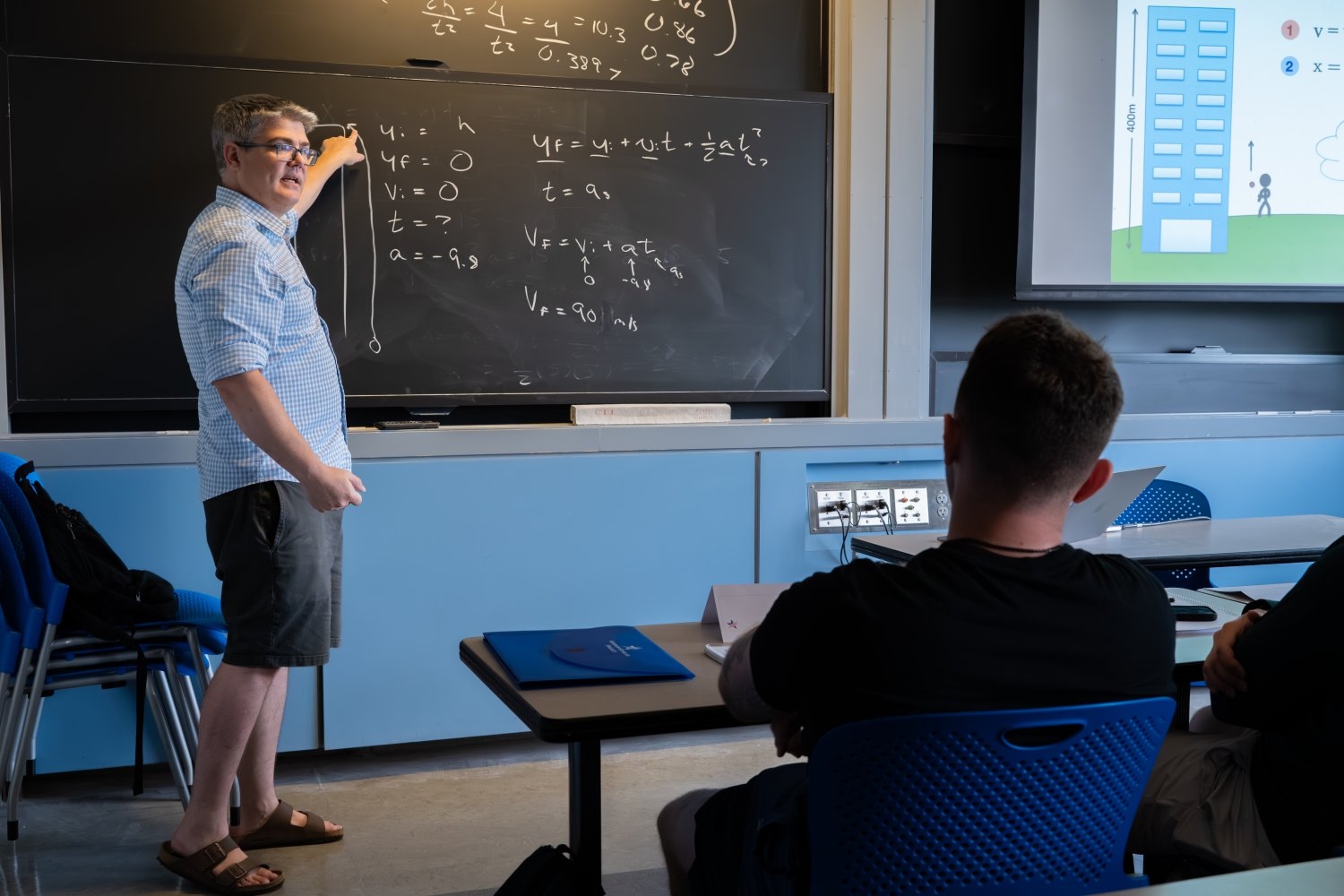
The Warrior-Scholar Project (WSP) at the Massachusetts Institute of Technology (MIT) is making significant strides in helping enlisted veterans transition to higher education. The program has gained attention for its intense academic boot camp, which prepares veterans like Justin Cole for college life and rigorous STEM education. Cole, an Air Force veteran, was inspired to pursue higher education after witnessing the impact of climate change during his nine years of service, including responding to the devastating 2013 Black Forest fire in Colorado and navigating two Category 5 typhoons in Okinawa in 2018.
After leaving the military, Cole engaged with climate-focused nonprofits and enrolled in engineering courses. In 2023, he attended a weeklong STEM boot camp hosted by the WSP at MIT. “It definitely reaffirmed that I wanted to continue down the path of at least getting a bachelor’s,” Cole reflects, having transferred to MIT in 2024 to major in climate system science and engineering.
Creating Opportunities for Veterans
The Warrior-Scholar Project was founded at Yale University in 2012 and has expanded to 19 universities across the United States, offering programming focused on business, college readiness, and STEM subjects. MIT joined the initiative in 2017, becoming one of the first institutions to offer the STEM boot camp. The program is designed to simulate the undergraduate experience, providing participants with a rigorous academic schedule that runs from 08:45 to 22:00 throughout the week.
Cole describes the experience as akin to a typical MIT semester, filled with problem sets, faculty lectures, and hands-on research projects. “It was definitely rigorous,” he recalls, highlighting the collaborative environment among participants.
The program is led by Michael McDonald, an associate professor of physics at the Kavli Institute for Astrophysics and Space Research, and Nelson Olivier, an MBA graduate from MIT and a Navy veteran. Since its inception, MIT-WSP has successfully supported over 120 scholars, with an exceptional 93 percent of participants going on to attend prestigious institutions such as Stanford University, Harvard University, and the University of California at Berkeley.
Building Confidence Through Shared Experience
A unique aspect of the WSP is its emphasis on peer mentorship. Each boot camp is staffed by alumni who serve as fellows, providing support and sharing their experiences in higher education. Cole, who became a fellow after his boot camp experience, noted the powerful impact of meeting successful veterans. “Just seeing people existing at these institutions made me realize, this is a thing that is doable,” he explains.
Participants often experience a transformation during the weeklong program. McDonald notes that while scholars arrive eager, they can feel overwhelmed by mid-week. “By the end of the week, they’re like, ‘I could do another week,’” he observes, as their confidence builds through recognizing the value of their military experience in an academic setting.
The program also allows veterans to connect with current MIT students, like Andrea Henshall, a retired Air Force major and PhD candidate in Aeronautics and Astronautics. Henshall actively participates in the program by offering mentorship and sharing her journey, which inspires new scholars to envision themselves in rigorous academic environments.
At the end of the boot camp, participants receive a challenge coin designed by Olivier and McDonald, featuring Newton’s laws of motion and the WSP logo. “It symbolizes the ethos of the unit,” Olivier explains, emphasizing the program’s goal of encouraging scholars to make a significant impact.
As Aaron Kahler, a former Marine Corps communications operator and current MIT first-year student, reflects, “I don’t think I would be here if it weren’t for the Warrior-Scholar Project.” The initiative not only prepares veterans for academic challenges but also fosters a community that empowers them to pursue their goals with confidence and determination.
















