









































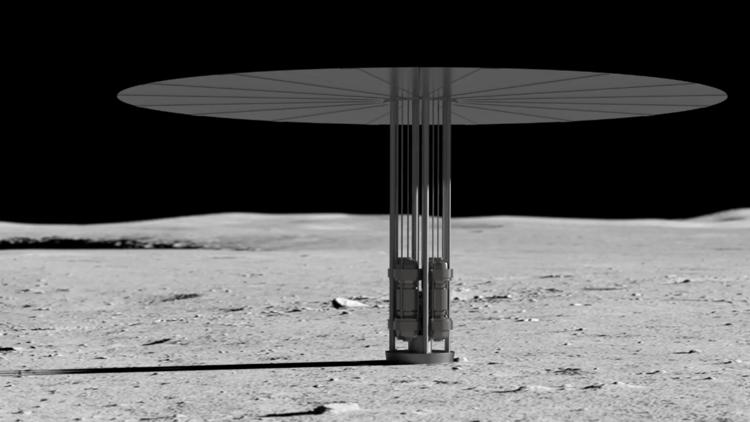
The United States is set to construct and deploy nuclear reactors on the moon within the next four years, as confirmed by a recent announcement from NASA and the U.S. Department of Energy. Officials from both agencies signed a renewed agreement aimed at facilitating the development of these power systems, which will support NASA’s ongoing lunar research and future missions to Mars.
This initiative represents a significant step in utilizing nuclear power for space exploration. According to NASA Administrator Jared Isaacman, “Achieving this future requires harnessing nuclear power.” He emphasized that this agreement fosters closer collaboration between NASA and the Department of Energy to provide the necessary capabilities for what he described as the “Golden Age of space exploration and discovery.”
Details of the Nuclear Reactors
The lunar reactors will be based on nuclear fission surface power systems. These systems are designed to employ a uranium reactor core roughly the size of a paper towel roll, which is expected to generate enough energy to sustain several average households continuously for a minimum of ten years. This design was previously demonstrated in 2018, highlighting its potential effectiveness for lunar conditions.
The choice of a nuclear system is particularly advantageous for the moon, where solar power faces significant limitations due to extended lunar nights, which last approximately 14 Earth days. NASA had previously concluded the initial phase of the Fission Surface Power Project in 2024, focusing on developing preliminary designs for this technology. The agency aims to have a reactor ready for deployment by the early 2030s.
Impact on Earth’s Energy Landscape
While the U.S. advances its space energy capabilities, the nation’s power grid is grappling with potential shortages. The emergence of hyperscale data centers for artificial intelligence is straining electricity supplies. The largest power grid operator in the country, PJM Interconnection, which serves approximately 67 million people across 13 states, has warned of possible power shortages as early as 2027 if supply levels are not significantly increased.
This situation marks a historical first, as operators have struggled to secure sufficient energy to meet expected demands. The Midcontinent Independent System Operator, covering 15 states and serving 45 million residents, is also facing alarms regarding energy shortfalls, with predictions indicating that shortages might commence around 2031.
In a stark example of the rising costs associated with energy acquisition, Ameren, the primary utility provider for much of Illinois and Missouri, reported a dramatic increase in electricity prices. The cost of purchasing electricity from the Midcontinent Independent System Operator surged from approximately $30 per megawatt day in 2024 to an alarming $666.50 in 2025.
As the U.S. forges ahead with its plans for lunar nuclear reactors, the dual challenges of energy supply in space and on Earth reveal the intricate balancing act facing energy policy and technological advancement in an increasingly data-driven world.
















