






































When researcher [xoreaxeax] introduced a lens-less optical microscope capable of deducing the structure of samples through diffraction patterns, he revealed a fascinating connection between light and mathematics. By shining a laser beam through samples, he showcased how the resulting diffraction pattern represents a frequency decomposition of the specimen’s features, effectively acting as a Fourier transform. Now, he has returned with a detailed explanation of the underlying principles governing this phenomenon.
The foundation of his analysis begins with the premise that light behaves as a wave, which can be accurately described by a sinusoidal function. To simplify the complex mathematics involved, the formula for a sine wave was transformed into an exponential form of a complex number. This approach aligns with the Huygens principle, which posits that when light emerges from a point within a sample, it disperses in spherical waves. Consequently, the wave observed at any specific point can be calculated as a function of distance.
Utilizing the principle of superposition, where the amplitude at any given point is the sum of the amplitudes of overlapping waves, [xoreaxeax] extended this concept to account for all light sources emanating from the sample. This resulted in an infinite integral that ultimately simplified to a specific form of the Fourier transform.
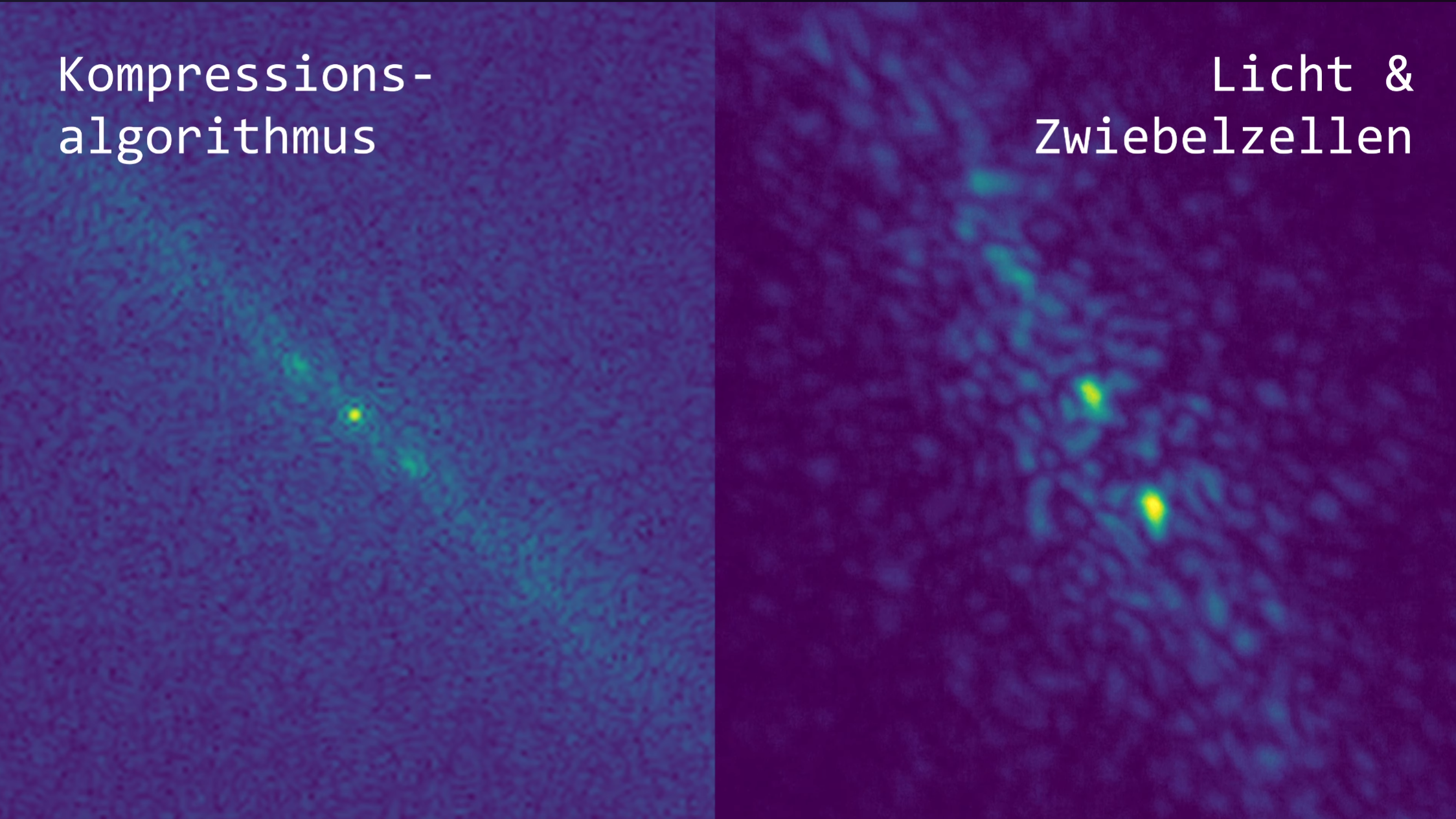
One intriguing outcome of this relationship is the connection to JPEG image compression. JPEG technology calculates the Fourier transform of an image and encodes it as a series of sine-wave striped patterns. By arranging tiles of these striped patterns based on their frequency and orientation, and shading each tile according to its contribution to the overall image, a speckle pattern emerges that closely resembles the diffraction pattern created when a laser is directed through onion cells.
For those interested in the original experiment that produced these remarkable patterns, [xoreaxeax] previously showcased his innovative ptychographical microscope. This technique not only highlights the interplay between light and mathematics but also demonstrates practical applications of diffraction in modern imaging technologies.
As research continues to explore the relationship between physical structures and Fourier transforms, the implications for fields such as imaging, optics, and signal processing remain vast and promising. The ongoing work of scientists like [xoreaxeax] illustrates the seamless integration of theoretical physics with practical applications, paving the way for advancements that could reshape our understanding of light and its interactions with matter.