


































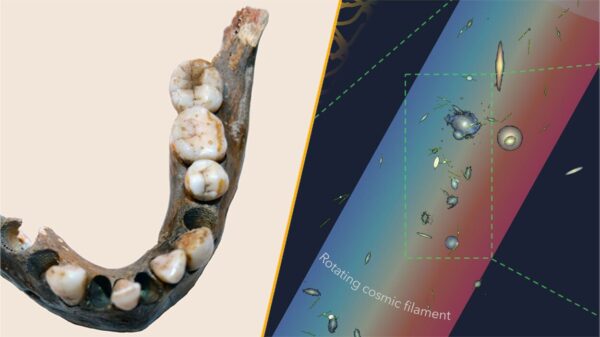
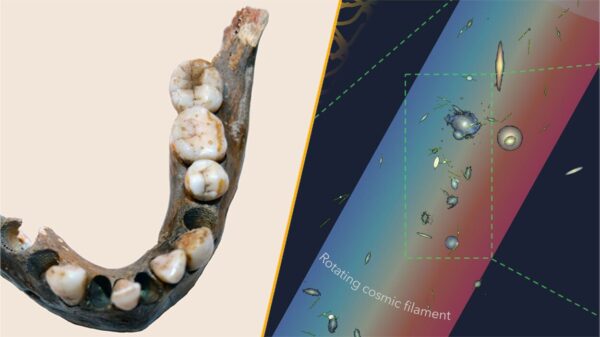




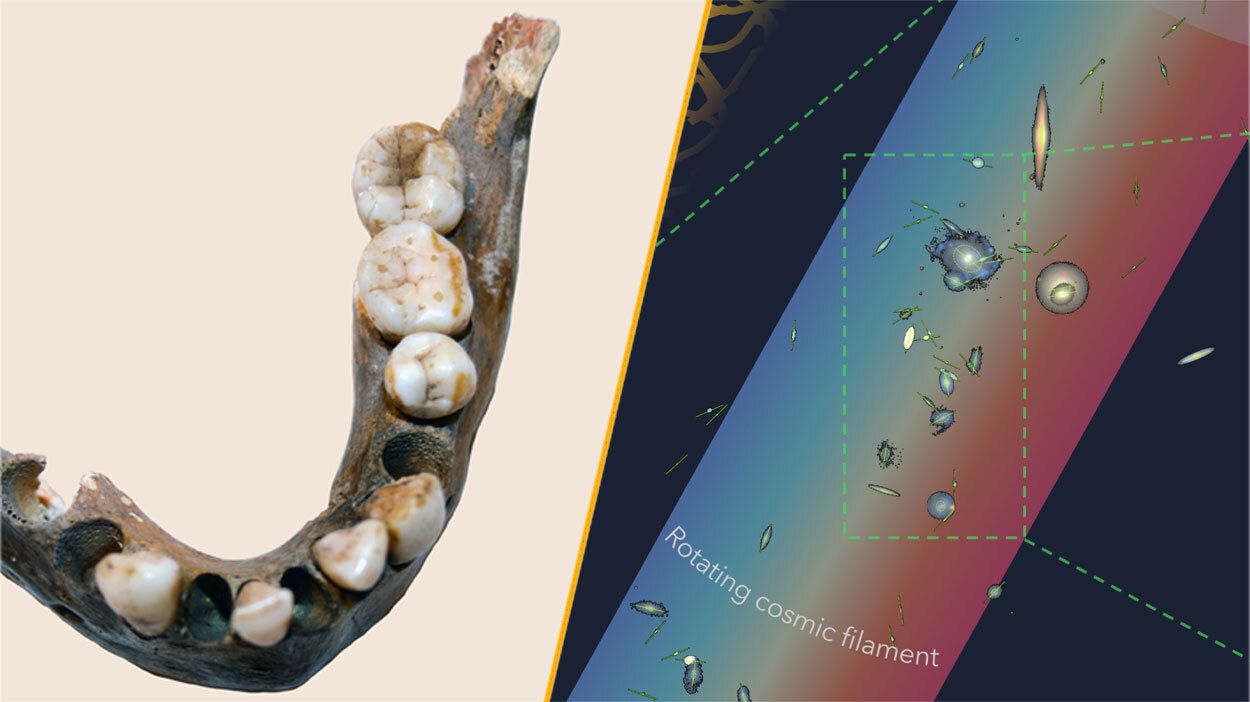
This week in science brought forth significant discoveries that span both our planet and the cosmos. Researchers unveiled a cosmic marvel located approximately 140 million light-years away, identifying the largest spinning object in the universe. Meanwhile, closer to home, a study revealed a genetically isolated human population in southern Africa that thrived for 100,000 years before disappearing from the genetic landscape.
Scientists discovered the colossal rotating filament, which is wider than the Milky Way, is connected to a chain of 14 galaxies. This remarkable filament spins at an astonishing speed of around 68 miles per second (110 kilometers per second). Its discovery was made possible through advanced observational techniques that tracked the relationships between these galaxies.
In southern Africa, researchers examined human skeletons dating back as far as 10,000 years, unearthed south of the Limpopo River. These ancient remains exhibited a genetic structure vastly different from that of modern humans. The findings indicated that these individuals represent “an extreme end of human genetic variation,” as noted by the study’s authors. This discovery not only adds to our understanding of human evolution but also highlights the complexities of genetic diversity across regions.
Archaeological Discoveries and Modern Ecosystem Challenges
In a striking archaeological find, a massive pit filled with skulls was uncovered near a 4,000-year-old city in China. The majority of the remains belonged to males, which diverges sharply from the established patterns of human sacrifice observed in nearby settlements. This anomaly presents new questions about social structures and ritual practices during that era.
Archaeologists also expressed confusion over an elaborate tomb found in Greece, which contained the remains of a woman adorned with an upside-down crown, a detail that has yet to be fully understood.
Meanwhile, a long-term ecological project in China, aimed at mitigating desertification through the Great Green Wall initiative, has led to unforeseen consequences. Although the project has successfully increased tree cover, it has also altered rainfall and evaporation patterns, resulting in diminished water levels in some of the nation’s most densely populated areas.
In another unsettling revelation, recent research suggests that the world record for the highest temperature, set in Death Valley in 1913, may have been influenced by human error. This finding adds to ongoing discussions about climate accuracy and historical data integrity.
Interstellar Discoveries and Innovative Technologies
The scientific community is also captivated by the interstellar comet 3I/ATLAS, which has been observed exhibiting what appear to be “ice volcanoes.” Recent images captured by the Joan Oró Telescope at the Montsec Observatory in northeastern Spain show spiral jets emanating from the comet’s surface. These observations suggest that the comet heats up rapidly as it approaches the sun, leading to the sublimation of ice—a phenomenon that aligns it with other similar celestial bodies within our solar system.
In a groundbreaking technological advancement, researchers at MIT have developed a method to extract drinking water from the air using ultrasound. This innovative technique allows for the extraction of water in just minutes, significantly improving efficiency compared to older systems that rely on evaporation. The new system is reported to be 45 times more efficient than traditional methods, although it does require a power source. Researchers are optimistic about pairing it with solar technology to enhance its effectiveness in arid regions.
As the week unfolds, the scientific community continues to explore these remarkable findings, each contributing to a greater understanding of both our planet and the universe beyond.