



































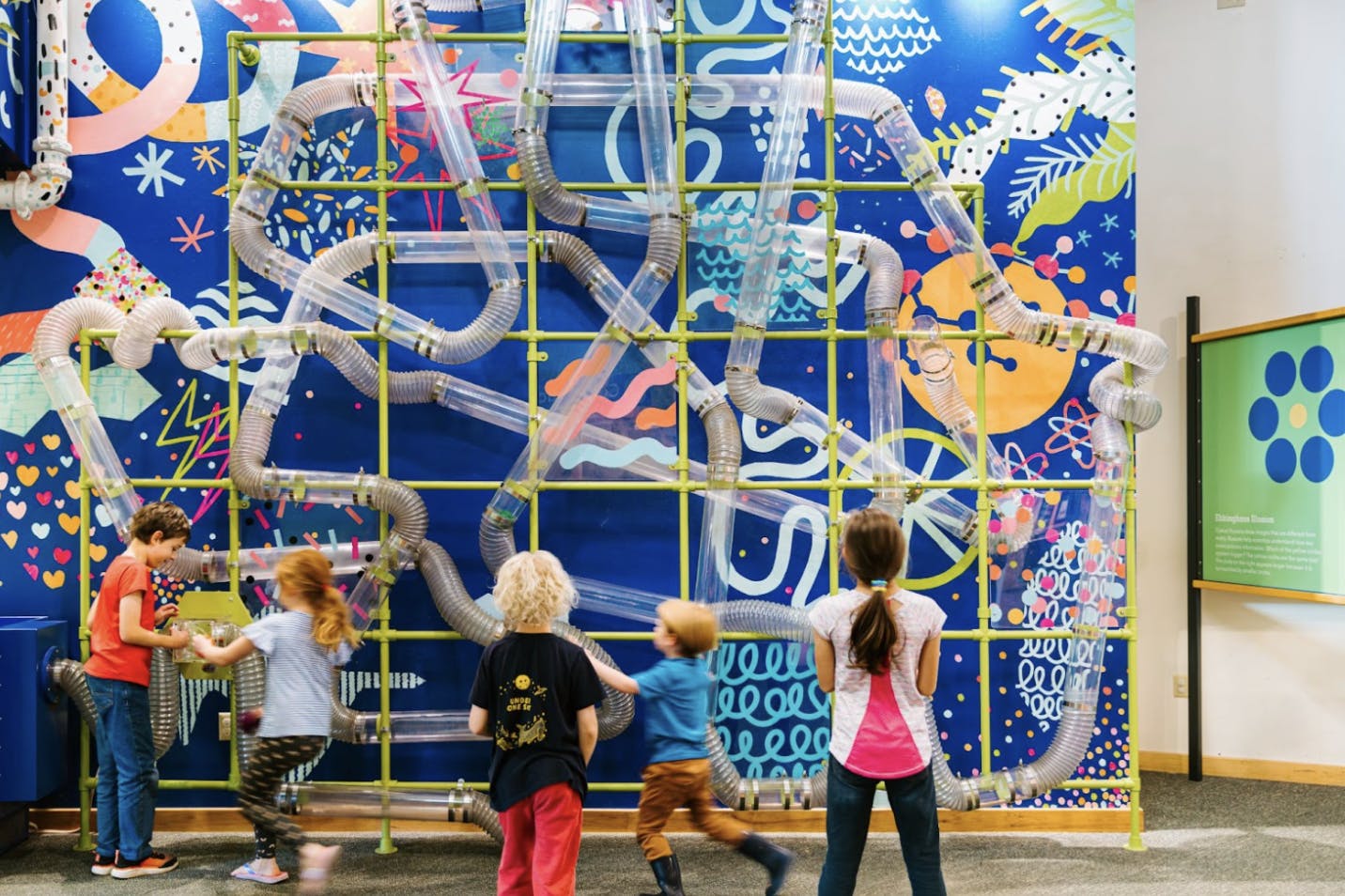



The Sciencenter, located in Ithaca, New York, marks its 30-year journey dedicated to fostering curiosity through hands-on learning experiences. Unlike typical modern attractions, the Sciencenter’s atmosphere is alive with the sounds of children engaging with interactive exhibits, rather than the silence of passive observation. Visitors are encouraged to explore, touching everything from rubber ducks to the delicate scales of a rainbow boa, making for memorable educational moments.
Sierra Coathup, the Sciencenter’s volunteer program manager, recently witnessed a touching exchange in the Saltonstall Animal Room, home to various amphibians, reptiles, and fish. A child excitedly exclaimed to their parents, “See, I told you it was real!” upon spotting an axolotl. Coathup noted the joy in watching the child take on the role of teacher, underscoring the Sciencenter’s mission to cultivate “an engaged community of curious, collaborative, critical thinkers,” as stated on its website.
The importance of environments that stimulate curiosity cannot be overstated. According to Professor Chris Schaffer from Cornell University’s biomedical engineering department, science education typically shifts from exploration to rote memorization as students progress through formal schooling. “Until the end of middle school, science is, on average, everybody’s favorite subject,” Schaffer explained. He emphasized the need for interactive learning spaces that sustain curiosity through active exploration.
Research supports Schaffer’s observations. A comprehensive 33-year study tracking a national sample of Generation X individuals found that early life experiences, particularly hands-on science activities, significantly shape lifelong interests and engagement in science.
Creating these enriching experiences at the Sciencenter involves a meticulous process. The institution does not simply place colorful exhibits on display; it “engineers” curiosity through extensive audience research, prototyping, and testing. Each exhibit typically undergoes a rigorous five-year cycle of evaluation and refinement before its launch.
One notable project is Bridges to Bioengineering, a collaborative effort involving faculty and students from Cornell’s Meinig School of Biomedical Engineering. This bilingual traveling exhibition, available in both Spanish and English, aims to bridge the gap between complex biomedical engineering concepts and public understanding. Now in its third year, it spans 1,500 square feet and serves as a testament to the Sciencenter’s commitment to community engagement.
The project began with “front-end evaluation,” as described by Adrienne Testa, the director of exhibitions. In this phase, the team gathers insights through interviews with professionals, students, and parents in middle schools throughout Tompkins County and Groton, New York. This groundwork informs the direction of the exhibition.
By the second year, the team enters the “proof of concept” phase, where they prototype their ideas and assess whether the exhibit captures attention and communicates its scientific message effectively. Currently, they are in a workshop in the Sciencenter’s basement, dynamically adjusting the exhibition based on findings from public testing. Schaffer noted that they monitor how children interact with the exhibits, collecting feedback on their experiences and knowledge retention.
“Did they seem to have fun? And after, what knowledge did they take away?” Schaffer asked, highlighting the iterative design process. The ultimate goal is to create an engaging experience that encourages visitors to not only observe science but to actively participate in it, promoting inquiry and enjoyment.
The Sciencenter’s influence extends beyond its Ithaca location. In 2025 alone, the institution’s 11 completed traveling exhibitions reached 14 states and two Canadian provinces, captivating hundreds of thousands of visitors. Plans are already underway for an exhibition to travel to a children’s science museum in Chengdu, China, further expanding its reach across cultural and geographic boundaries.
At the Sciencenter, curiosity is not viewed as something that diminishes with age, but as a vital trait worth nurturing. Through the dedicated efforts of staff, researchers, and countless volunteers, the Sciencenter ensures that discovery remains tangible, interactive, and enjoyable. The culmination of this work is often found in simple moments, such as a child confidently exclaiming in front of an aquarium, “See? I told you it was real!”
















