









































Researchers at the Chinese Academy of Sciences have revealed that humic substances, formed from crop residues, significantly influence soil microbial metabolism and contribute to the accumulation of antibiotic resistance genes (ARGs). This study, published on 5 December 2025 in the journal Agricultural Ecology and Environment, highlights a crucial ecological trade-off between enhancing soil fertility and the risk of increasing antibiotic resistance in agricultural settings.
Understanding Humification and Its Impact
Every year, billions of tons of lignocellulosic biomass from crop residues are added to soils globally. This organic matter undergoes decomposition and humification, a process that is vital for maintaining soil health, carbon sequestration, and microbial balance. The *molecular composition* of organic matter plays a pivotal role in determining how microbes access carbon and energy. It also affects the interactions between viruses and their hosts, as well as the spread of resistance traits within soil ecosystems.
Previous research has indicated that organic inputs can alter microbial stress responses and influence antibiotic resistance. However, the specific effects of lignocellulose-derived humic substances, particularly those containing phenolic compounds from lignin, have not been thoroughly understood until now.
Key Findings from the Study
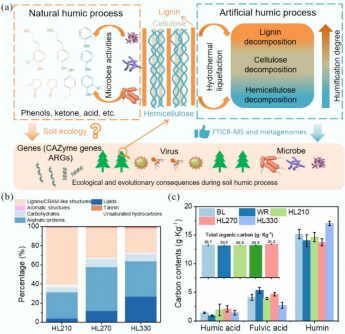
The research team, led by Xiangdong Zhu, simulated the natural humification process by applying controlled thermal treatments to rice straw at temperatures of 210, 270, and 330 °C. These temperatures correspond to the decomposition stages of hemicellulose, cellulose, and lignin, resulting in the formation of three distinct humic substances: HL210, HL270, and HL330. These substances were chemically analyzed and added to paddy soils in equal concentrations to evaluate their effects on soil microbial communities.
Results showed that increasing temperatures not only transformed lignin into lipids and aliphatic compounds but also led to higher concentrations of phenolic compounds. This transformation altered microbial carbon metabolism significantly. The study found that carbohydrate-active enzymes (CAZymes), particularly glycoside hydrolases, were predominantly represented, comprising 97.8% of total CAZymes. The relative abundance of glycoside hydrolases increased from approximately 61% in HL210 to 84% in HL330, indicating an enhanced microbial capability to degrade a variety of carbohydrates.
Moreover, the research highlighted that ARGs increased stepwise with the degree of humification, rising up to 4.6-fold in HL330-treated soils. These enriched ARGs were primarily linked to antibiotic efflux, target protection, and inactivation, predominantly contributed by microbial groups such as Proteobacteria, Acidobacteria, Firmicutes, and Chloroflexi.
The findings emphasize that while humification enhances soil carbon storage and fertility, it may also create conditions conducive to the spread of antibiotic resistance. This revelation underscores the critical need for balanced strategies in crop residue management that maximize ecological benefits while minimizing risks associated with antibiotic resistance.
The work was supported by the National Natural Science Foundation of China (Grant No. 22276040), demonstrating the ongoing commitment to understanding the complex interactions between agricultural practices and ecological systems.
As researchers continue to explore the implications of these findings, it becomes increasingly clear that sustainable practices in agriculture must consider both soil health and the potential for unintended ecological consequences related to antibiotic resistance.
















