









































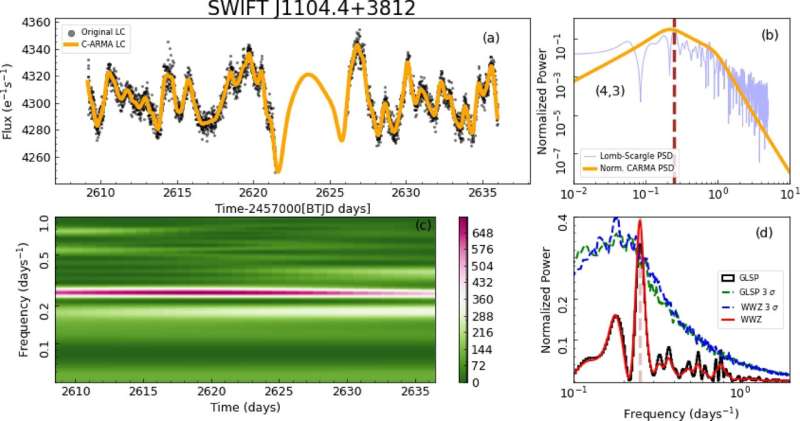
Astronomers have identified significant quasi-periodic oscillations (QPOs) in several blazars, a type of active galactic nucleus. This discovery, led by Ashutosh Tripathi from the Xinjiang Astronomical Observatory at the Chinese Academy of Sciences, highlights the potential for these phenomena to enhance our understanding of the universe.
The study, published on December 12, 2025, in the Monthly Notices of the Royal Astronomical Society, utilized data from NASA’s Transiting Exoplanet Survey Satellite (TESS) and a comprehensive 157-month hard X-ray survey conducted by the Swift’s Burst Alert Telescope (BAT). Researchers discovered that out of 38 variable objects analyzed, four exhibited periodic signals with high statistical significance.
These QPOs were found to oscillate within a timeframe of five to ten days. Remarkably, one blazar displayed a quasi-periodic signal in observations taken over five years, suggesting a persistent behavior that spans intervals without TESS observations. This finding indicates that the QPOs could last several years, providing an intriguing avenue for further research.
The periodicities observed are attributed to possible instabilities within the jets of these blazars. These jets, composed of charged particles, can evolve over time, leading to the observed oscillations. Tripathi explained, “The periods of these oscillations were found to be in the range of five to ten days for all objects, indicating a significant level of regularity.”
This research underscores the effectiveness of time-series analysis methods in astrophysics, offering new insights into the dynamics of compact systems such as blazars. The findings not only contribute to the ongoing exploration of the universe but also enhance our understanding of the complex mechanisms at play in active galactic nuclei.
The work of Ashutosh Tripathi and his collaborators demonstrates the importance of advanced observational tools and data analysis techniques in uncovering the mysteries of the cosmos. As technology continues to evolve, the potential for further discoveries in this field remains promising.
The full study can be found in the Monthly Notices of the Royal Astronomical Society, under the title “Probable quasi-periodic oscillations in the TESS observations of blazars in the Swift X-ray Survey.” This research stands as a testament to the collaborative efforts within the scientific community in expanding the boundaries of astronomical knowledge.
















