































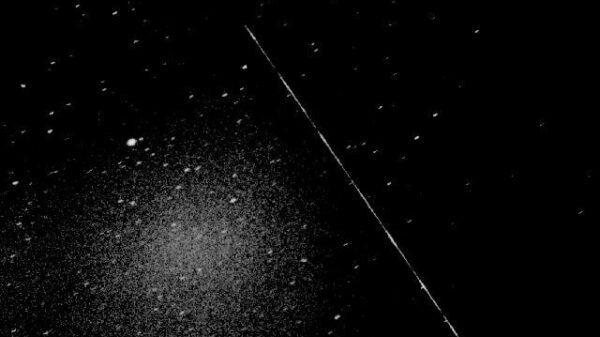





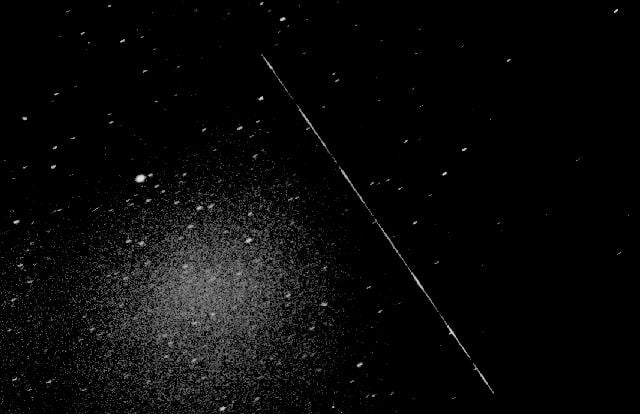
The challenge of tracking and managing space debris has taken a significant step forward with the development of a new algorithm by researchers at GMV, a prominent player in the European orbital tracking market. As the number of large debris pieces in orbit continues to rise, posing threats to functional satellites, understanding their movement becomes crucial to prevent the onset of a catastrophic scenario known as Kessler Syndrome. This phenomenon occurs when the density of objects in low Earth orbit becomes so high that collisions create even more debris, leading to a cascade of further collisions.
To address this pressing issue, GMV’s new algorithm aims to analyze how space debris tumbles and moves before any deorbiting attempts are made. Traditional methods often struggle to provide precise data due to limitations in ground-based telescopes, which typically capture only minimal details of debris. Consequently, researchers have turned to a technique known as a light curve, which charts the brightness of an object over time. This approach is commonly used in astronomy to observe stellar activities or the transits of exoplanets.
Understanding Light Curves and Their Impact
As a piece of debris spins, different surfaces reflect sunlight variably. For instance, solar panels will reflect less light compared to shiny metal surfaces. By analyzing the changes in brightness over time, researchers can infer the object’s rotation speed and direction. The challenge lies in the complexity of the resulting data, which is often affected by minor changes in the debris’s orientation, causing significant variations in the observed light curve.
To tackle these difficulties, the GMV team introduced the AISwarm-UKF algorithm, consisting of a five-step pipeline designed to enhance the accuracy of debris tracking. The process begins with the generation of thousands of potential orientations for the satellite, known as “particles.” Using a method called Bayesian inference, the algorithm narrows down these particles to those that align most closely with the observed light curve.
The second step involves “Systematic Resampling,” which refines the guesses by duplicating high-probability particles while discarding those with lower likelihoods. The third component employs a technique termed Particle Swarm Optimization to guide the particles towards the best potential solution, minimizing errors in the inverse problem.
Refining Solutions Through Advanced Techniques
The challenges of inverse problems often lead algorithms to settle on local minima, which can misrepresent the best solution. To counteract this, the AISwarm-UKF includes steps to ensure that the solution does not become trapped in these misleading dips. Another algorithm, known as Density-Based Spatial Clustering, groups particles that converge around valid answers, addressing the issue of multiple orientations producing similar light curves.
Crucially, the final step applies the Kalman filter using these clusters to estimate the true orientation of the satellite, allowing for a more precise assessment of its movement. To validate the effectiveness of this approach, the researchers conducted an experiment using a simulated satellite and an artificially created light curve from Grail, a simulation tool developed by GMV.
One notable outcome of the study was the advantage of stereoscopic vision, which involves using light curves from two separate ground-based telescopes. This method significantly reduced the ambiguities introduced by the satellite’s symmetry, as the differing geographical locations provided slightly varied light curves, enhancing the algorithm’s accuracy.
The AISwarm-UKF algorithm is expected to be integrated into a software package offered by GMV to clients such as the German Space Situational Awareness Center and the Spanish Space Agency. As space debris becomes an increasingly critical issue affecting the operation of satellites, tools like AISwarm-UKF will prove invaluable in tracking and managing these threats effectively. The development not only represents a technological advancement but also underscores the importance of collaborative efforts in ensuring the sustainability of space operations.