









































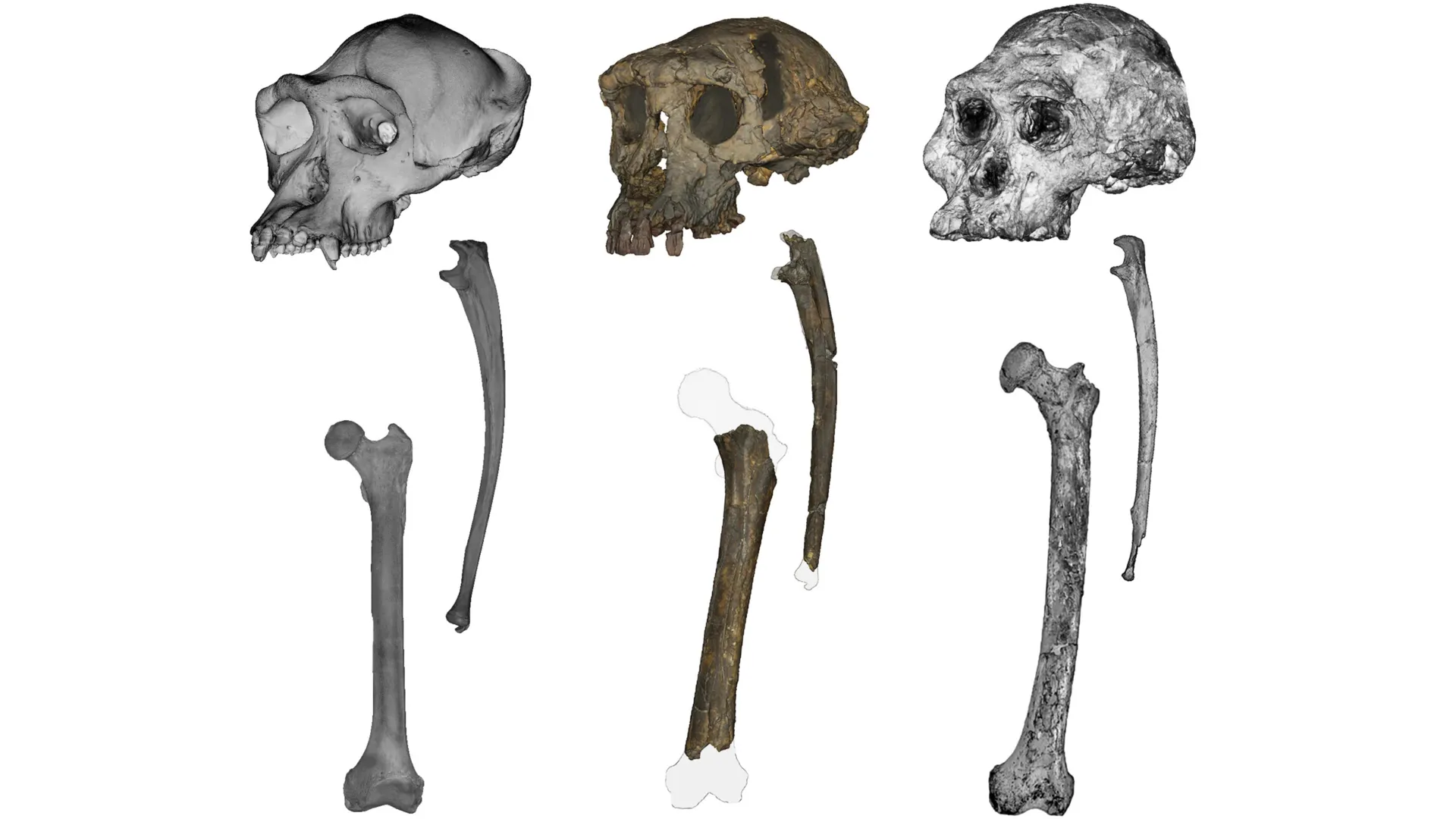
A recent study has discovered compelling evidence suggesting that the ancient fossil known as Sahelanthropus tchadensis, dating back approximately seven million years, was capable of walking upright. This finding, published in the journal Science Advances, positions bipedalism at the very beginning of the human evolutionary timeline, potentially reshaping our understanding of human origins.
The research, led by Scott Williams, an associate professor at New York University, indicates that this species, despite its ape-like features and small brain size, exhibited anatomical traits that support upright walking. The study highlights the discovery of a femoral tubercle, a critical attachment point for the iliofemoral ligament, which plays a significant role in bipedal movement.
Using advanced 3D imaging techniques, the team analyzed the skeletal structure of Sahelanthropus, revealing several key features associated with bipedalism. “Sahelanthropus tchadensis was essentially a bipedal ape that possessed a chimpanzee-sized brain and likely spent a significant portion of its time in trees, foraging and seeking safety,” Williams stated. “Despite its superficial appearance, Sahelanthropus was adapted to using bipedal posture and movement on the ground.”
Reexamining the Fossil Evidence
The origins of this fossil trace back to the Djurab Desert in Chad, where it was first unearthed by paleontologists in the early 2000s. Initially, studies focused primarily on the skull, which provided limited insight into the creature’s locomotion. Over the past two decades, additional bone discoveries, including ulnae and femur samples, have sparked renewed discussions regarding the species’ ability to walk upright.
In the latest study, researchers revisited these bones by comparing them with both modern species and other fossil specimens. This involved two primary methods: examining multiple traits in the bones and employing 3D geometric morphometrics to analyze bone shapes in detail. One of the fossil species used for comparison was Australopithecus, an early human ancestor best known for the famous “Lucy” skeleton, which dates back around four to two million years.
Three Key Features of Bipedalism
The analysis identified three distinct anatomical features in Sahelanthropus that support the idea of upright walking. Notably, femoral antetorsion and the structure of the gluteal complex were confirmed through the study. These findings are significant as they illustrate a clear evolutionary step towards bipedalism.
Additionally, researchers found that Sahelanthropus exhibited a relatively long femur compared to its ulna. This contrasts with apes, which typically have long arms and short legs, while hominins demonstrate the opposite pattern. Although the legs of Sahelanthropus were shorter than those of modern humans, their limb proportions resembled those of Australopithecus, suggesting an evolutionary transition towards upright walking.
“Our analysis of these fossils offers direct evidence that Sahelanthropus tchadensis could walk on two legs, demonstrating that bipedalism evolved early in our lineage from an ancestor closely resembling today’s chimpanzees and bonobos,” Williams concluded.
The collaborative study included contributions from researchers at the University of Washington, Chaffey College, and the University of Chicago. Funding for the research was provided by the National Science Foundation.
As new findings emerge, the ongoing exploration of ancient fossils continues to unveil the complex story of human evolution, challenging long-standing perceptions and offering fresh insights into our ancestral past.
















