









































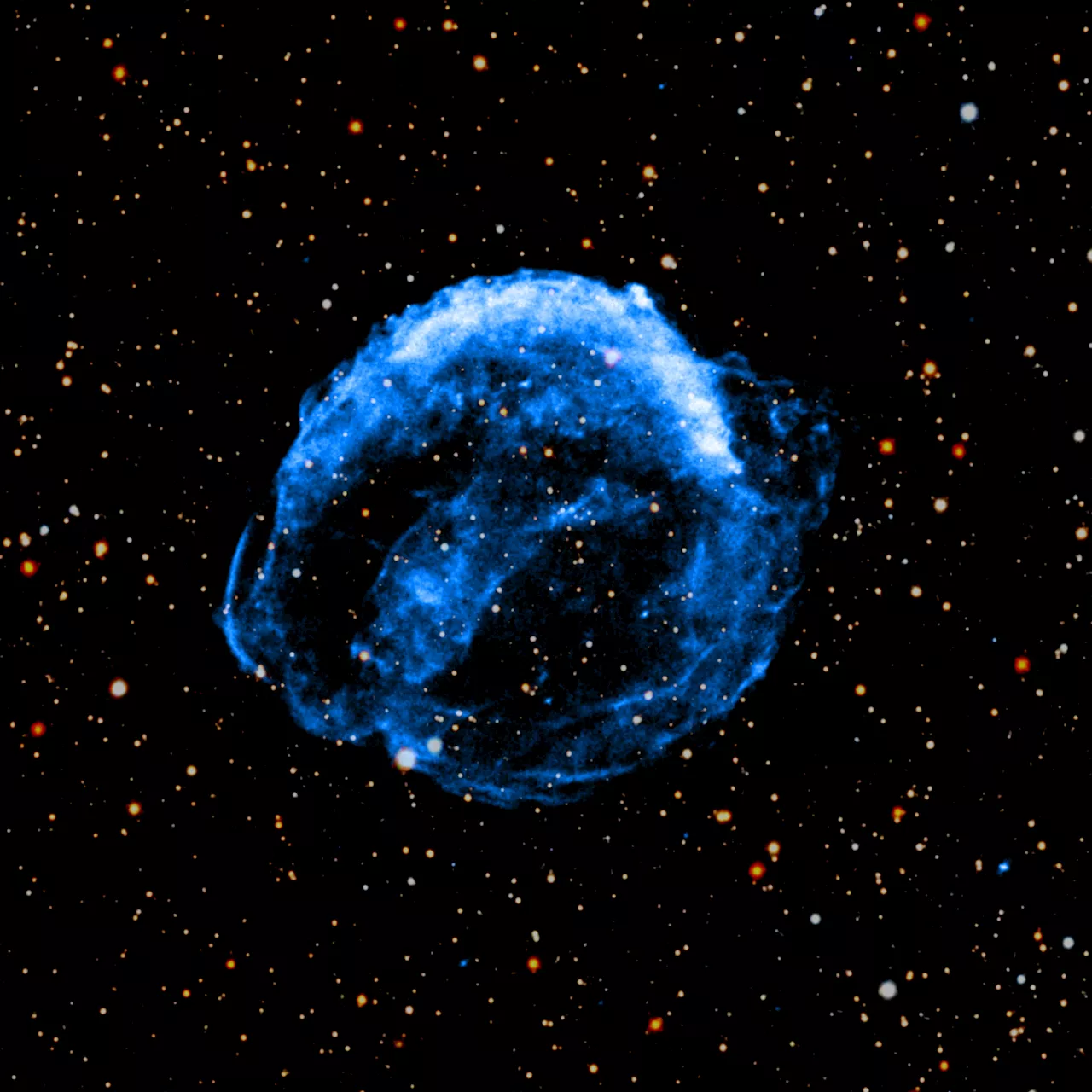
A new video showcasing the evolution of Kepler’s Supernova Remnant has been released by NASA, utilizing data collected over more than two and a half decades. The video, the longest ever produced by the Chandra X-ray Observatory, highlights significant changes in the supernova remnant, capturing observations from the years 2000, 2004, 2006, 2014, and the upcoming 2025.
Kepler’s Supernova Remnant, named after the German astronomer Johannes Kepler, was first observed in the night sky in 1604. It is believed to have originated from a white dwarf star that exploded after exceeding its critical mass, either by drawing material from a companion star or merging with another white dwarf. This event is classified as a Type Ia supernova, a crucial marker used by scientists to measure the expansion of the universe.
The remnant, situated approximately 17,000 light-years from Earth, is characterized by its intense X-ray emissions, a result of the explosion’s debris being heated to millions of degrees. The new video combines X-ray data from Chandra with optical imagery from Pan-STARRS, providing a vivid visual representation of the remnant’s expansion over time.
Research Insights from the Video
The video was presented by Jessye Gassel, a graduate student at George Mason University, during the 247th meeting of the American Astronomical Society in Phoenix. Gassel remarked, “The plot of Kepler’s story is just now beginning to unfold. It’s remarkable that we can watch as these remains from this shattered star crash into material already thrown out into space.”
The research team observed that the fastest components of the remnant are traveling at approximately 13.8 million miles per hour, directed towards the bottom of the visual representation. In contrast, the slower-moving sections, which are advancing at about 4 million miles per hour, are positioned at the top. This disparity in speed is attributed to the differing densities of gas encountered by the remnant, providing scientists with insight into the conditions surrounding the supernova explosion.
Brian Williams, a principal investigator from NASA’s Goddard Space Flight Center, emphasized the significance of supernovae: “Supernova explosions and the elements they hurl into space are the lifeblood of new stars and planets. Understanding exactly how they behave is crucial to knowing our cosmic history.”
The Expanding Legacy of Kepler’s Supernova
The research team also analyzed the width of the rims forming the blast wave, which represents the leading edge of the explosion. By measuring the blast wave’s dimensions and velocity, astronomers gain deeper insights into both the nature of the explosion and the surrounding environment.
NASA’s Marshall Space Flight Center in Huntsville, Alabama, oversees the Chandra program, while the Smithsonian Astrophysical Observatory operates Chandra’s science and flight operations.
The release includes a ten-second silent video of Kepler’s expanding Supernova Remnant, illustrating its growth over a span of more than two decades. The video utilizes X-ray data from various years, creating a timelapse effect that visually conveys the remnant’s expansion. The remnant is depicted as a cloudy neon blue ring with a diagonal cross, expanding subtly like an inflating balloon.
Upon closer examination, researchers have determined that the bottom of the remnant is expanding more rapidly—approximately 13.8 million miles per hour, or around 2% of the speed of light—compared to the top, which is expanding at about 4 million miles per hour or 0.5% of the speed of light. This data represents the culmination of decades of research, shedding light on the environment into which the white dwarf star exploded and enhancing the understanding of how supernova remnants evolve over time.
















