









































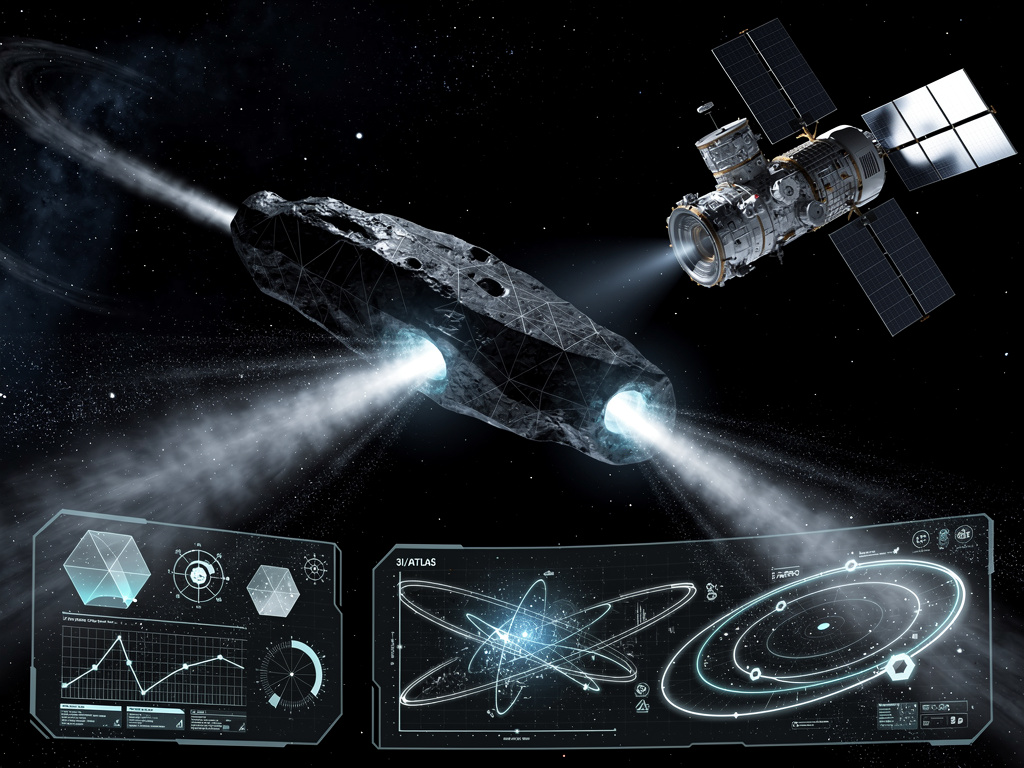
A recent analysis of the interstellar object known as 3I/ATLAS has ignited discussions regarding the possibility of extraterrestrial technology. Discovered in July 2025, this unique celestial body exhibits unusual behavior, specifically three symmetrical jets that challenge conventional understandings of cometary activity. Images from the Hubble Space Telescope reveal these jets, which seem to align with the object’s rotation axis, rather than the expected solar direction. Harvard astronomer Avi Loeb has raised the possibility that this could signify a technological origin.
Unusual Features of 3I/ATLAS
The jets from 3I/ATLAS were captured in a series of 17 images taken between November 30 and December 27, 2025. They appear at regular 120-degree intervals, forming a geometric pattern that is atypical for comets. Unlike previous interstellar objects, such as ‘Oumuamua, which exhibited acceleration without visible outgassing, 3I/ATLAS displays a coma and tail similar to solar system comets. Yet, its rapid velocity and interstellar origin make it distinct.
NASA’s collaborative missions continue to track 3I/ATLAS as it exits our solar system, with data suggesting an evolving nature in its jets. Observations indicate a slight wobbling in the sun-facing tail, which is known as an “anti-tail,” a rare phenomenon typically caused by perspective effects during a comet’s orbit. However, the rhythmic shifting within the tail’s jet structures remains a mystery.
The scientific community has responded to these findings with a mix of excitement and caution. Speculation abounds on social media, with astronomy enthusiasts sharing observations of the jets and questioning their origins. Some describe the jets as “razor straight” and stable, which has further fueled debates about whether 3I/ATLAS is merely a comet or something engineered.
Scientific Analysis and Public Speculation
Loeb’s theories have garnered significant attention, as he postulates that the precise geometry of the jets could imply an advanced technological design. He highlights that while ice sublimation in comets often leads to irregular bursts, the symmetry observed in 3I/ATLAS suggests a more uniform process. Ongoing discussions on social media platforms reflect a broader fascination with the idea of alien technology.
In response, a team of international researchers has pushed back against the notion of extraterrestrial origins, emphasizing that 3I/ATLAS aligns more closely with typical cometary behavior. A January 3, 2026, report from Yahoo News underscores their point, noting the object’s unelongated nucleus and coma as evidence of natural formation.
Further exploration of the jets’ composition has been conducted, with reports from Gizmodo indicating that attempts to detect artificial emissions during the object’s closest approach to Earth yielded no results. This absence of signals, while not definitive, has strengthened the argument for a natural origin.
Comparing 3I/ATLAS to its predecessors, such as 2I/Borisov, offers additional context for its significance. Only three interstellar objects have been confirmed thus far, and the visible activity of 3I/ATLAS provides researchers with valuable data points. The symmetrical jets challenge existing theories of comet formation and outgassing, prompting a reevaluation of established models.
As the debate continues, the scientific community remains divided. While some favor natural explanations, the precision of the jets invites scrutiny and ongoing investigation. Upcoming missions aimed at studying similar interstellar objects could yield more definitive answers about the nature of 3I/ATLAS and its intriguing features.
In conclusion, whether the jets of 3I/ATLAS are products of alien technology or natural phenomena, they exemplify the excitement of discovery in astronomy. As research progresses, the quest to understand these cosmic wonders will likely drive advancements in observational technology and methodologies, ensuring a deeper comprehension of our universe.
















