








































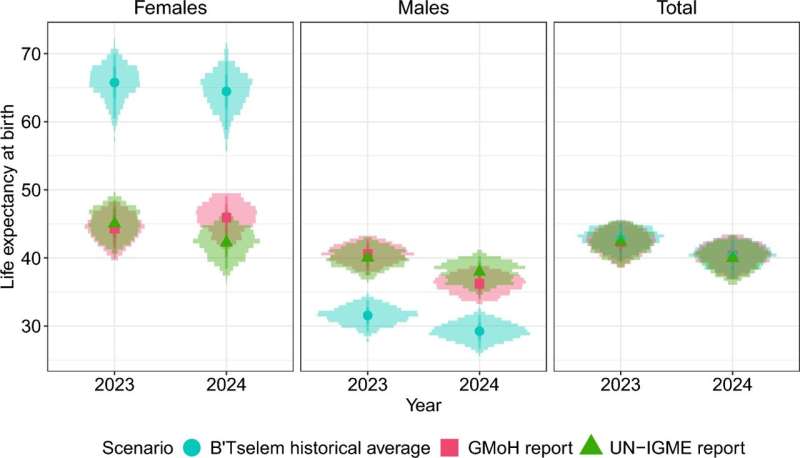
A recent study by researchers from the Max Planck Institute for Demographic Research (MPIDR) and the Center for Demographic Studies (CED) has revealed that the ongoing conflict in Gaza has resulted in a staggering increase in mortality rates. The research estimates that between October 7, 2023, and December 31, 2024, approximately 78,318 individuals lost their lives due to the violence. The implications of this loss are profound, as life expectancy in Gaza has plummeted to nearly half of what it would have been without the conflict.
The initial findings, published in the journal Population Health Metrics, underscore the urgency of this humanitarian crisis. Following the study’s publication, the authors revised their estimates, indicating that by October 6, 2025, the death toll could exceed 100,000.
Understanding the Impact of Conflict on Mortality
The researchers employed a robust methodology to assess the war’s impact on mortality, addressing the significant challenges posed by limited and often unreliable data from conflict zones. Ana C. Gómez-Ugarte, a lead researcher on the project, stated, “The tension between data limitations and the demand for meaningful metrics was the impetus for this study.” This highlights the delicate balance between obtaining accurate mortality estimates and the often inconsistent data available from such regions.
The study utilized information from several reputable sources, including the Gaza Ministry of Health, B’Tselem, and the United Nations Office for the Coordination of Humanitarian Affairs (OCHA). By employing a pseudo-Bayesian modeling approach, the researchers accounted for uncertainties regarding the total number of fatalities and the demographic characteristics of the victims.
The study concluded that the number of conflict-related deaths during this period was likely between 70,614 and 87,504, reflecting the challenges of accurately recording deaths in volatile environments.
Life Expectancy and Broader Implications
The research highlights that the unprecedented mortality rates have led to a dramatic reduction in life expectancy in Gaza. In 2023, life expectancy fell by 44%, and in 2024, by 47%, translating to losses of 34.4 and 36.4 years, respectively. This significant decline illustrates the devastating impact of armed conflict on civilian populations.
Furthermore, the study noted that the demographic distribution of violent deaths in Gaza closely resembled patterns observed in various genocides documented by the United Nations Inter-Agency Group for Child Mortality Estimation (UN IGME). While the study did not focus on labeling these events as genocide, it opened up discussions on the severe implications of the deaths.
Gómez-Ugarte and her colleagues emphasized the importance of incorporating uncertainties into mortality estimates. “Our estimates of the impact of war on life expectancy in Gaza and Palestine are significant, but probably represent only a lower limit of the actual mortality burden,” she explained. The study focused solely on direct conflict-related deaths, leaving out the indirect effects of war, which often have more profound and lasting consequences.
In conclusion, this research sheds light on the critical need for accurate mortality assessments in conflict areas. As Gómez-Ugarte pointed out, “Urgency should not be an excuse for a lack of methodological rigor.” The findings of this study highlight the necessity for continued and improved data collection and analysis in conflict settings, ensuring that the true human cost of such crises is understood and addressed.