









































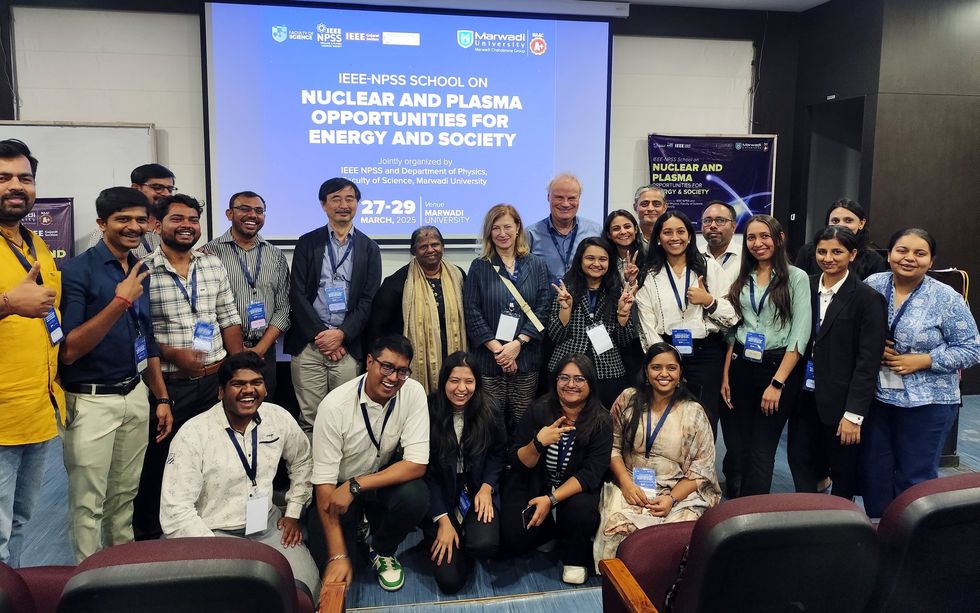
Professor Cinzia DaVià of the University of Manchester in England and Stony Brook University in New York underscores the importance of collaboration in her successful career in physics. With a diverse background that includes significant contributions to the CERN (European Organization for Nuclear Research) and ongoing research in portable energy generation, DaVià exemplifies how teamwork can drive innovation in science and technology.
Throughout her academic journey, DaVià has established connections across various disciplines, which she credits as essential to her achievements. Her ongoing collaboration with CERN allows her to engage with a wide network of professionals, highlighting her belief that collaboration is fundamental to progress. She emphasizes that successful outcomes stem from collective efforts rather than individual accolades, stating, “The people involved in any project are really the ones to be celebrated. The focus should be on them, not me.”
Early Influences and Career Development
DaVià’s fascination with physics began during her childhood in the Italian Dolomites, inspired by the documentary series “Astronomia,” reminiscent of Carl Sagan’s “Cosmos.” This passion led her to pursue a degree at the University of Bologna, focusing on astronomy and astrophysics. However, a summer internship at CERN shifted her path dramatically. She became involved in constructing experiments for the Large Electron-Positron (LEP) collider, which was the largest electron-positron accelerator at that time and a pivotal project in validating the standard model of particle physics.
Her early experiences at CERN, particularly her work on radiation instrumentation, laid the foundation for her future contributions. After graduating in 1989, DaVià returned to CERN for what was intended as a one-year assignment. This tenure extended to a decade, wherein she achieved milestones such as securing a fellowship to complete her Ph.D. at the University of Glasgow in 1997, focusing on radiation detectors in medical applications.
Groundbreaking Discoveries and Innovations
During her tenure at CERN, DaVià played a vital role in several groundbreaking discoveries. One of her notable contributions involved addressing the limitations of silicon sensors in collider experiments. She pioneered methods to revive damaged sensors through cooling to extreme temperatures, a process now known as the Lazarus effect.
Her most significant achievement was her collaboration with inventor Sherwood Parker to develop 3D silicon sensors capable of functioning in high-radiation environments. This innovation allowed scientists to replace traditional planar silicon sensors with more robust options, significantly enhancing the performance of detectors in large collider experiments.
DaVià’s ability to unite a diverse team, including competitors in the industry, was instrumental in this success. She recalls, “I was able to convince them that working together would be the best and fastest way forward.” This unprecedented collaboration not only advanced sensor technology but also fostered an environment where information could be shared freely among industry peers.
Her efforts in this area were documented in the co-authored book, “Radiation Sensors With 3D Electrodes,” which highlights the collaborative nature of her research.
Sustainable Solutions and Future Endeavors
Beyond her work in particle physics, DaVià is deeply concerned about the impacts of climate change and extreme weather events. Her commitment to sustainability was reinforced after attending the American Institute of Architects International symposium in June 2023. Here, discussions around natural disasters and mitigation strategies inspired her to explore innovative solutions, such as “smart shelters” designed for disaster recovery.
The concept of these shelters is rooted in the IEEE-USA MOVE initiative, which provides power and communication capabilities to communities affected by disasters. DaVià has gathered a cross-disciplinary team to further develop this idea, culminating in a two-day conference on sustainable entrepreneurship scheduled for October at CERN. The event aims to foster collaboration across various disciplines to generate deployable solutions that enhance resilience against climate-related challenges.
DaVià’s leadership extends to her involvement in the IEEE Online Forum on Climate Change Technologies and the creation of the Climate Change Initiative within the IEEE Nuclear and Plasma Sciences Society. Her efforts have secured funding for climate-related workshops, focusing on the intersection of nuclear physics and societal energy needs.
As she balances her roles between the University of Manchester, Stony Brook University, and CERN, DaVià remains dedicated to nurturing the next generation of scientists. She continues to mentor students and contribute to innovative projects at CERN’s IdeaSquare, where interdisciplinary minds collaborate to convert high-energy physics innovations into practical solutions for global issues.
Through her extensive involvement with the IEEE, DaVià has fostered connections that enhance collaboration in the scientific community. She highlights the importance of these relationships, stating, “IEEE helps bring people together who might not otherwise connect. We are stronger together with IEEE.”
Cinzia DaVià’s career is a testament to the power of collaboration in advancing scientific knowledge and addressing pressing global challenges. Her journey reflects a commitment not only to her field but also to the betterment of society through innovative research and sustainable practices.
















