

































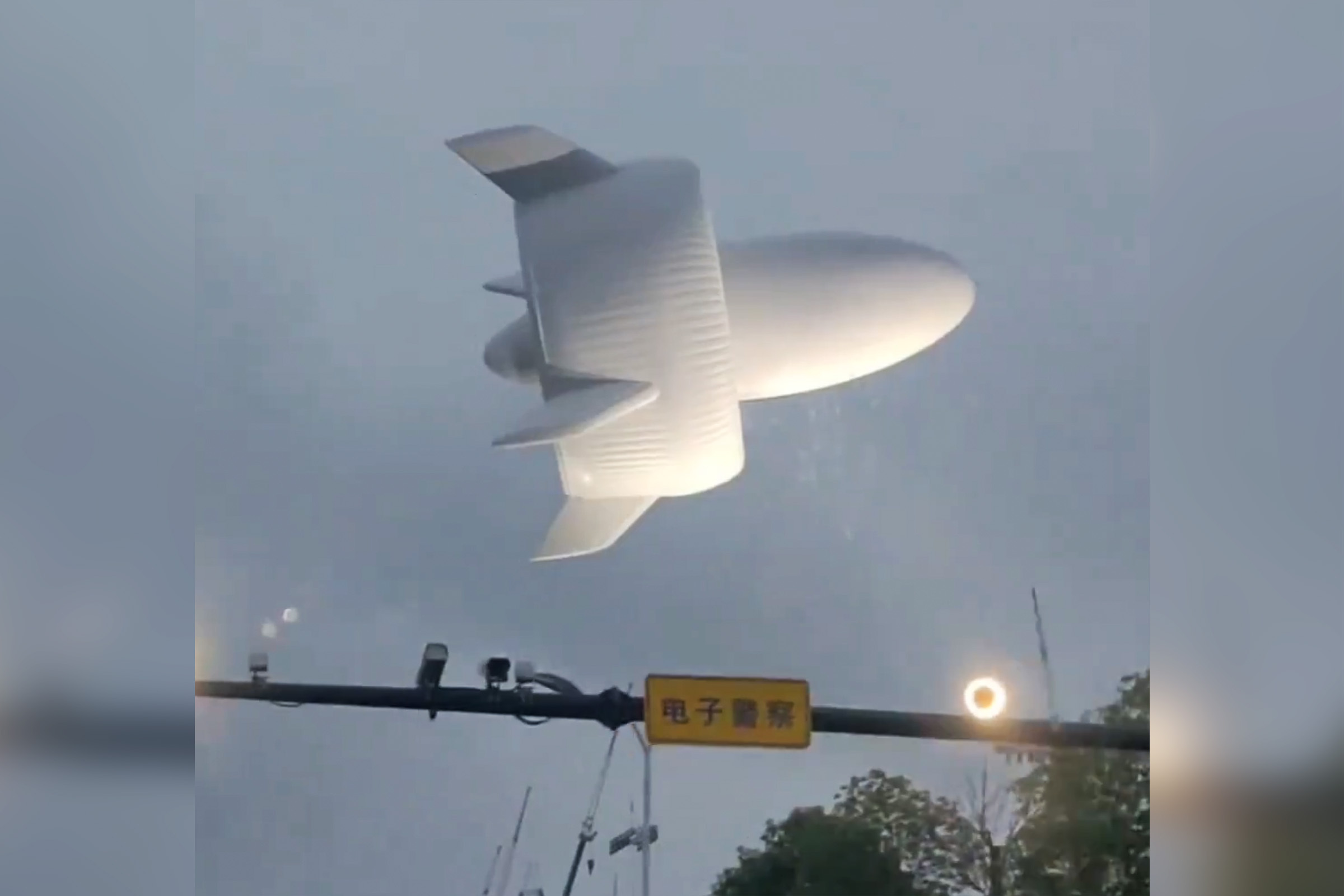
A groundbreaking airborne wind turbine (AWT) has taken to the skies in Sichuan Province, China, showcasing the country’s commitment to green energy innovation. Developed by the Chinese energy company Linyi Yunchuan, the SAWES S2000 successfully completed its test flight on January 9, 2026. This prototype represents a significant advancement in harnessing high-altitude winds for electricity generation.
A video shared by Chinese journalist Li Zexin on social media platform X highlighted the impressive sight of the AWT as it hovered in the air. “New unreal airborne wind turbines that float to harness high-altitude winds are being used in China,” Li stated. He emphasized that despite already being a leader in renewable energy, China’s ambition in this sector continues to grow.
The SAWES S2000, a product of collaboration between Linyi Yunchuan, Tsinghua University, and the Institute of Aeronautics and Astronautics, is touted as the world’s first megawatt-class high-altitude wind power system designed for urban deployment. With a maximum power output of approximately 3 megawatts, it is engineered to capture the strong winds found at altitudes of around 6,500 feet.
During its 30-minute flight, the SAWES S2000 generated about 385 kilowatt-hours of electricity, successfully connecting to the local power grid. This achievement marks a significant milestone as it is the first AWT to connect to a grid during a test flight. According to Dun Tianrui, the chief designer of the system, “At its current output level, one hour of operation can generate enough electricity to fully charge approximately 30 top-spec electric vehicles from zero to full.”
The design of the SAWES S2000 allows for ease of transport and storage, as it can be housed in shipping containers. The inflation process for the turbine takes about eight hours, but with access to helium, this could be reduced to just four or five hours. The AWT functions similarly to an airship but is designed to remain stationary while lifting 12 lightweight turbine-generators into high-altitude wind streams, thereby harnessing renewable energy efficiently.
In a previous successful test, the SAWES team flew an earlier model, the S1500, which had a generator capacity of 1.2 megawatts. This earlier unit was described as being “about the size of a basketball court and as tall as a 13-story building.” The completion of its maiden voyage was marked by generating a full megawatt of power.
These test flights come at a pivotal time for China, as the nation has reported a decline in CO2 emissions for the first time, attributing this change to an increase in green energy sources like wind and solar power. As the global leader in solar energy and offshore wind infrastructure, China’s advancements in airborne wind turbines further solidify its position in the renewable energy landscape.
The development of the SAWES S2000 is not only a technical achievement but also aligns with China’s broader goal of enhancing its green energy capabilities, demonstrating a commitment to sustainable energy solutions for urban environments.