


































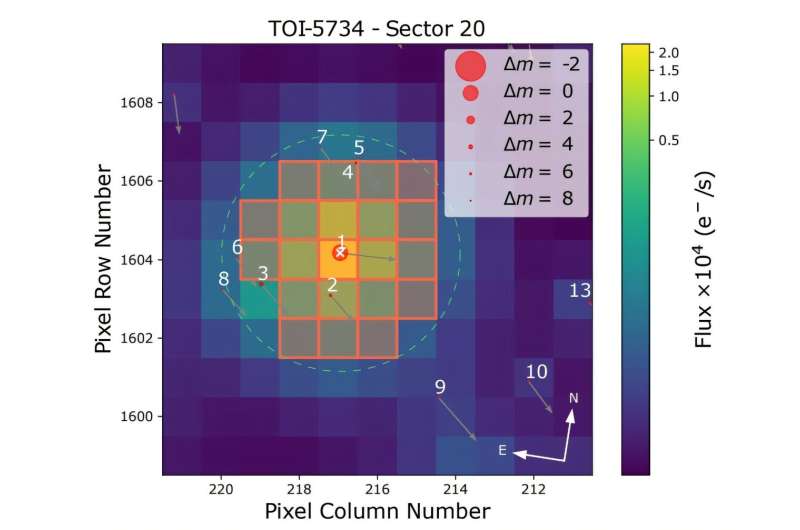





International astronomers have announced the discovery of a new exoplanet, named TOI-5734 b, a hot sub-Neptune approximately twice the size of Earth. This significant finding was made using the Transiting Exoplanet Survey Satellite (TESS) and the High Accuracy Radial velocity Planet Searcher for the Northern Hemisphere (HARPS-N). The details of the research were published on February 20, 2026, on the arXiv pre-print server.
Characteristics of TOI-5734 b
Located about 106 light years from Earth, TOI-5734 b orbits a relatively young dwarf star known as TOI-5734, or TIC 9989136. This star, classified as a K3-K4 V spectral type, has a radius of approximately 0.64 solar radii and a mass around 0.72 solar masses. Its effective temperature is estimated to be around 4,750 K.
The initial clues indicating the presence of TOI-5734 b emerged in 2022 when TESS detected a transit signal in the star’s light curve. Follow-up observations led by Simone Filomeno from the Astronomical Observatory of Rome confirmed these findings, establishing the planetary nature of the signal. In the research paper, the astronomers stated, “In this paper, we present the detection and characterization of the transiting young planetary system TOI-5734 (TIC 9989136).”
Density and Composition Insights
TOI-5734 b measures approximately 2.1 Earth radii and has a mass estimated at 9.1 Earth masses. This results in a density slightly lower than that of Earth. The exoplanet completes an orbit around its host star every 6.18 days, at a distance of just 0.06 AU. The equilibrium temperature of TOI-5734 b is estimated to be around 688 K.
The findings classify TOI-5734 b as a hot sub-Neptune exoplanet, characterized by an Earth-like density. The researchers noted that it lies at the upper edge of the “radius valley,” a region in the mass-radius diagram where there is a noted scarcity of planets with sizes between 1.5 and 2.0 Earth radii.
Regarding its chemical composition, the team suggests that TOI-5734 b is likely a rocky world with a depleted primordial atmosphere. They consider the possibility of it being a water world but believe it will likely lose its primordial envelope within 300 million years. The authors concluded that throughout its lifetime, TOI-5734 b has likely migrated from a region of larger radii in the mass-radius diagram to its current position near the radius gap.
The discovery of TOI-5734 b adds to the growing catalog of exoplanets and offers insights into the diverse characteristics of worlds beyond our solar system. As astronomy continues to evolve, findings like these deepen our understanding of planetary formation and the conditions that govern exoplanet atmospheres and compositions.
















