









































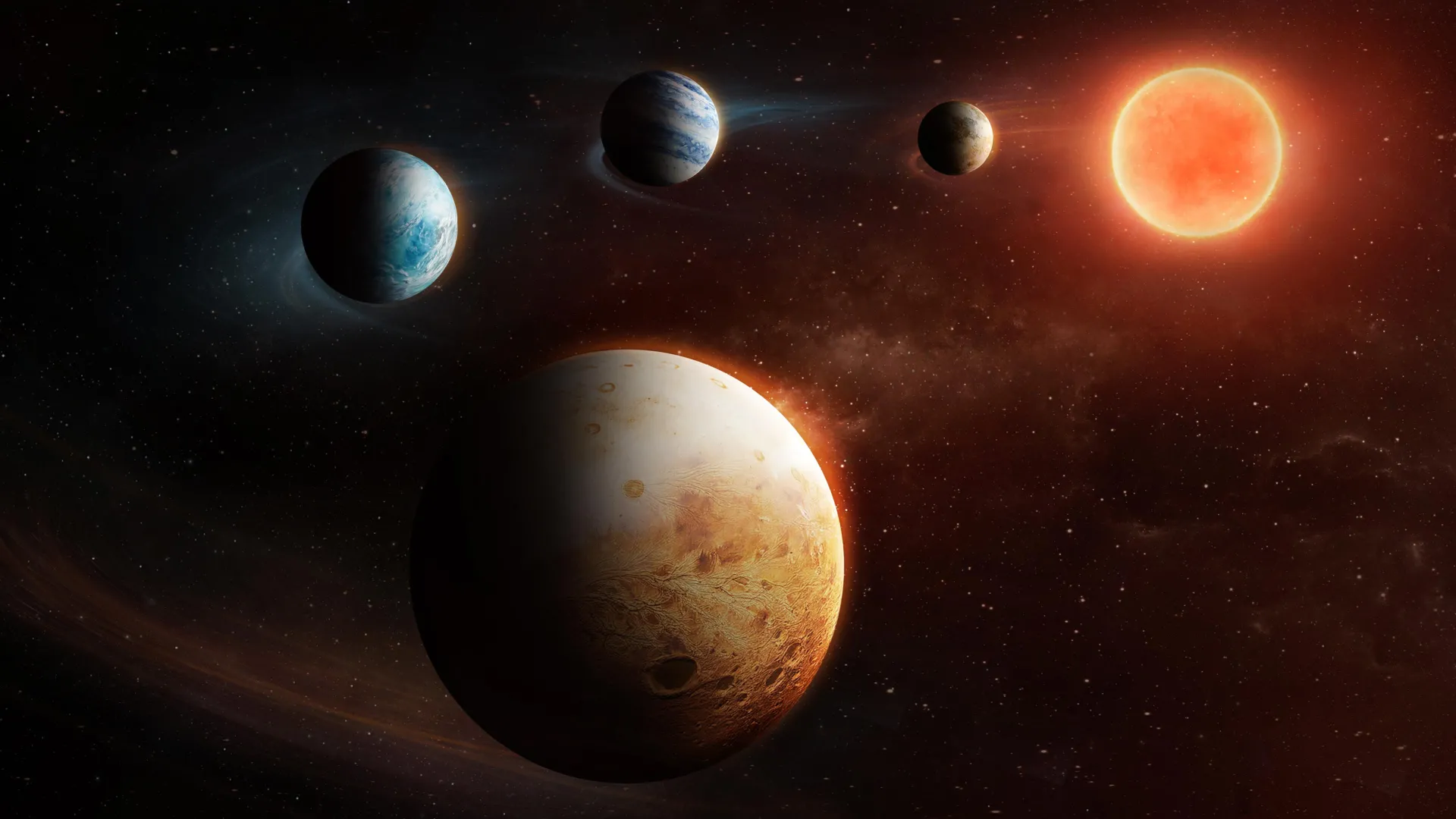
A team of astronomers has made a groundbreaking discovery, identifying a rocky planet in an unexpected location within the LHS 1903 planetary system. This finding challenges long-held theories about how planets are formed, particularly the conventional wisdom that rocky planets typically orbit closer to their stars while gas giants reside further away.
Unexpected Planetary Arrangement
On February 14, 2026, researchers from McMaster University, led by Prof. Ryan Cloutier and Prof. Thomas Wilson of the University of Warwick, published their findings in the journal Science. The team initially detected three planets orbiting the small, faint red dwarf star LHS 1903. Consistent with established planetary system models, the first two planets were found to be rocky and gas-rich, respectively.
However, subsequent observations revealed a surprising development. The outermost planet, designated LHS 1903 e, was confirmed to be rocky rather than gaseous, defying expectations. “We’ve seen this pattern: rocky inside, gaseous outside, across hundreds of planetary systems,” stated Cloutier. “But now, the discovery of a rocky planet in the outer part of a system forces us to rethink the timing and conditions under which rocky planets can form.”
Reevaluating Planet Formation Theories
The traditional model of planet formation suggests that young stars emit intense radiation, stripping away gases from nearby developing planets and resulting in rocky worlds close to the star. In contrast, cooler temperatures further out enable the formation of gas giants. The LHS 1903 system, however, indicates a different formation pathway.
To explore this anomaly, the research team considered various hypotheses, including the possibility of a massive collision that could have stripped away an atmosphere from LHS 1903 e. They also investigated whether the planets might have shifted positions over time. Through detailed computer simulations and analysis, both scenarios were ruled out.
The findings suggest a sequential formation of planets in this system, where environmental conditions varied significantly over time. As the planets formed, they did so under different circumstances, affecting their composition. By the time LHS 1903 e was forming, much of the gas in the surrounding disc may have already dissipated, leading to its rocky nature.
“It’s remarkable to see a rocky world forming in an environment that shouldn’t favour that outcome,” Cloutier added. “It challenges the assumptions built into our current models.” This discovery raises questions about whether LHS 1903 is an anomaly or indicative of a broader pattern that scientists have yet to fully understand.
As detection methods improve, researchers are increasingly uncovering planetary systems that do not conform to traditional models. Each new discovery adds to a growing understanding of planetary diversity, prompting scientists to reassess the processes that shape worlds throughout the galaxy.
This remarkable find not only expands our knowledge of planetary systems but also underscores the complexity of the universe, suggesting that many more surprises may lie ahead in our quest to understand how planets form and evolve.
















