



































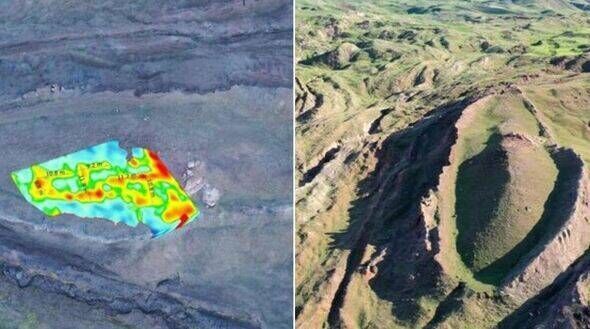

Archaeologists have made a significant discovery in Turkey, using advanced radar technology to identify what they believe could be the remains of Noah’s Ark. The research team, known as Noah’s Ark Scans, employed Ground Penetrating Radar (GPR) at the Durupinar Formation, located approximately 18 miles south of Mount Ararat. Their scans revealed a “chemical imprint,” alongside “pieces of wood” and the outline of a structure resembling a hall.
The significance of this find is rooted in biblical history. According to accounts in the Book of Genesis, Noah’s Ark was a large vessel that preserved life during a catastrophic flood over 4,300 years ago. The researchers claim to have detected angular formations and a hollow space deep within the mountain, suggesting the presence of a structure consistent with the biblical description of the ark.
Details from Ground Penetrating Radar Analysis
The GPR analysis conducted by independent researcher Andrew Jones uncovered what appears to be a 13-foot corridor within the formation. The scans indicated the presence of central and side walkways, potentially supporting the biblical claim that the ark had three decks, as stated in Genesis 6:16. This verse describes the ark’s dimensions and structure, suggesting a complex design rather than a simple geological formation.
In an interview with CBN News, Jones emphasized that while they are not expecting to find a fully preserved ark, the data collected indicates significant features. “What’s left is the chemical imprint, pieces of wood, and the shape of a hall,” he explained. The Durupinar Formation has only been known to the modern world since the late 20th century, following heavy rains and earthquake activity in May 1948 that revealed the area.
Comparative Soil Analysis and Future Research Plans
Further analysis revealed intriguing results regarding the soil within the formation. William Crabtree, another researcher from Noah’s Ark Scans, noted that the organic matter in the soil beneath the formation was double that of the surrounding earth. He pointed out that potassium levels were elevated by approximately 40 percent, which could indicate the presence of decaying organic material, consistent with the remains of a wooden vessel.
Jones and his team are planning to expand their soil testing efforts beyond the 22 samples already collected. They are also preparing for core drilling and additional GPR surveys to compare the internal structure of the formation with the surrounding area. “This could give us a much clearer picture of whether this is truly something man-made,” Jones said.
The discovery has reignited a long-standing debate regarding the historical and geological significance of the Durupinar Formation. While some scholars argue it is merely a natural rock structure, others, including the researchers at Noah’s Ark Scans, are convinced it may be something far more extraordinary.
The implications of these findings could resonate beyond archaeology, potentially influencing religious and cultural discussions surrounding the biblical narrative of Noah’s Ark. As research continues, the team remains dedicated to uncovering the truth behind this ancient story, one layer at a time.