









































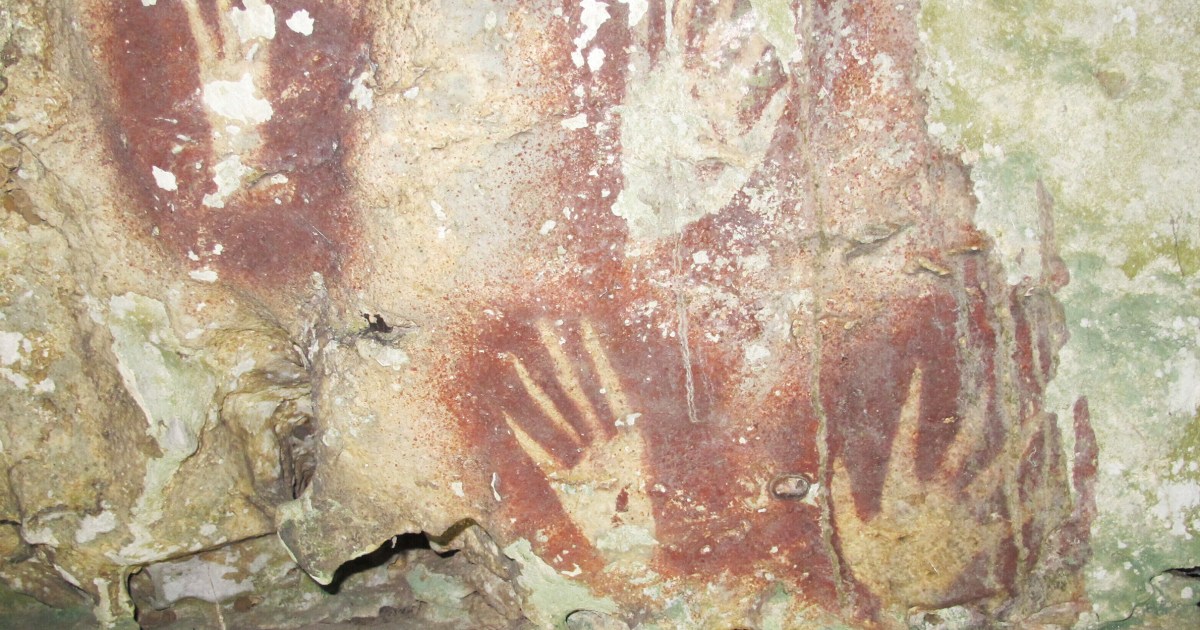
The oldest known cave art, a hand stencil dating back at least 67,800 years, has been discovered in a limestone cave on Muna Island, Indonesia. This groundbreaking find contributes to the understanding of early human artistic expression and the timeline of art development in the region, according to researchers from Indonesia and Australia.
The hand stencils, found inside the Liang Metanduno cave, were created by blowing pigment around a hand pressed against the rock surface, leaving a faint outline. While the stencils are somewhat faded, their age has been confirmed through the analysis of mineral crusts that formed on top of them. The discovery was detailed in a study published in the journal Nature on March 6, 2024.
Significance of the Discovery
The discovery is notable for its implications on the understanding of when early humans began creating art and how this art evolved over time. Adam Brumm, a professor of archaeology at Griffith University in Brisbane and a co-author of the study, emphasized the rarity of dating rock art. “This find is pretty extraordinary,” Brumm stated. “Usually, rock art is very difficult to date, and it doesn’t date back to anywhere near that old.”
The stencils are over 15,000 years older than a previously discovered painting in another cave in Sulawesi, which is approximately 51,200 years old and depicts human-like figures interacting with a pig. Brumm remarked, “I thought we were doing pretty well then, but this one image just completely blew that other one away.”
Research teams are hopeful about finding even older art, including storytelling images in unexplored archaeological sites across Indonesia.
Impacts on Understanding Human Migration
The implications of these findings extend beyond art history. They may provide insights into the migration patterns of early humans, particularly concerning the arrival of modern humans in Australia. Aboriginal peoples are widely believed to have settled in Australia at least 50,000 years ago, with some archaeological evidence suggesting human presence up to 65,000 years ago.
Brumm noted that the proximity of Muna Island to Australia makes it more plausible that modern humans were present in Australia around the same time. “Now that we’re finding rock art dating to 67-68,000 years ago on the island of Sulawesi, which is essentially on Australia’s doorstep, it does make it considerably more likely that modern humans indeed were in Australia at least 65,000 years ago,” he explained.
The Liang Metanduno site has previously attracted attention for its cave art, mainly depicting chickens and other domesticated animals believed to be around 4,000 years old. The recent discovery was made possible when Adhi Oktaviana, an Indonesian rock art specialist and lead author of the study, identified faint hand stencils beneath more recent artworks.
Brumm remarked, “No one had ever observed them before. No one even knew that they were there, but Adhi spotted them.” This discovery challenges long-held beliefs about the origins of cave art and emphasizes the sophistication of artistic expression among early humans outside of Europe.
For generations, researchers have focused on Ice Age cave paintings in Europe, which are about 30,000 to 40,000 years old. Brumm believes that the recent discoveries in Indonesia demonstrate that complex cave art existed tens of thousands of years earlier, significantly before humans set foot in Europe.
The findings from Muna Island not only enrich the historical narrative of human creativity but also expand the geographical understanding of early human civilization. The research team is keen to continue exploring the caves of Indonesia, where much remains to be discovered about the artistic endeavors of our ancient ancestors.
















