







































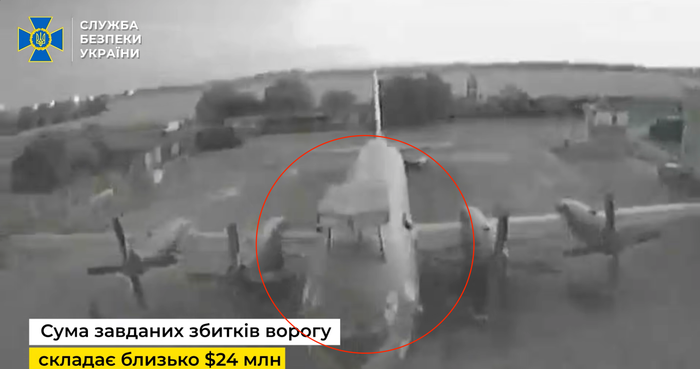
Ukraine’s Security Service, known as the SBU, has disclosed details about a recent drone operation targeting a Russian submarine’s protective aircraft. This operation involved the strategic use of an aerial drone equipped with an airburst warhead capable of dispersing approximately 2,000 fragments upon detonation. The SBU announced these developments on March 12, 2024, outlining how this attack laid the groundwork for Ukraine’s subsequent strike on a Russian submarine.
The SBU’s video release showed a drone approaching the Il-38N reconnaissance aircraft, also referred to as the Sea Dragon, at the Yeysk air base. The drone’s explosive payload detonated directly above the aircraft’s main equipment compartment, damaging critical components, including the engine. Although the exact timing and location of the footage could not be independently verified, the implications of the strike are significant for ongoing military operations in the region.
Disabling the Sea Dragon was a crucial step prior to Ukraine’s main strike against the submarine. The SBU noted that this particular aircraft was actively monitoring Ukrainian maritime drone activities, posing a direct threat to operations targeting Russian assets. The agency emphasized that this was the only aircraft of its kind operating in the Black Sea, making it a key element in Russia’s maritime surveillance network.
The Yeysk air base is located on the eastern flank of the Sea of Azov, across from Mariupol, and approximately 140 miles from the Russian port city of Novorossiysk. This port is a strategic hub for Russia’s naval operations, housing many of its maritime assets. Earlier this month, the SBU reported successfully targeting a Kilo-class submarine at Novorossiysk using its modified underwater drone, the Sub Sea Baby.
The Sub Sea Baby is a version of the Sea Baby uncrewed surface vessel modified for underwater operations, designed to strike its target with an explosive warhead. The SBU released footage of an explosion near a pier in Novorossiysk, although the timing of this video remains unclear. In response to the attack, Russia’s Black Sea Fleet has denied any significant damage to the Kilo-class submarine, valued at an estimated $400 million. This submarine is capable of carrying up to four Kalibr cruise missiles, which have been frequently used in attacks against Ukrainian cities.
Despite lacking a formal navy, Ukraine has effectively utilized drones and missiles to challenge Russia’s Black Sea Fleet, at times compelling it to retreat. The SBU reported that the targeted Kilo-class submarine had recently retreated to Novorossiysk from Crimea following Ukrainian strikes, highlighting the ongoing tension in the region.
As the conflict continues, these drone operations underscore the evolving tactics employed by Ukraine in its defense efforts against Russian military capabilities. The implications of these strikes extend beyond immediate military engagements, reflecting a broader strategy to counteract Russia’s naval superiority in the Black Sea.