









































President Donald Trump recently struck a deal with India aimed at reshaping the global oil landscape in response to ongoing tensions with Russia. Despite this initiative, significant challenges remain, particularly regarding Venezuela’s capacity to deliver oil at a scale that could effectively replace Russian supplies.
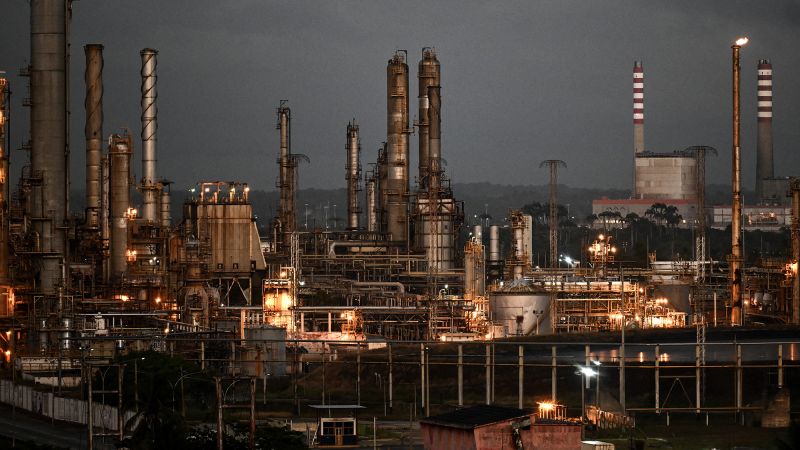
Venezuela’s oil production has been severely impacted by years of mismanagement and sanctions, currently averaging just over 1 million barrels per day. Approximately two-thirds of this crude is directed towards its largest customer, China. While Venezuela possesses the world’s largest proven oil reserves, its infrastructure is in dire need of investment and modernization. Experts estimate that reviving production levels to over 3 million barrels per day would require tens of billions of dollars in foreign investment spread over several years.
The recent agreement with India comes as Western nations continue to impose sanctions on Russian oil in response to the invasion of Ukraine. India’s energy sector is particularly reliant on Russian oil, importing around 1.5 million barrels daily. Although Trump has indicated that Indian Prime Minister Narendra Modi is committed to reducing Russian oil imports, transitioning to Venezuelan supplies is not a straightforward process.
Venezuela’s Oil Potential and Challenges
Venezuela’s crude is notably similar to Russian oil, characterized by its heavy, sour composition, which suits India’s refining capabilities. The U.S. has encouraged foreign companies to re-engage with Venezuela’s oil sector, especially following the overthrow of Nicolás Maduro. In a recent legislative move, Venezuelan authorities enacted reforms designed to attract foreign investment, a step welcomed by industry analysts such as Homayoun Falakshahi from Kpler, who stated, “It is definitely a step in the right direction, and it will help pave the way for higher investment in the country.”
Despite these reforms, the reality is that Venezuela’s oil production remains insufficient to meet India’s needs. Even with a complete pivot towards India, Venezuela would not be able to fill the gap left by Russian oil imports. Industry insiders point out that substantial foreign investment and a stable political environment are crucial for any meaningful recovery of Venezuela’s oil output.
India’s Dilemma: Transitioning from Russia
India faces a complex situation in its oil procurement strategy. While the prospect of Venezuelan oil presents an appealing alternative, logistical and financial barriers complicate an immediate transition. Rob Haworth, a senior investment strategy director at U.S. Bank Asset Management, emphasizes that “the adjustment of the global supply distribution chain will take time.” The infrastructure required to process Venezuelan oil would demand significant upgrades, and current logistical routes favor Russian imports.
Additionally, Venezuelan crude typically trades at a premium compared to the discounted prices of Russian oil, which currently trades at approximately $16 less per barrel than OPEC or U.S. crude. This price difference poses a significant challenge for India, which has benefitted from cost-effective Russian crude supplies.
Despite the challenges, the introduction of Venezuelan oil into the market could disrupt Russia’s economic stability. The Russian economy has already been struggling under the weight of sanctions and declining oil prices. Although Russian President Vladimir Putin‘s administration has adapted to these pressures, losing India as a customer would further complicate its financial landscape.
As the situation evolves, the potential impact of Venezuelan oil on the global market remains to be seen. While short-term gains are unlikely to dramatically alter the dynamics of the Russia-Ukraine conflict, any reduction in Russian oil revenues could complicate funding for the ongoing war. In a conflict that has already claimed nearly 2 million lives, every shift in the economic balance carries significant implications.
















