









































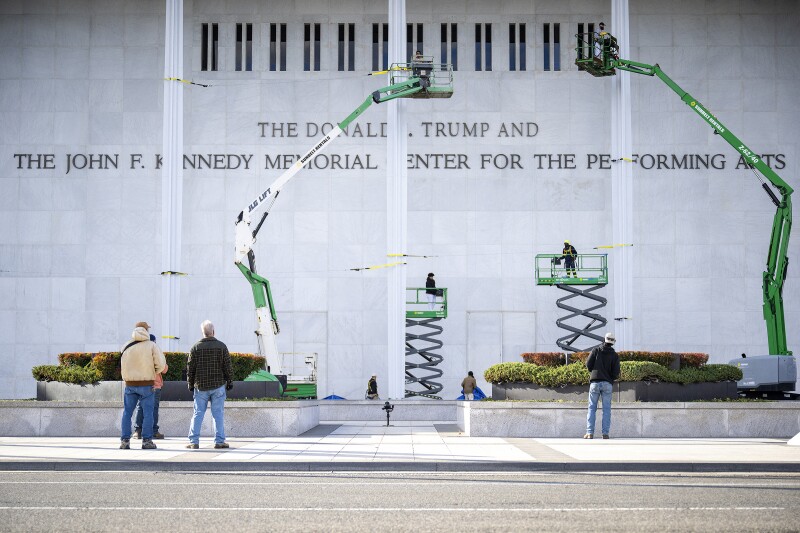
In a controversial decision, the board of the John F. Kennedy Center for the Performing Arts has been renamed to include President Donald Trump’s name, now titled “The Donald J. Trump and the John F. Kennedy Center for the Performing Arts.” This move has raised significant concerns among lawmakers and the arts community, with accusations of federal law violations and ongoing legal challenges.
Joyce Beatty, a congresswoman from Ohio, has filed a lawsuit aiming to restore the original name of the center. Beatty’s objections were reportedly silenced during a recent meeting where her microphone was muted as she attempted to voice her concerns. The rebranding, which appears to have been predetermined, has drawn ire, particularly as it was conducted by a board largely composed of Trump allies, including Susie Wiles, a prominent Republican strategist.
The board’s actions have already had immediate repercussions, including cancellations of high-profile performances, such as the acclaimed musical “Hamilton.” Ticket sales have seen a steep decline, and the center’s reputation as a cultural landmark is now under threat. Critics argue that the move to rename the center symbolizes a troubling trend of personal ego overshadowing public institutions.
Legal experts have pointed out that the renaming of the Kennedy Center violates existing federal legislation. The original statute designated the center as the sole memorial to President John F. Kennedy, who played a pivotal role in its establishment. According to the law, “no additional memorials or plaques in the nature of memorials shall be designated or installed in the public areas” of the Kennedy Center, with exceptions not applicable to Trump’s actions.
Trump’s actions have drawn parallels to a broader pattern of behavior that some describe as megalomaniacal. Critics contend that his presidency is marked by an inclination to prioritize personal branding over public service. Maria Shriver, Kennedy’s niece, emphasized this point on social media, stating that her uncle “brought the arts into the White House” and fostered a culture that celebrated artists and the arts.
The implications of this renaming extend beyond cultural institutions. Observers note that Trump has exhibited a disregard for the norms of governance, including the potential to unilaterally make decisions that carry significant consequences. Concerns have been raised about his ability to initiate military actions without congressional approval, adding to fears regarding the concentration of power in the presidency.
As the controversy surrounding the Kennedy Center unfolds, the future remains uncertain. While the next president could potentially reverse this decision, the growing sentiment is that Trump’s actions reflect a troubling trend in American politics. Critics argue that this is not merely a matter of vanity but rather an affront to the democratic principles upon which these institutions were founded.
The Kennedy Center renaming is just one of many instances where Trump’s administration has faced backlash for actions perceived as self-serving. From his insistence on branding policies after himself to the establishment of a “Trump Rx” pharmaceutical plan, the pattern of personalizing government initiatives raises questions about the integrity of the office.
As this situation develops, the arts community, lawmakers, and citizens alike will be watching closely. The outcome of Beatty’s lawsuit and the potential for legislative action could have lasting impacts on the Kennedy Center and the broader cultural landscape in the United States.
















