









































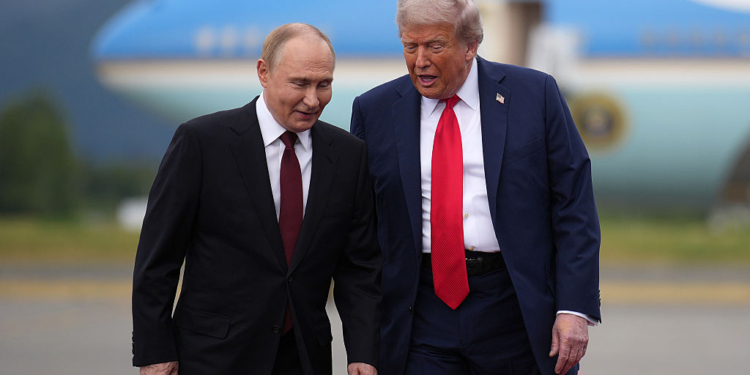
A significant diplomatic development occurred on October 30, 2023, as the Kremlin announced that Russian President Vladimir Putin has received an invitation to participate in President Donald Trump’s proposed “Board of Peace.” This governing body aims to oversee the future of Gaza following ongoing conflict. Kremlin spokesman Dmitry Peskov confirmed that the invitation was communicated through diplomatic channels, and he expressed that Moscow seeks further clarification from Washington.
The “Board of Peace” is a central element of Trump’s post-cease-fire strategy for Gaza. The plan envisions replacing Hamas with a technocratic governing authority that would operate under international oversight. Trump is set to take on the role of inaugural chairman, allowing him considerable authority over the board’s structure, including veto power over decisions and the final say on which nations may participate.
Putin’s potential involvement has sparked immediate interest due to his controversial global reputation. The Russian leader, aged 73, faces allegations of war crimes linked to Russia’s invasion of Ukraine, a conflict that has resulted in significant loss of life, with estimates indicating over one million Russian and Ukrainian military personnel either killed or wounded. Moreover, Russia maintains a longstanding alliance with Iran, which is Hamas’ primary supporter.
The White House confirmed that while three-year terms on the board would be offered at no initial cost, countries aspiring for permanent seats must contribute $1 billion towards Gaza’s reconstruction efforts. Trump has characterized the board as “the Greatest and Most Prestigious Board ever assembled,” highlighting its ambitious scope.
According to U.S. officials, expected participants on the board include prominent figures such as Secretary of State Marco Rubio, former British Prime Minister Tony Blair, and Canadian Prime Minister Mark Carney. Invitations have also been extended to representatives from Argentina, Egypt, and Turkey, all of which have confirmed their participation.
Despite this initiative, Israeli officials have expressed reservations. The office of Prime Minister Benjamin Netanyahu stated that the announcement regarding the board was “not coordinated with Israel and runs contrary to its policy,” reflecting ongoing tensions related to the plan.
The invitation to Putin coincides with the progression of the U.S. administration’s Gaza Peace Plan, which is structured in three phases. The first phase, initiated in October 2023, successfully resulted in Hamas releasing all living hostages and Israel scaling back its military operations in the region. The second phase demands that Hamas disarm and relinquish control of Gaza to international peacekeepers and a new civilian government—an ultimatum that Hamas has thus far rejected.
In anticipation of a shift in governance, former Palestinian Authority official Dr. Ali Sha’ath has been proposed as the leader of the new government should Hamas agree to step aside. The White House has praised Sha’ath, describing him as “a widely respected technocratic leader” who would be tasked with overseeing the restoration of essential public services, rebuilding civil institutions, and stabilizing daily life in Gaza.
Despite Hamas’ continued refusal to disarm, a White House official emphasized that the objective is to establish an alternative that aligns with the aspirations for peace and to empower those who seek it. The unfolding developments surrounding the “Board of Peace” signal a complex and evolving diplomatic landscape in the region.
















