









































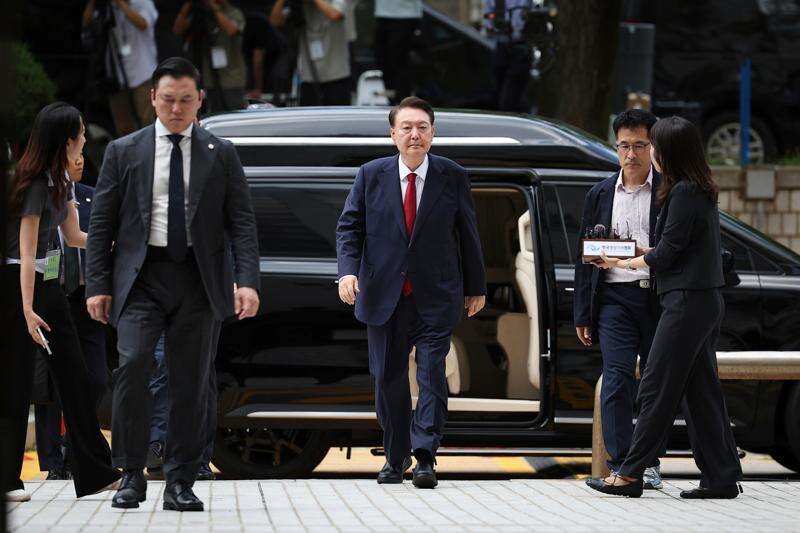
Former President Yoon Suk Yeol has received a life sentence for his brief imposition of martial law in December 2024. The ruling was delivered by Judge Jee Kui-youn, who found Yoon guilty of rebellion for deploying military and police forces in an illegal attempt to seize control of the National Assembly. The court characterized Yoon’s actions as a serious threat to democracy, emphasizing the lengthy duration of his attempt to consolidate power without checks.
Yoon’s legal team has indicated that he plans to appeal the verdict. The special prosecutor had sought the death penalty, arguing that Yoon’s actions endangered the democratic framework of South Korea. However, analysts had speculated that a life sentence would be the likely outcome given that the poorly executed power grab did not result in any fatalities. Notably, South Korea has maintained a de facto moratorium on capital punishment since the last execution in 1997.
As Yoon arrived at the courthouse, significant police presence was evident, with hundreds of officers monitoring the situation. Outside, supporters rallied vocally, expressing their discontent as the prison bus transporting Yoon passed by. In contrast, a group of his critics gathered nearby, calling for the death penalty for the former leader.
Convictions of Associates and Broader Implications
The court also convicted several former military and police officials who enforced Yoon’s martial law decree. Among them, Kim Yong Hyun, the former Defense Minister, was sentenced to 30 years in prison for his pivotal role in planning the measure and mobilizing the military. This ruling reflects a broader accountability for actions taken during Yoon’s administration.
Yoon’s defense has framed the martial law decree as a necessary measure to counter what he described as “anti-state” forces obstructing his legislative agenda. The decree, which lasted approximately six hours, was lifted after lawmakers successfully circumvented a military blockade and voted unanimously to rescind it.
Following his impeachment by the National Assembly on December 14, 2024, Yoon was formally removed from office by the Constitutional Court in April 2025. He has been in custody since July 2025, facing multiple criminal trials. The rebellion charge represented the most severe of these allegations.
In addition to Yoon’s sentencing, the Seoul Central Court has convicted two of his Cabinet members in separate cases. Prime Minister Han Duck-soo received a 23-year sentence for his attempts to legitimize the martial law decree, which included falsifying records and misleading the court under oath. Han has also filed an appeal against his conviction.
Yoon’s case and the subsequent judicial actions highlight significant tensions within South Korea’s political landscape, focusing on the balance of power and the safeguarding of democratic institutions. As the legal proceedings unfold, the implications for South Korea’s democracy and governance remain a central concern for observers both domestically and internationally.
















