









































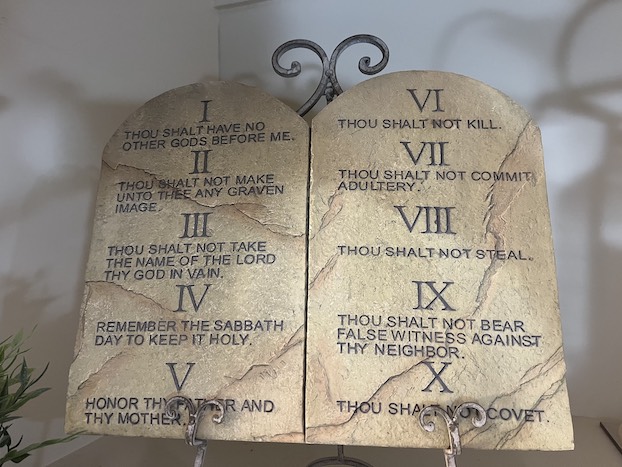
The Fifth Circuit Court of Appeals recently heard arguments regarding lawsuits from Louisiana and Texas concerning laws that require the display of the Ten Commandments in public school classrooms. Both states have faced legal challenges after their legislatures passed bills mandating these displays. The full court’s session on March 12, 2024, followed earlier rulings by district courts that deemed these laws unconstitutional.
In Louisiana, Governor Jeff Landry was the first to enact such legislation, followed by Texas Governor Greg Abbott. Following the passage of these bills, multiple groups filed lawsuits, arguing that the laws violate the First Amendment’s establishment clause. Courts in both states initially sided with the plaintiffs, blocking the implementation of the laws. The Texas injunction currently applies only to specific school districts.
After Louisiana requested a full court review, the Fifth Circuit agreed to hear both cases, leading to a detailed discussion among the judges. Attorney General Elizabeth Murrill represented Louisiana during the hearings, expressing optimism about the potential for a favorable ruling. “I like our chances,” Murrill stated, noting that there seems to be a considerable number of judges who disagree with the earlier panel decision.
During the hearings, attorneys engaged in discussions concerning Supreme Court precedents and their interpretations, suggesting that this legal debate may continue beyond the Fifth Circuit. Regardless of the outcome, both sides are likely to escalate the matter to the U.S. Supreme Court.
Murrill emphasized the state’s belief in the constitutionality of the law, stating, “We believe that you can apply this law constitutionally. We went to the trouble of creating numerous posters to illustrate that point.” Governor Landry also weighed in, asserting that the United States was built on Judeo-Christian principles and should acknowledge this heritage.
Landry pointed to the phrase “In God We Trust” found on U.S. currency, questioning why a similar acknowledgment in schools should not be accepted. He argued that the Ten Commandments serve as a foundational document for American legal and historical traditions, urging parents to instill a moral code in their children.
The lawsuits, titled Rev. Roake v. Brumley in Louisiana and Rabbi Nathan v. Alamo Heights Independent School District in Texas, raise significant questions about religious freedom and the separation of church and state, according to the American Civil Liberties Union (ACLU). The ACLU represents plaintiffs in both states, alongside Americans United for Separation of Church and State and the Freedom From Religion Foundation, with pro bono legal support from Simpson Thacher & Bartlett LLP.
The plaintiffs include a diverse group of individuals, such as Protestant pastors, Islamic leaders, and secular parents. They contend that no federal court has ever upheld a public school display of the Ten Commandments. The ACLU highlights that these families seek to have their constitutional rights respected, specifically the right to determine their children’s religious education.
Rev. Jeff Sims from Louisiana articulated concerns that state-sanctioned religious displays create an environment of favoritism among different faiths. “These religious displays send a message to my children and other students that people of some religious denominations are superior to others,” he remarked, emphasizing that public schools should remain neutral and inclusive.
Rabbi Mara Nathan from Texas echoed this sentiment, stating, “No one faith should be canonized as more holy than others.” She reinforced the belief that children’s religious education should be the responsibility of their families and faith communities rather than the government or public schools.
As the Fifth Circuit Court deliberates on these cases, the implications extend beyond the immediate legal question, touching on fundamental issues of religious freedom and the role of religion in public life. The upcoming ruling could set important precedents regarding the intersection of education, law, and religious expression in the United States.
















