









































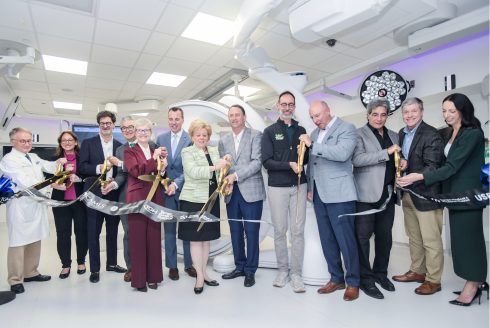
The University of South Florida (USF) and Tampa General Hospital (TGH) have enhanced their collaboration with GE HealthCare to pioneer advanced surgical training and clinical innovation. This partnership has led to the installation of the Allia Moveo, a next-generation image-guided therapy (IGT) solution, at USF’s Center for Advanced Medical Learning and Simulation (CAMLS) in Tampa, Florida. This marks the first installation of the Allia Moveo in Florida, and the third globally.
The Allia Moveo system is designed to improve mobility, workflow efficiency, and image quality for minimally invasive procedures. It features a compact, cable-free C-arm and lateral wide-bore cone beam computed tomography. These advancements aim to enhance image quality and accommodate a diverse range of patients and procedures, fostering a more inclusive environment for interventional and endovascular surgery.
Transforming Surgical Education
CAMLS, recognized as one of the largest free-standing simulation facilities dedicated to healthcare training, will be the first in the world to integrate the Allia Moveo into its educational programs. This integration allows students, faculty, and practicing clinicians to train on innovative hybrid operating room technology typically found in leading medical centers.
According to Dr. Haru Okuda, executive director of CAMLS and associate vice president of Interprofessional Education and Practice with USF Health, “Gaining access to the latest surgical imaging and guidance technologies further ensures that innovation in education keeps pace with innovation in care.” This initiative aims to create a training ecosystem that enhances clinical confidence and ultimately benefits patient care.
John Couris, president and CEO of TGH, emphasized the importance of this collaboration in advancing healthcare systems. He stated, “Our Tampa Medical & Research District is leading the way in building a better healthcare system and driving the next generation of life science advancements across clinical care, academics, research, biotechnology, and innovation.” The partnership aims to expand access to world-class healthcare services in the region and beyond.
Meeting the Demands of Modern Surgery
The rise of minimally invasive surgery (MIS) worldwide has highlighted the need for innovative training approaches. With patient benefits including reduced pain, shorter hospital stays, and fewer complications, the pace of advancements in robotics, imaging, and AI-enabled workflows is rapidly growing. Traditional training models are struggling to keep up with these changes, making high-fidelity simulation centers like CAMLS indispensable.
Catherine Estrampes, president and CEO of GE HealthCare in the U.S. and Canada, noted the significance of this partnership, stating, “This relationship reflects the very best of what can be achieved when academic excellence, clinical expertise, and innovative technology come together with a shared purpose.” The collaboration aims to equip clinicians with the necessary tools and training to deliver precise and personalized care, ultimately benefiting patients through enhanced training and practice.
Incorporating the Allia Moveo into CAMLS’ simulation-based learning environment provides multidisciplinary teams with hands-on experience using technology increasingly employed in complex minimally invasive procedures. This initiative ensures that the next generation of healthcare providers is prepared to meet the rising clinical demands.
The Allia Moveo system features a slim, compact design that allows for full movement and unobstructed patient access. It is engineered to accommodate a diverse patient population and includes AI-powered workflow tools that streamline procedures, enhancing the overall patient experience.
Looking ahead, a second Allia Moveo system is set to be installed at Tampa General Hospital in 2026 for clinical use in its hybrid operating room suite. This installation will further enhance the capabilities of one of the country’s leading academic health systems and solidify the Tampa Medical & Research District as a hub for healthcare excellence, training, and innovation. Together, these organizations are committed to driving discovery, accelerating innovation, and improving patient care within one of the largest academic health systems in the United States.
















