









































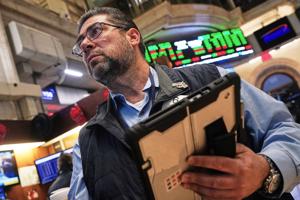
U.S. futures are experiencing modest gains as the first week of the earnings season concludes, with major markets trading near record levels. Futures for the S&P 500 increased by 0.2%, while futures for the Dow Jones Industrial Average remained nearly unchanged. In contrast, Nasdaq futures saw a rise of 0.5%. Oil prices rebounded by approximately 1.5% following a sharp decline the previous day.
Several regional banks reported their earnings on Friday, following a mixed bag from larger financial institutions earlier in the week. Notably, Pittsburgh’s PNC Financial Services surged by 3.2% after exceeding Wall Street’s fourth-quarter targets, driven by increased interest income and fees. Similarly, Buffalo’s M&T Bank experienced a 1% rise after also surpassing analyst expectations. Conversely, transport company J.B. Hunt reported quarterly profits above forecasts but saw its shares drop nearly 4% due to a decline in fourth-quarter revenue.
Focus Shifts to Technology Sector
As earnings season for major U.S. companies gains momentum, Wall Street’s focus is shifting towards the technology sector and companies involved in artificial intelligence. According to Ipek Ozkardeskaya from Swissquote, “As we dive into the heart of earnings season in the coming weeks, tech results will be scrutinized in far greater detail.” She highlighted ongoing concerns about circular AI deals, leverage, and delayed returns on investment, compounded by rising costs for electricity, metals, and memory chips, alongside potential supply disruptions.
In Europe, midday trading showed Germany’s DAX slipping by 0.3%, while the CAC 40 in Paris declined by 0.8%. Britain’s FTSE 100 remained steady, showing no significant change.
Asian markets displayed varying trends, with Taiwan leading gains as its benchmark rose nearly 2% following a new trade agreement with the United States. This deal reduces tariffs on Taiwanese goods to 15% in exchange for $250 billion in new investments in the U.S. technology sector, prompting protests from China, which claims Taiwan as its territory. In Japan, the Nikkei 225 decreased by 0.3%, while Hong Kong’s Hang Seng and the Shanghai Composite index both fell by 0.3%.
Global Economic Outlook
China is set to release its economic growth data for 2025 on Monday, with forecasts suggesting an annual growth rate of about 4.5%, a decrease from earlier in the year. Meanwhile, South Korea’s Kospi rose by 0.9%, reaching a record high of 4,840.74. This performance has been buoyed by a resurgence in confidence surrounding AI-related stocks, with Samsung Electronics climbing 3.5%.
In Australia, the S&P/ASX 200 gained 0.5% to settle at 8,903.90, while India’s Sensex saw a slight increase of 0.2%. Easing oil prices also contributed to a calmer atmosphere for investors. Early on Friday, a barrel of benchmark U.S. crude was priced at $59.95, reflecting an increase of 87 cents from the previous day. This followed a significant drop of 4.6% on Thursday, prompted by comments from former President Donald Trump regarding tensions in Iran.
Brent crude, the international benchmark, rose by 93 cents to reach $64.69 per barrel, recovering from a drop of 4.1% the day before. Financial markets interpreted Trump’s remarks about Iran as a potential easing of tensions in a region critical to global oil supplies, thereby reducing fears of disruptions in oil production.
As the financial landscape continues to evolve, investors will closely monitor upcoming earnings reports and geopolitical developments that may further influence market trends.
















