









































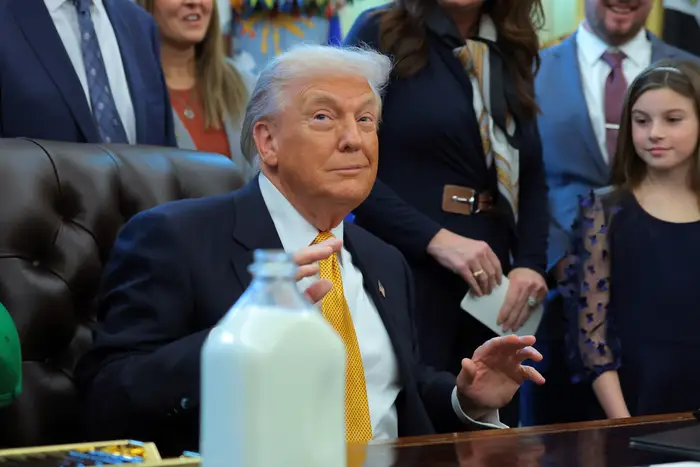
On March 15, 2024, President Donald Trump signed the Whole Milk for Healthy Kids Act, reversing an Obama-era restriction on whole milk in schools participating in the federal lunch program. While Trump celebrated the return of whole milk, stating it is beneficial for farmers and children, New York City’s public schools announced they will continue to offer only 1% and skim milk options.
During the signing ceremony, Trump positioned himself alongside a jug of milk, expressing his delight and declaring it a “very important thing for our farmers, and I think maybe more important for our people.” The act, which allows schools to serve whole milk, also mandates that a plant-based alternative be available when requested by a student’s doctor or guardian.
NYC Schools Maintain Current Milk Options
Despite the federal shift, officials from the New York City Department of Education confirmed that there will be no changes to their current milk offerings. Spokesperson Isla Gething emphasized that the city’s universally free breakfast and lunch program is based on research-driven nutrition guidance and student feedback.
For over a decade, the federal lunch program allowed only low-fat or non-fat flavored or unflavored milk, citing concerns about the contribution of milk fat to childhood obesity. The new law modifies those guidelines by exempting milk from the federal limits on saturated fat in school meals. Secretary of Health Robert F. Kennedy Jr. stated that this change is part of the broader “Make America Healthy Again” initiative, which aligns with recent changes to the food pyramid promoting increased consumption of meat and dairy.
Responses to the new federal guidelines have been mixed. Brooklyn parent Eva Bogaisky expressed support for the inclusion of whole milk, suggesting that better-tasting milk might encourage more children to drink it. “I wish New York City would at least go to 2%,” she remarked, highlighting concerns about children’s nutritional choices.
Controversy and Health Perspectives
The milk policy in New York City has a history of stirring debate among parents and officials. As Brooklyn borough president, Eric Adams previously criticized the sugar content in chocolate milk, advocating for healthier beverage options like water. Now serving as mayor, Adams has considered banning chocolate milk altogether, prompting Rep. Elise Stefanik to propose a bill requiring flavored and unflavored milk options in schools.
Nutrition experts continue to analyze the implications of the whole versus skim milk debate. Pam Koch, an associate professor of nutrition and education at Teachers College, Columbia University, noted that while there have been varying studies on the issue, the recommendation for 1% and skim milk remains prudent in light of pervasive saturated fats and ultra-processed foods in many diets.
Koch acknowledged that while chocolate milk served in city schools contains added sugar, it is less than what is found in many commercial brands. Despite this, she recognizes that chocolate milk continues to be a contentious issue among parents and children alike.
As the educational landscape navigates these changes in federal guidelines, the decision by New York City to maintain its current milk offerings reflects a commitment to established nutritional standards, even as national policies evolve.
















