









































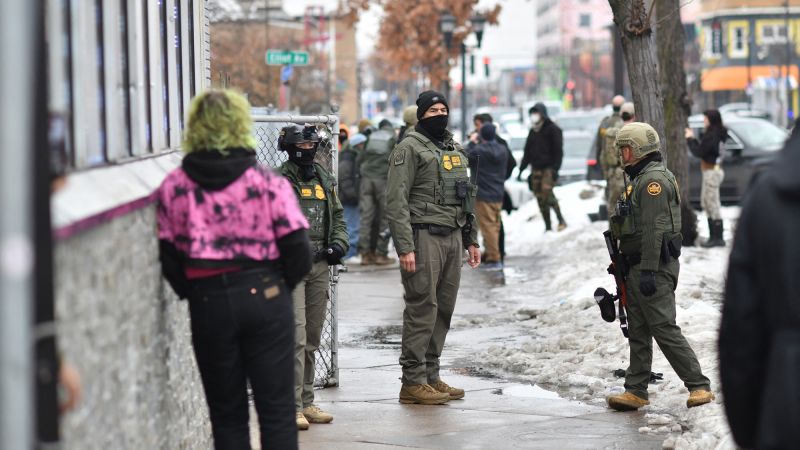
Federal immigration agents have significantly impacted local businesses in Minneapolis and St. Paul, Minnesota, over the past week. The presence of unmarked vans and masked agents has triggered a sharp decline in customer turnout, leading to reduced sales and heightened fears for the future of established local institutions. One such business, El Burrito Mercado, a well-known Mexican supermarket and restaurant, has seen its operations severely disrupted. CEO Melissa Silvia-Diaz described the situation in a recent interview, stating, “ICE is using my business as a hunting ground.”
The recent immigration enforcement actions, initiated by the Trump administration, have prompted widespread concern among business owners and local leaders. According to the Department of Homeland Security, more than 2,000 individuals have been arrested in the region as federal agents intensify their efforts. This crackdown has led many immigrants, both legal and undocumented, to avoid public spaces, resulting in empty shopping districts and reduced economic activity. Business owners report sales drops ranging from 50% to 80%, likening the current climate to the economic strain experienced during the Covid-19 pandemic.
Community Impact and Business Responses
The economic repercussions escalated following the tragic death of Renee Good, a US citizen, at the hands of an ICE agent last week. In response, numerous businesses shuttered temporarily. Notably, comedian John Mulaney postponed a series of performances, and planned events, including an arts festival and a Pride celebration, were canceled. El Burrito Mercado, which has been a staple of the community for 47 years, operated for only four hours one day last week due to a lack of customers.
“This is not sustainable,” Silvia-Diaz remarked, expressing her fears for the future. The cities of Minneapolis and St. Paul have initiated a lawsuit against the Trump administration, seeking to halt the ongoing operations and highlighting the detrimental economic impact on local businesses.
The White House defended its stance, stating, “The Trump Administration’s immigration enforcement operations have resulted in countless dangerous criminal illegals being removed from the streets.” They claim that such measures will foster safer communities conducive to business growth.
Historical Context and Current Challenges
El Burrito Mercado is situated in the District del Sol, a vibrant Mexican-American commercial area in St. Paul. Established by Silvia-Diaz’s parents, who emigrated from Mexico in the 1970s, the business has expanded to include a food truck and a catering service. The District del Sol has deep historical roots, with many immigrants settling in the area during the mid-20th century for work in meatpacking and railroads.
Business activities at El Burrito Mercado began to decline last year amidst increased immigration enforcement in nearby Chicago. The situation deteriorated further after federal agents arrived in the Twin Cities. Silvia-Diaz noted a significant shift in her customer demographics, with a marked decrease in her predominantly Latino clientele. “You wipe them out and then what?” she asked, emphasizing the critical role immigrant businesses play in local economies.
Similar challenges are affecting other establishments. Miguel Lopez, owner of Homi, a Mexican restaurant in St. Paul, has shifted to a pickup-only model, citing safety concerns for himself and his employees. “I don’t feel safe either in my house or my business,” he stated.
The crackdown has also led to heightened tensions at corporate giants like Target, headquartered in Minneapolis. The company has witnessed immigration agents frequenting its stores, leading to arrests and calls from local leaders for the retailer to protect its employees and customers. Despite the visible impact, many large corporations have remained largely silent to avoid antagonizing the administration.
Long-term Economic Consequences
The ongoing immigration enforcement actions pose a significant threat to Minnesota’s economy, which heavily relies on immigrant labor and businesses. The Minnesota Chamber of Commerce recently reported that the state is experiencing a slowdown in population growth, with an increasing need for immigrant workers to fill numerous job vacancies.
Notably, 94% of Minnesota’s net population growth between 2020 and 2024 has been attributed to immigration. The foreign-born labor force has surged by 41% since 2010, contrasting sharply with a mere 4% growth among US-born workers.
Concerned leaders, such as Mike Logan, CEO of the Minneapolis Regional Chamber of Commerce, warn that the current environment could deter talent attraction and retention, which are vital for sustained economic growth. “For the sake of the economy, businesses, and the community, the sooner this can come to a civil conclusion, the better,” he stated.
As the situation continues to unfold, the ramifications for local businesses and the broader economy remain uncertain, with many stakeholders hoping for a resolution that allows communities to thrive once again.
















