








































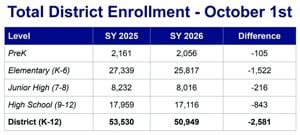
The student enrollment in Mesa Public Schools has dropped significantly, leading to substantial budgetary challenges. The largest school district in Arizona reported a 4.8% decrease in its midyear student headcount, exceeding initial projections. While officials anticipated a loss of 1,800 students, the actual decline has reached 2,581, impacting the district’s per-pupil funding from the state.
At the Governing Board meeting on December 11, 2023, Chief Business Officer Tyler Moore highlighted the financial implications of this drop. “The main driver in our budget is Average Daily Membership (ADM), which is student count,” Moore explained. He noted that the unexpected loss translates to a budget shortfall of approximately $5.7 million that the district must address.
Impact on School Capacity and Future Projections
The enrollment decline represents about 4.8% of the total district enrollment. Senior data engineer Jon House provided insights into the ramifications for various school sites. He indicated that in Fiscal Year 2022, 49%, or 28, of the district’s elementary schools had enrollments exceeding 500 students. However, projections for Fiscal Year 2026 suggest that only 14 schools will meet that threshold, roughly 12% of the total.
House also highlighted the struggles at junior high and high school levels, noting that three years ago, six junior high schools each boasted over 900 students. Currently, four of those schools are expected to have fewer than 700 students. The trend continues at the high school level, where no schools are projected to exceed 3,300 students, and three schools are anticipated to enroll less than 2,100 students.
Despite the overall decline, some schools have experienced growth. The K-8 STEM Academy at Red Mountain Ranch welcomed 55 new students this year, attributed to the addition of grades seven and eight. The East Valley Academy, a smaller alternative campus, also saw enrollment increases due to its Dropout Recovery Program.
Strategizing for the Future
House identified the schools with the most significant losses, including Wilson Elementary, Kino Junior High, and Westwood High School, which lost 226, 299, and 661 students respectively. The board recently approved a plan to repurpose Wilson Elementary into a Franklin Accelerated Academy to better address declining enrollment.
Board member Lacy Chaffee raised concerns about future enrollment over the next five to ten years and its implications for capital projects. House assured the board that a draft demographic report, which includes long-term projections, would be presented in January.
Superintendent Dr. Matt Strom emphasized the district’s commitment to providing high-quality education to its 54,000 pre-K to 12 students. He noted that Census Bureau and American Community Survey data indicate a decreasing population of children aged five to seventeen in Mesa, complicating the district’s efforts to attract students.
“We must be prudent with taxpayer dollars,” Strom stated. “We want to avoid investing in schools that may not have sufficient capacity in the long run.”
Board member Rachel Walden pointed out the financial constraints facing Arizona, noting the State Land Trust’s potential for education funding remains largely untapped. “It’s money just sitting there,” she remarked, expressing hope for future changes that could enhance funding without burdening taxpayers.
The district has identified $1.4 billion in capital needs but cannot request taxpayer support for such an amount. Strom explained that the district is focused on understanding demographic trends to develop a strategic plan that will outline priorities for the next three to ten years.
Strom reiterated the importance of maintaining as many schools as possible. He acknowledged the need for a forward-thinking approach to education, which has become essential as schools adapt to changing demographics.
Board member Sharon Benson highlighted the pressing issue of a declining birth rate affecting enrollment while also noting that around 20,000 school-age children in the area are not enrolled in district schools. She stressed the importance of outreach to parents to understand their choices regarding education.
“There is a perception issue regarding public education nationally,” Benson added. “It’s crucial for us to communicate effectively with parents and demonstrate our commitment to their values.”
As Mesa Public Schools navigates these challenges, the district’s leadership remains focused on adapting to the evolving educational landscape, ensuring that resources are allocated wisely while striving to maintain educational excellence in the community.