









































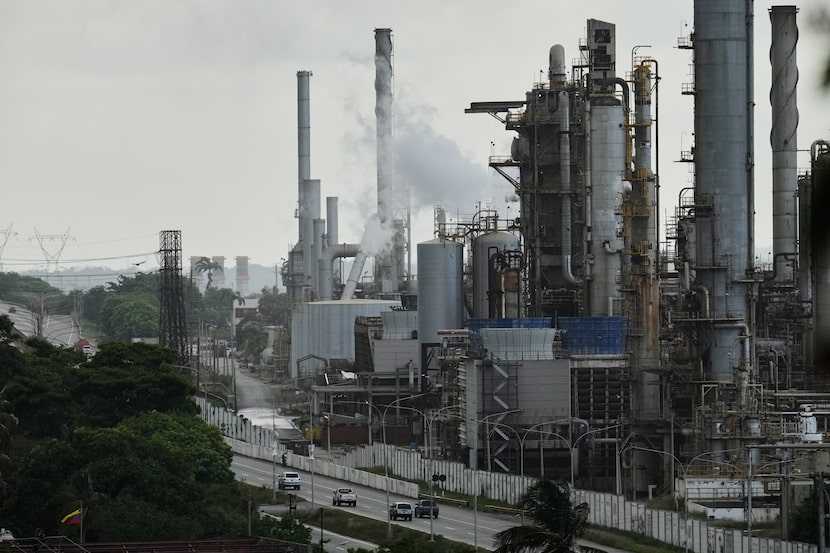
The recent shift in U.S. foreign policy towards Venezuela has reignited interest in the country’s vast oil reserves, which are estimated to be the largest in the world. Following President Donald Trump‘s efforts to oust Nicolás Maduro, energy companies are cautiously optimistic about the potential for tapping into Venezuela’s oil wealth. However, experts warn that significant obstacles remain, and it could take a decade or more for the nation to regain its oil production capabilities.
Venezuela currently faces a saturated global oil market, with an oversupply estimated at approximately 2 million barrels per day. This oversupply significantly outstrips the country’s current output of around 900,000 barrels per day. Even if Venezuela could ramp up production to its previous high of 3 million barrels per day, it would still be a relatively minor player in the global market.
The feasibility of a deal in which Venezuela ships 50 million barrels of oil to U.S. refineries along the Gulf Coast has been discussed. Such an arrangement could lead to slight reductions in gasoline and diesel prices. Notably, around 70% of U.S. refining capacity is optimized for the heavy crude produced by Venezuela. Despite this, operational capacity on the Gulf Coast is limited to about 3 million to 4 million barrels of heavy crude per day, translating to a mere 12-day supply from Venezuela.
Achieving sustainable lower fuel prices would require a long-term supply agreement. Furthermore, a shift towards importing more heavy crude from Venezuela may decrease imports from Canada, potentially increasing costs for smaller refineries in China, which rely on Venezuelan oil.
Reviving Venezuela’s troubled oil sector will not be straightforward. The state-owned oil company, PDVSA, has suffered from decades of mismanagement and corruption, leaving the nation’s energy infrastructure in a state of disrepair. According to Rystad Energy, restoring production to levels seen in the 1990s will necessitate an investment of approximately $183 billion and may take more than a decade.
Drilling in the Orinoco Basin, where the majority of Venezuela’s reserves are located, is complicated and costly. The oil in this area is extra-heavy and sulfur-rich, requiring advanced technology for extraction and refining. Rystad estimates that the break-even price for oil production in the Orinoco Basin is around $80 per barrel, significantly higher than the current prices of $60 per barrel for Brent and $56 per barrel for West Texas Intermediate.
Political stability will be crucial in determining the future of Venezuela’s oil industry. Major U.S. oil companies, including Exxon Mobil and ConocoPhillips, exited Venezuela following the nationalization of the industry in the mid-2000s, leaving behind losses exceeding $10 billion. The American Petroleum Institute has stated that energy companies make investment decisions based on factors such as stability and the rule of law.
Currently, Chevron is the only major American firm with permission to operate in Venezuela, employing around 3,000 people. Even Chevron has adopted a cautious approach, waiting to see how the political landscape evolves.
While President Trump aims to bolster the United States’ position as a dominant force in global oil and gas markets, the interplay of domestic and international factors will ultimately determine the success of these ambitions. The future of Venezuela’s oil industry remains uncertain, influenced by both geopolitical dynamics and the realities of the global energy market.
















